In the Bleak Midwinter on the ocarina
On a 12-hole it starts A, B♭, high C, A. Medium, 45 notes, in F major.
Goes up to high D, so it does not fit a 4-hole.
In the Bleak Midwinter
Bar 1 of 16
What are the notes for In the Bleak Midwinter?
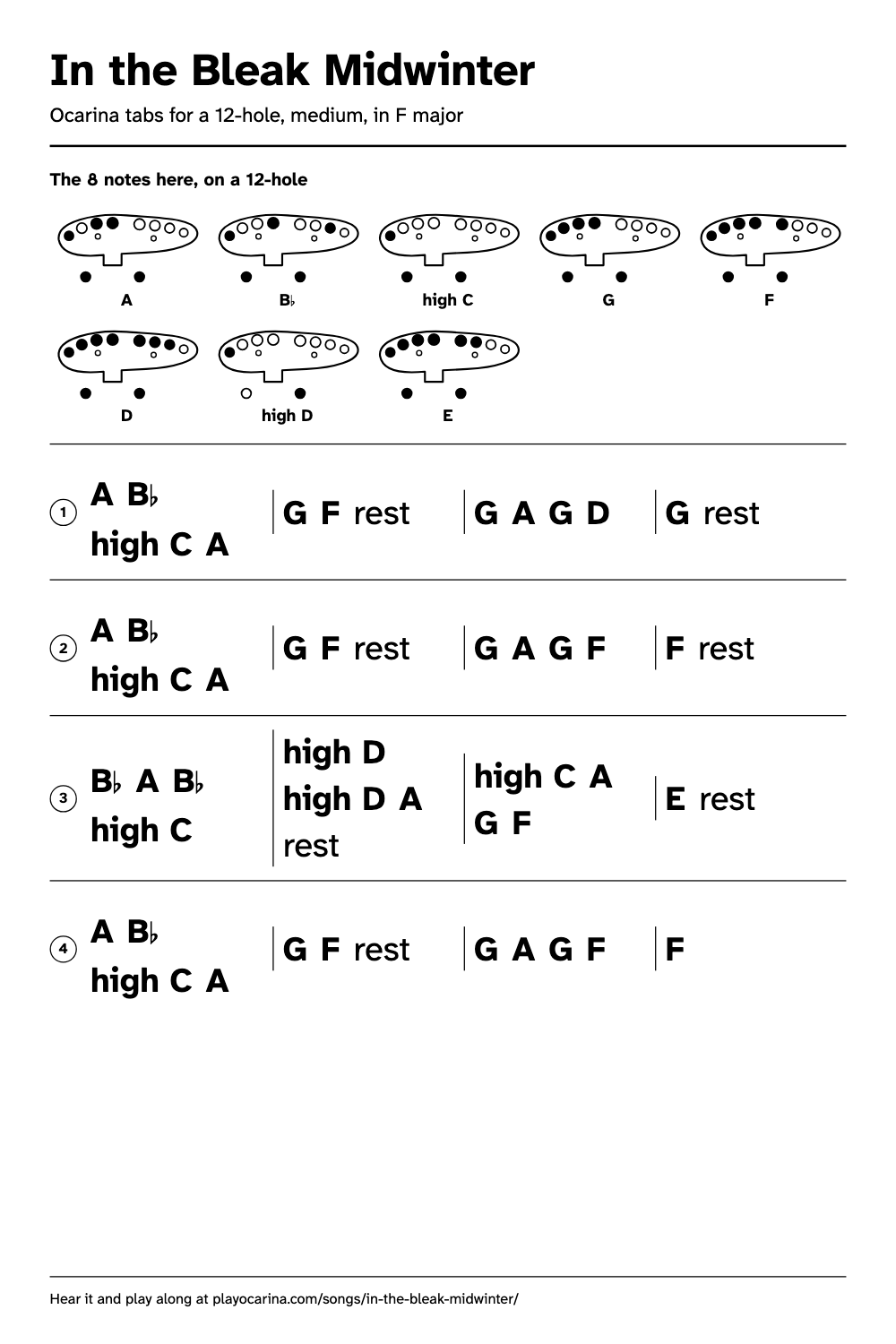
On a 12-hole. Read left to right, a line at a time.
- AB♭high CAGFrestGAGDGrest
- AB♭high CAGFrestGAGFFrest
- Tricky spot:B♭AB♭high Chigh Dhigh DAresthigh CAGFErest
- AB♭high CAGFrestGAGFF
In the Bleak Midwinter on the ocarina begins A, B flat, C, A, then a long G and a short F before a pause. Holst's tune stops for a beat of silence after every second bar, so the carol gives you time to breathe. In F major it spans D to high D, which suits a 12-hole or a 6-hole ocarina in C, and three of its four lines start with that same opening figure.
What is the tricky spot in In the Bleak Midwinter?
The start of the third line, where the tune climbs B flat, A, B flat, C and arrives on two high D's. On a 12-hole, In the Bleak Midwinter goes from high C to high D: you lift the left thumb. On a 6-hole, you lift the right thumb.
This is the only line that does not begin like the others, and it holds the two highest notes in the carol. Give the high D's a slightly faster breath than the notes around them (why high notes need more air), and tongue the second one softly so the pair stays even. The line then walks down C, A, G, F to a long E, the lowest point of the phrase: let the E sit for its three beats instead of rushing back to the opening A. Also watch the long-short pair that opens most lines: hold the first note for a beat and a half, then let the short B flat lead straight into C.
Where do you breathe in In the Bleak Midwinter?
Breathe in the one-beat rest printed after each long note: bars 2, 4, 6, 8, 10, 12 and 14 all end with one. The last line has no rest before its final F, so take a full breath in the rest after the long E.
Which ocarina can play In the Bleak Midwinter?
A 4-hole ocarina cannot reach high D, so play In the Bleak Midwinter in this key on a 12-hole or 6-hole ocarina in C. On an ocarina in G or F, use the same fingerings: the tune sounds in a different key, which is fine when you play alone. Each linked chart has every fingering for its ocarina, and you can check your notes with a tuner such as our free ocarina tuner.
The 8 notes here, on a 12-holeHoles in words, with a picture
| Note | Holes to cover | Picture |
|---|---|---|
| A | Cover the left pinky, left middle, left index, left thumb and right thumb | |
| B♭ | Cover the left pinky, left index, right ring, left thumb and right thumb | |
| high C | Cover the left pinky, left thumb and right thumb | |
| G | Cover every main hole but the right index, right middle, right ring and right pinky | |
| F | Cover every main hole but the right middle, right ring and right pinky | |
| D | Cover every main hole but the right pinky | |
| high D | Cover the left pinky and right thumb | |
| E | Cover every main hole but the right ring and right pinky |
Drawn as you see it while playing: mouthpiece towards you, left hand on the left.
| Note | Holes to cover | Picture |
|---|---|---|
| A | Cover the left index, left thumb and right thumb | |
| B♭ | Cover the right index, left thumb and right thumb | |
| high C | Cover the left thumb and right thumb | |
| G | Cover every hole but the left middle and right middle | |
| F | Cover every hole but the right middle and right index | |
| D | Cover every hole but the right middle | |
| high D | Cover the left thumb | |
| E | Cover every hole but the right index |
Drawn as you see it while playing: mouthpiece towards you, left hand on the left.
Which tune is In the Bleak Midwinter sung to?
Two tunes are popular: Cranham, the hymn tune on this page, and a choir setting by Harold Darke. Christina Rossetti's poem first appeared in Scribner's Monthly in January 1872, and Gustav Holst wrote Cranham, named after a village in Gloucestershire, for The English Hymnal of 1906. Darke wrote his in 1909 for trained choirs, to a different melody we do not teach here. Our tabs follow an early printing of that hymnal, where the tune is still credited to "G. von Holst": he dropped the "von" by deed poll in 1918. Holst died in 1934 and Rossetti in 1894. We show the melody only, not Holst's harmony. Music: the tune "Cranham" by Gustav Holst (1874-1934); words by Christina Rossetti (1830-1894).