Joyful, Joyful, We Adore Thee on the ocarina
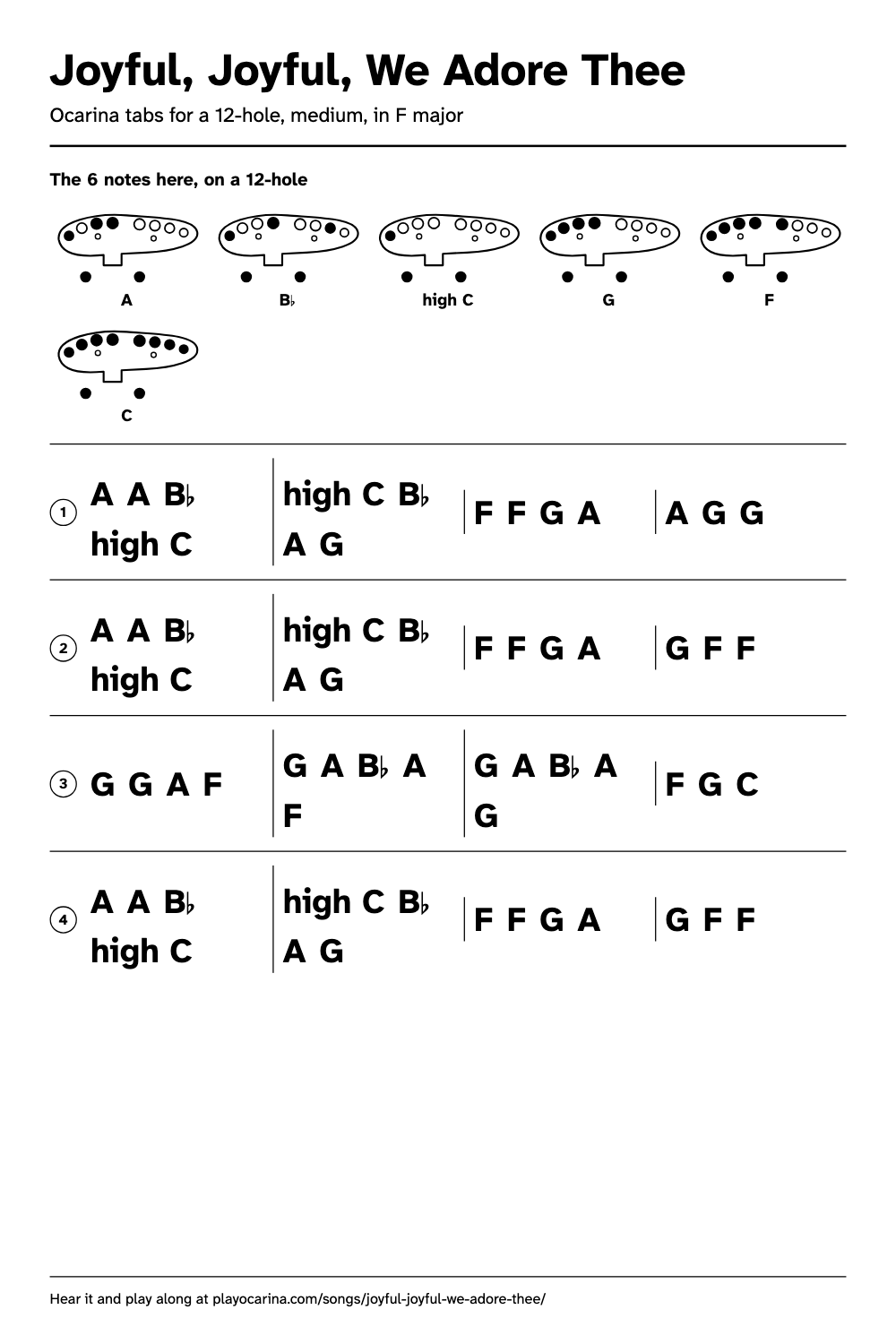
On a 12-hole it starts A, A, B♭, high C. Medium, 62 notes, in F major.
Joyful, Joyful, We Adore Thee
Bar 1 of 16
What are the notes for Joyful, Joyful, We Adore Thee?
On a 12-hole. Read left to right, a line at a time.
- AAB♭high Chigh CB♭AGFFGAAGG
- AAB♭high Chigh CB♭AGFFGAGFF
- GGAFGAB♭AFGAB♭AGTricky spot:FGC
- AAB♭high Chigh CB♭AGFFGAGFF
Joyful, Joyful, We Adore Thee is the hymn sung to Beethoven's Ode to Joy: four lines of four bars, nearly all quarter notes, and it opens A, A, B flat, C. We give it in F major, where the whole hymn sits between C and high C. That range suits a 12-hole, a 6-hole and even a 4-hole ocarina in C.
What is the tricky spot in Joyful, Joyful, We Adore Thee?
The close of the third line: two beats on the C, the lowest note in the hymn, then a leap up a sixth to the A that starts the last line. On a 12-hole, Joyful, Joyful, We Adore Thee goes from C to A: you lift the left ring, right index, right middle, right ring and right pinky. On a 6-hole or 4-hole, you lift the left middle, right middle and right index.
Play F, G and the long C, then stop and find the A before you blow it, so the jump is made with the fingers first and the breath second. Play the C with a soft, slow breath and give the A in the middle of the range a little more air, so ease off for the C and lift for the A (more on breath). The other spot to practise is the pair of quick A and B flat in the second and third bars of that line: half a beat each, tongued lightly, with the B flat's cross-fingering ready before you get there.
Where do you breathe in Joyful, Joyful, We Adore Thee?
Every line ends on a two-beat note: G, F, C, F. Breathe on each of them by cutting the note a little short. The hymnal marks a pause on the long F that ends the second line, so you can hold it and take your time over the breath there.
Which ocarina can play Joyful, Joyful, We Adore Thee?
Any 12-hole, 6-hole or 4-hole ocarina in C plays Joyful, Joyful, We Adore Thee in this key. On an ocarina in G or F, use the same fingerings: the tune sounds in a different key, which is fine when you play alone. Each linked chart has every fingering for its ocarina, and you can check your notes with a tuner such as our free ocarina tuner.
The 6 notes here, on a 12-holeHoles in words, with a picture
| Note | Holes to cover | Picture |
|---|---|---|
| A | Cover the left pinky, left middle, left index, left thumb and right thumb | |
| B♭ | Cover the left pinky, left index, right ring, left thumb and right thumb | |
| high C | Cover the left pinky, left thumb and right thumb | |
| G | Cover every main hole but the right index, right middle, right ring and right pinky | |
| F | Cover every main hole but the right middle, right ring and right pinky | |
| C | Cover every main hole |
Drawn as you see it while playing: mouthpiece towards you, left hand on the left.
| Note | Holes to cover | Picture |
|---|---|---|
| A | Cover the left index, left thumb and right thumb | |
| B♭ | Cover the right index, left thumb and right thumb | |
| high C | Cover the left thumb and right thumb | |
| G | Cover every hole but the left middle and right middle | |
| F | Cover every hole but the right middle and right index | |
| C | Cover every hole |
Drawn as you see it while playing: mouthpiece towards you, left hand on the left.
| Note | Holes to cover | Picture |
|---|---|---|
| A | Cover the left index | |
| B♭ | Cover the right index | |
| high C | All holes open | |
| G | Cover the left index and right index | |
| F | Cover the left middle and left index | |
| C | Cover every hole |
Drawn as you see it while playing: mouthpiece towards you, left hand on the left.
How is Joyful, Joyful, We Adore Thee different from Ode to Joy?
The tune is Beethoven's; the words came eighty years after his death. Henry van Dyke wrote the words in 1907, as a guest preacher at Williams College, and said the Berkshire mountains had inspired them; they were first printed in his poems in 1911. A year later Hymns of the Church, New and Old printed them as hymn 550, "The Hymn to Joy", credited only "Beethoven. Arr. fr. Ninth Symphony", in A major with four-part harmony, a pause at the end of the second line and an Amen; the book thanks van Dyke for the hymn among its permissions. Our tabs follow that page's melody and leave out the Amen, in F, a step lower than our Ode to Joy page, which takes the theme from the symphony itself. Beethoven died in 1827 and van Dyke in 1933; his words are not shown here, only the melody. Music: Ludwig van Beethoven (1770-1827), arranged as a hymn tune from his Ninth Symphony; words by Henry van Dyke (1852-1933).