Jupiter (The Planets) on the ocarina
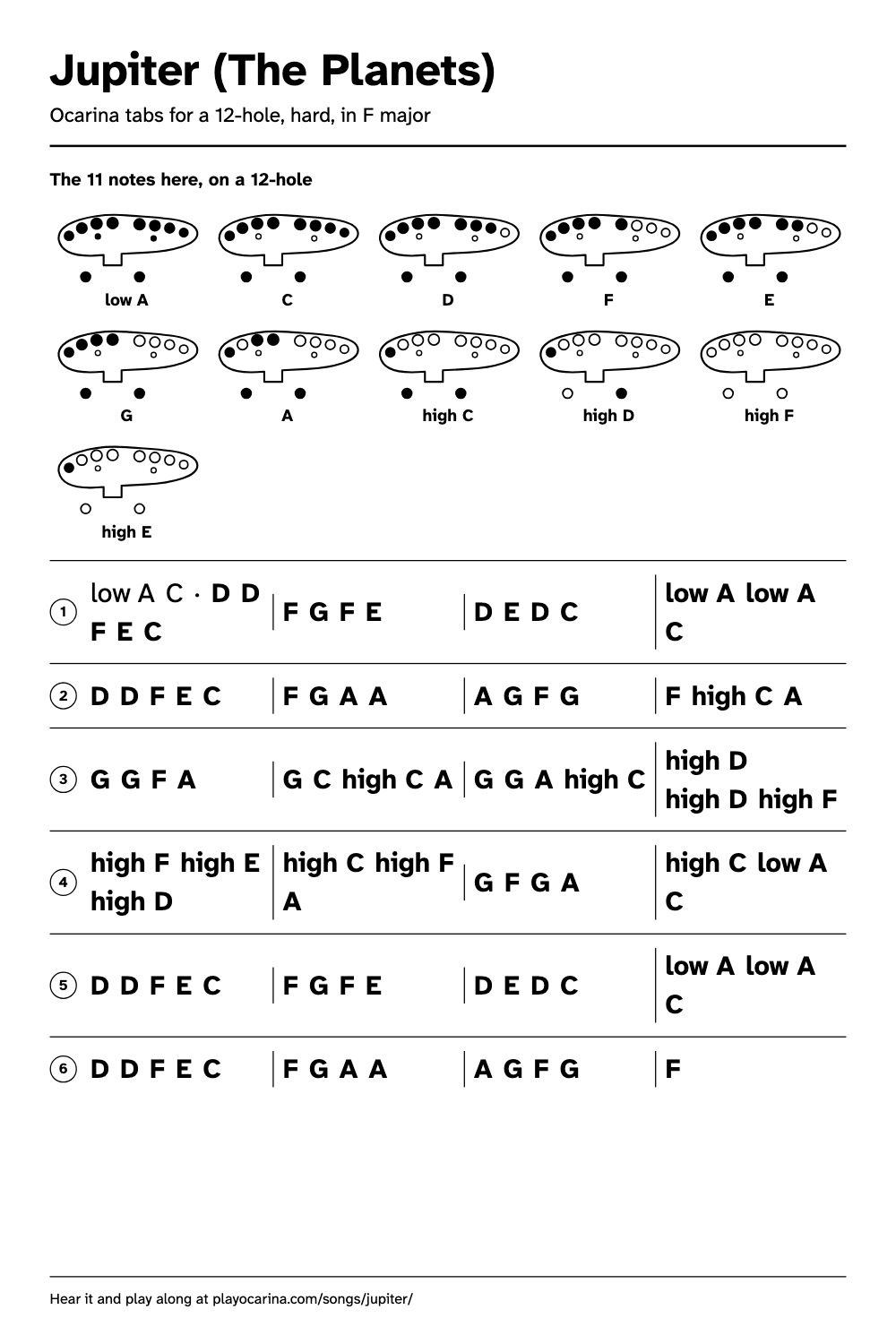
On a 12-hole it starts low A, C, D, D. Hard, 92 notes, in F major.
Goes up to high F, so it does not fit a 6-hole or 4-hole.
Jupiter (The Planets)
Bar 1 of 24
What are the notes for Jupiter?
On a 12-hole. Read left to right, a line at a time.
- low AC DDFECFGFEDEDClow Alow AC
- DDFECFGAAAGFGFhigh CA
- GGFAGChigh CAGGAhigh CTricky spot:high Dhigh Dhigh F
- high Fhigh Ehigh Dhigh Chigh FAGFGAhigh Clow AC
- DDFECFGFEDEDClow Alow AC
- DDFECFGAAAGFGF
Jupiter's big tune is the slow, broad melody in the middle of the fourth movement of Holst's The Planets, marked Andante maestoso. Here is that main theme as the first violins play it: a two-note lead-in and 24 bars of 3/4, in the 1921 score's rhythm, moved to F major. It runs from low A to high F, every note of a 12-hole, with no sharps or flats.
What is the hardest part of Jupiter on the ocarina?
The middle phrase, where a long high D is followed by a quick D and a jump up to high F, the top note of a 12-hole, before the tune steps down F, E, D. On a 12-hole, Jupiter goes from high D to high F: you lift the left pinky and right thumb.
High F is every hole open, so the jump from high D is mostly air: blow a little faster for it and ease off as the line falls back through E and D to C. Two bars before, the tune drops from G to the low C and leaps an octave straight up to high C; keep the low C short and relaxed so the leap lands on time. The opening figure comes back four times, a long note, two eighths and a dotted pair, so learn it once and the outer phrases are mostly done.
Which ocarina can play Jupiter?
A 6-hole ocarina cannot reach low A and high F, and a 4-hole ocarina cannot reach low A, high D, high E and high F, so play Jupiter in this key on a 12-hole ocarina in C. On an ocarina in G or F, use the same fingerings: the tune sounds in a different key, which is fine when you play alone. The linked chart has every fingering, and you can check your notes with a tuner such as our free ocarina tuner.
The 11 notes here, on a 12-holeHoles in words, with a picture
| Note | Holes to cover | Picture |
|---|---|---|
| low A | Cover every main hole, plus the left sub-hole and right sub-hole | |
| C | Cover every main hole | |
| D | Cover every main hole but the right pinky | |
| F | Cover every main hole but the right middle, right ring and right pinky | |
| E | Cover every main hole but the right ring and right pinky | |
| G | Cover every main hole but the right index, right middle, right ring and right pinky | |
| A | Cover the left pinky, left middle, left index, left thumb and right thumb | |
| high C | Cover the left pinky, left thumb and right thumb | |
| high D | Cover the left pinky and right thumb | |
| high F | All holes open | |
| high E | Cover the left pinky |
Drawn as you see it while playing: mouthpiece towards you, left hand on the left.
Where does the Jupiter tune come from?
Holst wrote Jupiter, the fourth of The Planets, at the end of 1914, and the suite was first played in London in 1918. In 1921 he fitted the tune, slightly extended, to a poem by Cecil Spring Rice, and that hymn, I Vow to Thee, My Country, is how many people know it. Our tabs follow the first violins in the full score printed in London in 1921, where the theme comes in at Andante maestoso. The score plays its last phrase an octave higher than the first; our tabs keep it at the first phrase's pitch so the whole tune fits one 12-hole. Holst died in 1934. We show the melody only. Music: Gustav Holst (1874-1934), the Andante maestoso tune from Jupiter, the Bringer of Jollity, the fourth movement of his suite The Planets.