Russian Dance (Trepak) on the ocarina
On a 12-hole it starts high C, high C, B, high C. Medium, 83 notes, in C major.
Goes down to low A, so it does not fit a 6-hole or 4-hole.
Russian Dance (Trepak)
Bar 1 of 16
What are the notes for the Russian Dance (Trepak)?
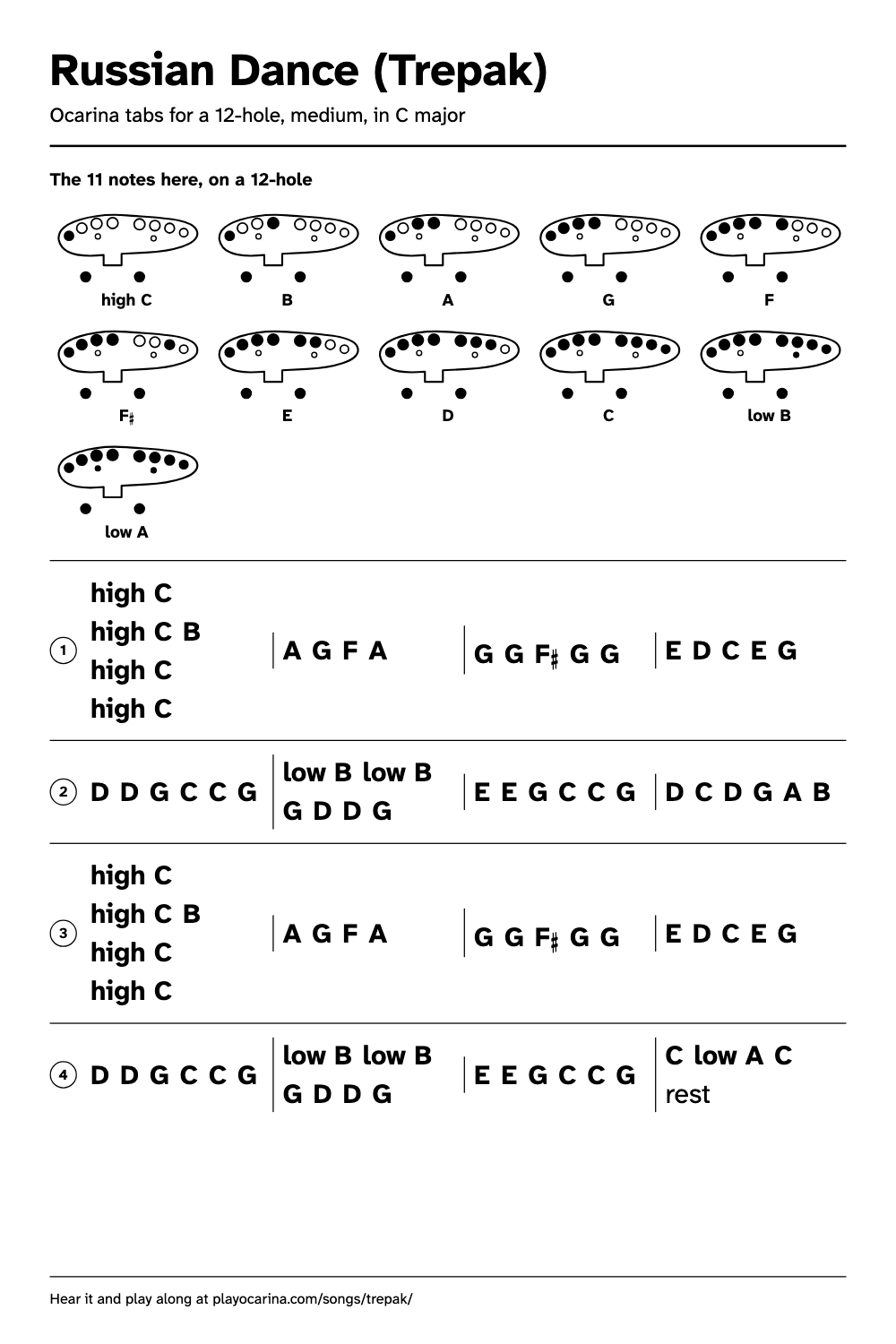
On a 12-hole. Read left to right, a line at a time.
- high Chigh CBhigh Chigh CAGFAGGF♯GGEDCEG
- DDGCCGTricky spot:low Blow BGDDGEEGCCGDCDGAB
- high Chigh CBhigh Chigh CAGFAGGF♯GGEDCEG
- DDGCCGlow Blow BGDDGEEGCCGClow ACrest
The Russian Dance from The Nutcracker opens on high C, with a quick dip to B and back, then steps down A, G, F and up to A again. Here is its whole first strain, 16 bars of 2/4, moved from G major to C major so that only one note, an F sharp in bars 3 and 11, needs a sharp. It runs from low A to high C, which puts it on a 12-hole ocarina. Bars 9 to 15 are bars 1 to 7 again, and the last bar closes the strain.
What is the hardest part of the Russian Dance (Trepak)?
Bar 6, where a quick B leaps up to G in a sixteenth note, the widest leap up in the tune; bar 14 is the same. On a 12-hole, the Russian Dance (Trepak) goes from low B to G: you lift the right index, right middle, right ring, right pinky and right sub-hole.
Bars 5 to 7 are six leaps of the same shape: a low note as an eighth and a sixteenth, then a jump up to G, always the same G. Practise them slowly on their own and say the rhythm "long, short, jump": the G is the one note that comes back every time, so settle its fingering first and let the lower note change under it. The leap up to G wants a little more air than the note it leaves, so give a quick extra push as you arrive and relax again for the next low note. Bar 8 runs D, G, A, B in sixteenth notes up into the high C that starts the repeat; tongue them lightly with "du" so they stay even. The printing puts a staccato dot on every eighth note, so play them short and separate rather than slurred. The F sharp in bars 3 and 11 sits between two G's: practise G, F sharp, G alone until the cross-fingering is quick.
Where do you breathe in the Russian Dance (Trepak)?
There is no printed rest until the last eighth of bar 16, so breathe by cutting a bar's last eighth note short: the end of bar 2 and the end of bar 3 are the easiest places, and again at bars 10 and 11. Bars 4 to 8 run on without a gap, about six seconds at this tempo, so take a full breath before bar 4.
Which ocarina can play the Russian Dance (Trepak)?
A 6-hole or 4-hole ocarina cannot reach low A and low B, so play the Russian Dance (Trepak) in this key on a 12-hole ocarina in C. On an ocarina in G or F, use the same fingerings: the tune sounds in a different key, which is fine when you play alone. The linked chart has every fingering, and you can check your notes with a tuner such as our free ocarina tuner.
The 11 notes here, on a 12-holeHoles in words, with a picture
| Note | Holes to cover | Picture |
|---|---|---|
| high C | Cover the left pinky, left thumb and right thumb | |
| B | Cover the left pinky, left index, left thumb and right thumb | |
| A | Cover the left pinky, left middle, left index, left thumb and right thumb | |
| G | Cover every main hole but the right index, right middle, right ring and right pinky | |
| F | Cover every main hole but the right middle, right ring and right pinky | |
| F♯ | Cover every main hole but the right index, right middle and right pinky | |
| E | Cover every main hole but the right ring and right pinky | |
| D | Cover every main hole but the right pinky | |
| C | Cover every main hole | |
| low B | Cover every main hole, plus the right sub-hole | |
| low A | Cover every main hole, plus the left sub-hole and right sub-hole |
Drawn as you see it while playing: mouthpiece towards you, left hand on the left.
Is the Trepak a Russian dance?
Tchaikovsky's own score is headed Danse russe, Trépak, and the trepak is an East Slavic folk dance, both Russian and Ukrainian, which Tchaikovsky had already used in the last movement of his Violin Concerto in 1878. In the ballet it is one of the dances of the second act, and IMSLP's list of the ballet's numbers gives it 84 bars; Petipa, the choreographer, set the tempo and bar count of each number for Tchaikovsky, so the tune on this page is only its first 16 bars. The dance was also in the concert suite Tchaikovsky made from eight of the ballet's numbers, first played under his direction on 19 March 1892, months before the ballet opened in December; our scan is the suite's full score in Rahter's Leipzig reprint of Jurgenson's edition. The strain plays its first eight bars twice. Tchaikovsky's own piano version of the suite writes the end of bars 8 and 16 as a triplet where the orchestral score has four sixteenth notes in bar 8 and a rest in bar 16, so our tabs follow the first violins of the full score, and leave out its accents and staccato dots. Tchaikovsky died in 1893. Music: Pyotr Ilyich Tchaikovsky (1840-1893), the Russian Dance from his ballet The Nutcracker, 1892.