Liebestraum No. 3 on the ocarina
On a 12-hole it starts D, B, B, B. Medium, 35 notes, in G major.
Goes up to high E, so it does not fit a 4-hole.
Liebestraum No. 3
Bar 1 of 12
What are the notes for Liebestraum No. 3?
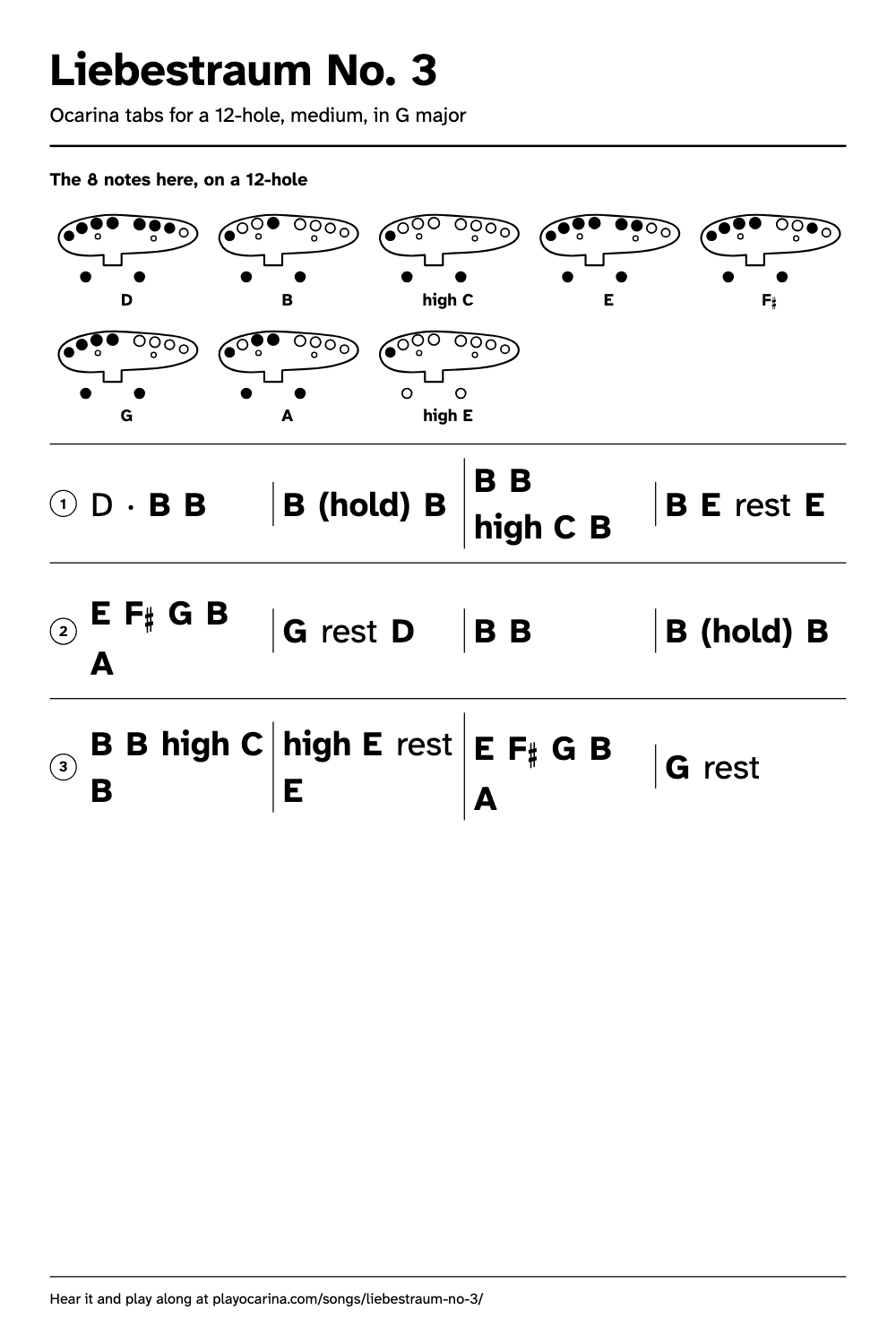
On a 12-hole. Read left to right, a line at a time.
- D BBB(hold)BBBhigh CBBErestE
- EF♯GBAGrestDBBB(hold)B
- Tricky spot:BBhigh CBhigh ErestEEF♯GBAGrest
Liebestraum No. 3 opens with a leap from D up to a long B, repeats that B, touches C, then falls to E and climbs back through F♯, G, B and A to settle on G: Liszt's famous love-dream melody, which he marked dolce cantando, sweetly singing. Here is its opening theme in G major, a one-beat pickup and 12 bars of 6/4, from D up to high E. It fits a 6-hole and a 12-hole ocarina; the one sharp is F♯.
What is the tricky spot in Liebestraum No. 3?
The tenth bar, where the second phrase climbs from B straight up to high E, the top note of the theme, and holds it for three beats. On a 12-hole, Liebestraum No. 3 goes from B to high E: you lift the left index, left thumb and right thumb. On a 6-hole, you lift the right middle, left thumb and right thumb.
High E sits a fourth above B. Practise B to high E slowly, then hold the E for a full three counts with a little more air than the B, and let it go without a bump before the low E that follows. The long B notes in the first two bars are the other test: the second bar ties a B across five beats, so keep the air steady and do not let the note sag or swell. Count six even beats in every bar.
Which ocarina can play Liebestraum No. 3?
A 4-hole ocarina cannot reach high E, so play Liebestraum No. 3 in this key on a 12-hole or 6-hole ocarina in C. On an ocarina in G or F, use the same fingerings: the tune sounds in a different key, which is fine when you play alone. Each linked chart has every fingering for its ocarina, and you can check your notes with a tuner such as our free ocarina tuner.
The 8 notes here, on a 12-holeHoles in words, with a picture
| Note | Holes to cover | Picture |
|---|---|---|
| D | Cover every main hole but the right pinky | |
| B | Cover the left pinky, left index, left thumb and right thumb | |
| high C | Cover the left pinky, left thumb and right thumb | |
| E | Cover every main hole but the right ring and right pinky | |
| F♯ | Cover every main hole but the right index, right middle and right pinky | |
| G | Cover every main hole but the right index, right middle, right ring and right pinky | |
| A | Cover the left pinky, left middle, left index, left thumb and right thumb | |
| high E | Cover the left pinky |
Drawn as you see it while playing: mouthpiece towards you, left hand on the left.
| Note | Holes to cover | Picture |
|---|---|---|
| D | Cover every hole but the right middle | |
| B | Cover the right middle, left thumb and right thumb | |
| high C | Cover the left thumb and right thumb | |
| E | Cover every hole but the right index | |
| F♯ | Cover every hole but the left middle | |
| G | Cover every hole but the left middle and right middle | |
| A | Cover the left index, left thumb and right thumb | |
| high E | All holes open |
Drawn as you see it while playing: mouthpiece towards you, left hand on the left.
What poem is Liebestraum No. 3 based on?
Ferdinand Freiligrath's "O lieb, so lang du lieben kannst", love as long as you can. Liszt first wrote the three Liebesträume as songs on poems by Ludwig Uhland and Freiligrath, and in 1850 they appeared both as songs and as piano nocturnes. Our tabs follow the first edition of the piano version, published by Fr. Kistner in Leipzig, which prints Freiligrath's poem on the page before No. 3 and puts the tune in the middle of the piano texture, passed between the hands, in A-flat major. Our tabs take the opening theme, up to the end of its second phrase, and move it to G major, two octaves less a semitone higher. Liszt died in 1886. We show the melody only. Music: Franz Liszt (1811-1886), the third of his three Liebesträume, nocturnes for piano, 1850.