Little Bee (Summ, Summ, Summ) on the ocarina
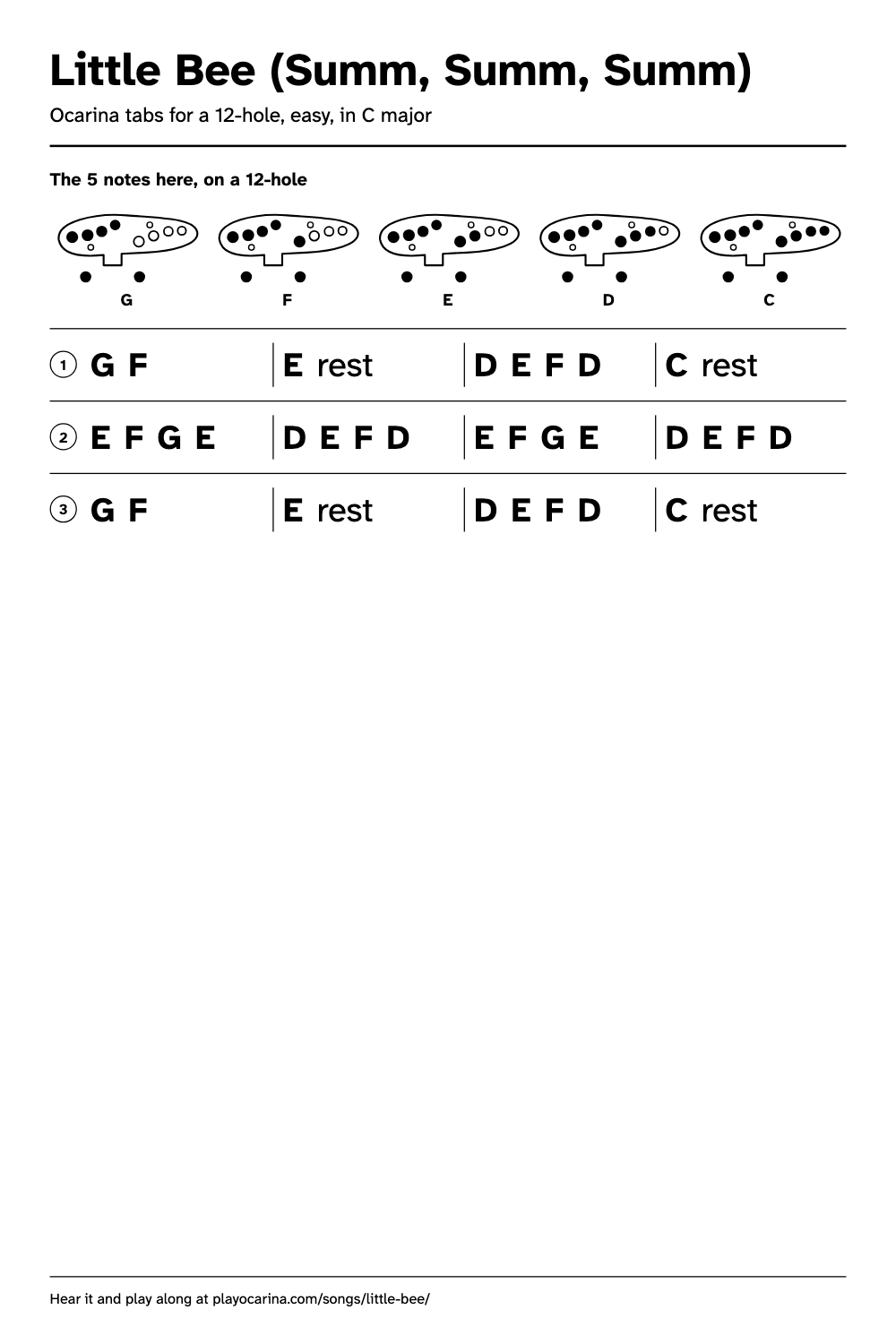
On a 12-hole it starts G, F, E, D. Easy, 32 notes, in C major.
Little Bee (Summ, Summ, Summ)
Bar 1 of 12
What are the notes for Little Bee (Summ, Summ, Summ)?
On a 12-hole. Read left to right, a line at a time.
- GFErestDEFDCrest
- EFGEDEFDEFGETricky spot:DEFD
- GFErestDEFDCrest
Little Bee, Summ, summ, summ in German, is a children's song that uses only five notes, C, D, E, F and G, so a 4-hole, 6-hole or 12-hole ocarina all play it. It is twelve short bars in 2/4: a falling opening, a middle of quick even notes, and the opening again to finish.
What is the tricky spot in Little Bee (Summ, Summ, Summ)?
The end of the middle part, where the quick notes stop on D and the tune jumps up to G to bring back the opening. On a 12-hole, Little Bee (Summ, Summ, Summ) goes from D to G: you lift the right index, right middle and right ring. On a 6-hole or 4-hole, you lift the left middle.
The middle is four bars of quick notes, half a beat each: E, F, G, E, then D, E, F, D, twice. Tongue each one lightly with a "du" so they stay separate, and move one finger at a time. Then land the G on the beat. The 1843 printing marks the song Munter, lively, so keep it bouncing rather than slow.
Where do you breathe in Little Bee (Summ, Summ, Summ)?
In the rests: after the E in the second and tenth bars and after the C in the fourth. The quick middle has no rest, so fill up at the rest in bar 4 before it; if you need more, take a quick breath after its last D, just before the opening comes back.
Which ocarina can play Little Bee (Summ, Summ, Summ)?
Any 12-hole, 6-hole or 4-hole ocarina in C plays Little Bee (Summ, Summ, Summ) in this key. On an ocarina in G or F, use the same fingerings: the tune sounds in a different key, which is fine when you play alone. Each linked chart has every fingering for its ocarina, and you can check your notes with a tuner such as our free ocarina tuner.
The 5 notes here, on a 12-holeHoles in words, with a picture
| Note | Holes to cover | Picture |
|---|---|---|
| G | Cover every main hole but the right index, right middle, right ring and right pinky | |
| F | Cover every main hole but the right middle, right ring and right pinky | |
| E | Cover every main hole but the right ring and right pinky | |
| D | Cover every main hole but the right pinky | |
| C | Cover every main hole |
Drawn as you see it while playing: mouthpiece towards you, left hand on the left.
| Note | Holes to cover | Picture |
|---|---|---|
| G | Cover every hole but the left middle and right middle | |
| F | Cover every hole but the right middle and right index | |
| E | Cover every hole but the right index | |
| D | Cover every hole but the right middle | |
| C | Cover every hole |
Drawn as you see it while playing: mouthpiece towards you, left hand on the left.
| Note | Holes to cover | Picture |
|---|---|---|
| G | Cover the left index and right index | |
| F | Cover the left middle and left index | |
| E | Cover every hole but the right index | |
| D | Cover every hole but the right middle | |
| C | Cover every hole |
Drawn as you see it while playing: mouthpiece towards you, left hand on the left.
Where do our Little Bee (Summ, Summ, Summ) tabs come from?
The tune is a folk melody from Bohemia, and Hoffmann von Fallersleben wrote the German words in 1835; the song was printed with its tune in 1843. These tabs are our own arrangement of the tune. Music: Bohemian folk tune, words by August Heinrich Hoffmann von Fallersleben (1798-1874).