Loch Lomond on the ocarina
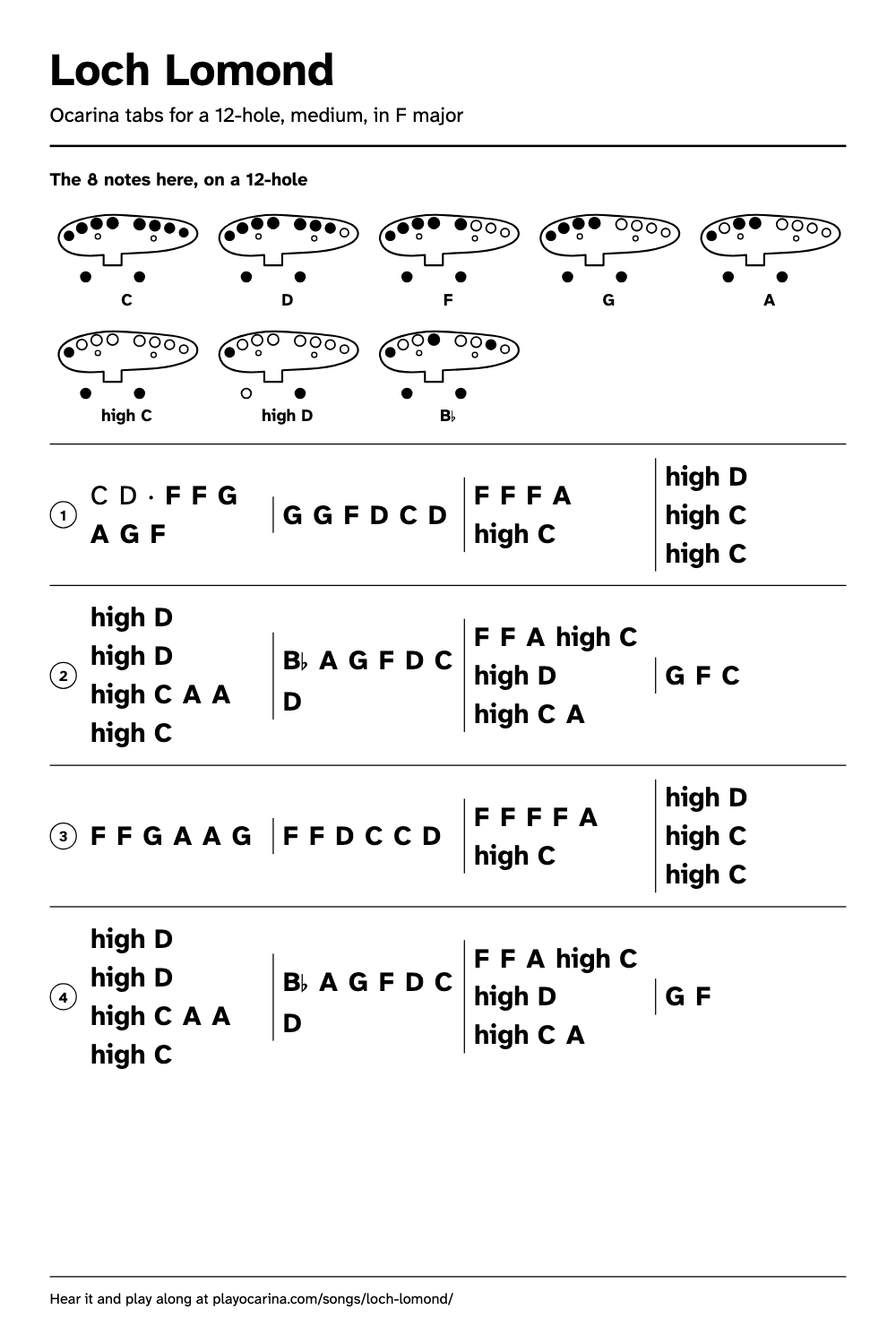
On a 12-hole it starts C, D, F, F. Medium, 88 notes, in F major.
Goes up to high D, so it does not fit a 4-hole.
Loch Lomond
Bar 1 of 16
What are the notes for Loch Lomond?
On a 12-hole. Read left to right, a line at a time.
- CD FFGAGFGGFDCDTricky spot:FFFAhigh Chigh Dhigh Chigh C
- high Dhigh Dhigh CAAhigh CB♭AGFDCDFFAhigh Chigh Dhigh CAGFC
- FFGAAGFFDCCDFFFFAhigh Chigh Dhigh Chigh C
- high Dhigh Dhigh CAAhigh CB♭AGFDCDFFAhigh Chigh Dhigh CAGF
Loch Lomond opens with two quick lead-in notes, C and D, then settles on F and climbs F, G, A. In F major it runs from C up to high D, with one flat, B flat, which turns up twice, in the quick run down from B flat to F near the end of each half. Both halves are here, the verse and then the chorus, eight bars each, and each one peaks on a long high D in its fourth bar.
What is the tricky spot in Loch Lomond?
The two snapped pairs in the second-last bar of each half: a very short F into a longer F, then a very short A into a longer C, just before high D. On a 12-hole, Loch Lomond goes from F to A: you lift the left ring and right index. On a 6-hole, you lift the left middle.
A short note snapping into a long one is the Scotch snap, and the 1923 songbook prints it both times this phrase comes round. Fit each pair into one beat: the first note is a flick of the tongue, a quarter of the beat, and the second is held to the end of the beat, more "t-daah" than "ta-ta". If it comes out rushed, play the bar as four even quick notes first, then shorten the first note of each pair. High D comes straight after and lasts a full beat: blow a little faster for it, then come down through C and A to the long G that closes the phrase.
Where do you breathe in Loch Lomond?
The songbook puts a pause sign on the low D near the end of each half: hold it a little longer, then breathe before the two quick notes after it. The verse ends on a long G and F; breathe there, then hold the lead-in C, which carries a pause too, before the chorus starts. If a phrase feels long, a quick breath after each long high D is fine.
Which ocarina can play Loch Lomond?
A 4-hole ocarina cannot reach high D, so play Loch Lomond in this key on a 12-hole or 6-hole ocarina in C. On an ocarina in G or F, use the same fingerings: the tune sounds in a different key, which is fine when you play alone. Each linked chart has every fingering for its ocarina, and you can check your notes with a tuner such as our free ocarina tuner.
The 8 notes here, on a 12-holeHoles in words, with a picture
| Note | Holes to cover | Picture |
|---|---|---|
| C | Cover every main hole | |
| D | Cover every main hole but the right pinky | |
| F | Cover every main hole but the right middle, right ring and right pinky | |
| G | Cover every main hole but the right index, right middle, right ring and right pinky | |
| A | Cover the left pinky, left middle, left index, left thumb and right thumb | |
| high C | Cover the left pinky, left thumb and right thumb | |
| high D | Cover the left pinky and right thumb | |
| B♭ | Cover the left pinky, left index, right ring, left thumb and right thumb |
Drawn as you see it while playing: mouthpiece towards you, left hand on the left.
| Note | Holes to cover | Picture |
|---|---|---|
| C | Cover every hole | |
| D | Cover every hole but the right middle | |
| F | Cover every hole but the right middle and right index | |
| G | Cover every hole but the left middle and right middle | |
| A | Cover the left index, left thumb and right thumb | |
| high C | Cover the left thumb and right thumb | |
| high D | Cover the left thumb | |
| B♭ | Cover the right index, left thumb and right thumb |
Drawn as you see it while playing: mouthpiece towards you, left hand on the left.
Who wrote Loch Lomond?
Nobody knows. It is a traditional Scottish song whose composer is unknown, thought to date from the Jacobite rising of 1745, and Lady John Scott, often named as its author, only wrote it down after hearing a boy sing it in the streets of Edinburgh. Our tabs follow The Golden Book of Favorite Songs (Chicago, 1923), which heads it "Old Scotch Air" and prints the verse and chorus in G major; we moved it down a whole tone to F, so it sits between C and high D. The chorus is not the verse sung again: it starts the same way, then bends off in its first two bars and lands on low C where the verse has D. Heart Songs (Boston, 1909) prints the same tune in F, except that the pairs of quick notes leading into a new line rise from C to E there, where the 1923 book has C to D. We show the melody only. Music: traditional Scottish song, composer unknown.