Swallowtail Jig on the ocarina
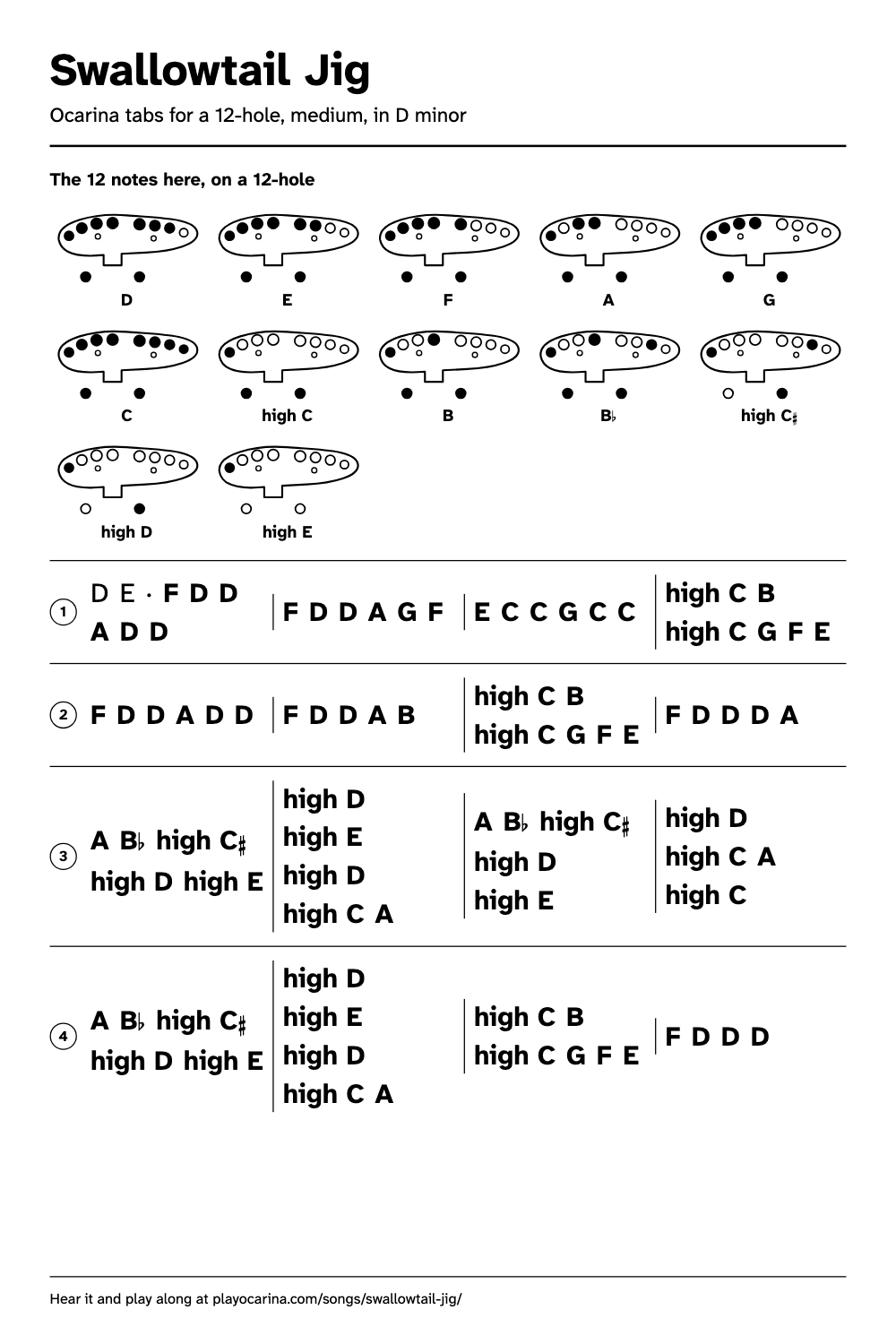
On a 12-hole it starts D, E, F, D. Medium, 87 notes, in D minor.
Goes up to high E, so it does not fit a 4-hole.
Swallowtail Jig
Bar 1 of 16
What are the notes for the Swallowtail Jig?
On a 12-hole. Read left to right, a line at a time.
- DE FDDADDFDDAGFECCGCChigh CBhigh CGFE
- FDDADDFDDABhigh CBhigh CGFEFDDDA
- Tricky spot:AB♭high C♯high Dhigh Ehigh Dhigh Ehigh Dhigh CAAB♭high C♯high Dhigh Ehigh Dhigh CAhigh C
- AB♭high C♯high Dhigh Ehigh Dhigh Ehigh Dhigh CAhigh CBhigh CGFEFDDD
The Swallowtail Jig runs in groups of three quick notes, F, D, D, then A, D, D, two groups to a bar, after a quick D and E to lead in. Here are both parts in D minor, from C up to high E. The first part has no sharps or flats; the second part has two, B flat and high C sharp, each time it climbs from A to D.
What is the tricky spot in the Swallowtail Jig?
The first, third and fifth bars of the second part, where the quick climb A, B flat, C sharp puts two cross-fingered notes side by side, a step and a half apart. On a 12-hole, the Swallowtail Jig goes from B♭ to high C♯: you lift the left index and left thumb. On a 6-hole, you lift the right index and right thumb and cover the right middle.
Take the climb on its own at half speed: A, B flat, C sharp, D, and back down, until each note sounds clean before the next one starts. B flat to C sharp is a wider step than the notes around it, and both fingerings are ones most tunes never ask for, so check each against the tuner before you put them back into the bar. In the first part the hard moment is the end of the third bar, where the low C jumps a whole octave to the high C that opens the fourth. Feel every bar as two lilting groups of three and tongue each quick note lightly; the fingers never get a rest until the held D at the end of each part.
Where do you breathe in the Swallowtail Jig?
Take a full breath on the held D that ends the first part, before the quick A that leads into the second, and a short one on the long high C halfway through the second part. The first part holds a note only once before its end, the A in its sixth bar, so if you run short there, leave out the last D of a group rather than break into the climb.
Which ocarina can play the Swallowtail Jig?
A 4-hole ocarina cannot reach high C♯, high D and high E, so play the Swallowtail Jig in this key on a 12-hole or 6-hole ocarina in C. On an ocarina in G or F, use the same fingerings: the tune sounds in a different key, which is fine when you play alone. Each linked chart has every fingering for its ocarina, and you can check your notes with a tuner such as our free ocarina tuner.
The 12 notes here, on a 12-holeHoles in words, with a picture
| Note | Holes to cover | Picture |
|---|---|---|
| D | Cover every main hole but the right pinky | |
| E | Cover every main hole but the right ring and right pinky | |
| F | Cover every main hole but the right middle, right ring and right pinky | |
| A | Cover the left pinky, left middle, left index, left thumb and right thumb | |
| G | Cover every main hole but the right index, right middle, right ring and right pinky | |
| C | Cover every main hole | |
| high C | Cover the left pinky, left thumb and right thumb | |
| B | Cover the left pinky, left index, left thumb and right thumb | |
| B♭ | Cover the left pinky, left index, right ring, left thumb and right thumb | |
| high C♯ | Cover the left pinky, right ring and right thumb | |
| high D | Cover the left pinky and right thumb | |
| high E | Cover the left pinky |
Drawn as you see it while playing: mouthpiece towards you, left hand on the left.
| Note | Holes to cover | Picture |
|---|---|---|
| D | Cover every hole but the right middle | |
| E | Cover every hole but the right index | |
| F | Cover every hole but the right middle and right index | |
| A | Cover the left index, left thumb and right thumb | |
| G | Cover every hole but the left middle and right middle | |
| C | Cover every hole | |
| high C | Cover the left thumb and right thumb | |
| B | Cover the right middle, left thumb and right thumb | |
| B♭ | Cover the right index, left thumb and right thumb | |
| high C♯ | Cover the right middle and left thumb | |
| high D | Cover the left thumb | |
| high E | All holes open |
Drawn as you see it while playing: mouthpiece towards you, left hand on the left.
How old is the Swallowtail Jig?
At least as old as the 1880s, and no composer is named. Ryan's Mammoth Collection (Boston, 1883) prints it as the "Swallow-Tail Jig" with no name beside it, marked E minor, and A. Baur's banjo method (New York, 1884) prints the same notes a year later. It is a double jig: every bar is two groups of three even eighth notes. The second part keeps a quirk of those old printings: Ryan climbs B, C, D sharp, E, with a plain C and a raised D, though the first part uses C sharp. Our tabs follow Ryan's notes, moved from E minor down a whole tone to D minor and up an octave so the tune sits on the ocarina; Baur writes the jig in D minor too. In this key the first part has no sharps or flats and the climb becomes A, B flat, C sharp, D. Ryan repeats each part; the tabs play each part once. Music: traditional jig, anonymous.