Long, Long Ago on the ocarina
On a 12-hole it starts G, G, A, B. Medium, 72 notes, in G major.
Goes up to high E, so it does not fit a 4-hole.
Long, Long Ago
Bar 1 of 16
What are the notes for Long, Long Ago?
On a 12-hole. Read left to right, a line at a time.
- GGABBhigh Chigh Dhigh Ehigh DBresthigh Dhigh CBAresthigh CBAGrest
- GGABBhigh Chigh Dhigh Ehigh DBresthigh Dhigh CBABAGrest
- Tricky spot:high Dhigh CBADDhigh CBAGresthigh Dhigh CBADDhigh CBAGrest
- GGABBhigh Chigh Dhigh Ehigh DBresthigh Dhigh CBABAGrest
Long, Long Ago is a slow, singing tune that lies kindly on the ocarina: seven neighbouring notes from D up to high E, with no sharps or flats. Here it is in G major, 16 bars, moved up an octave and a step from the F major of the 1839 sheet music. Most lines end on a short rest, so there is room to breathe and to find the next note.
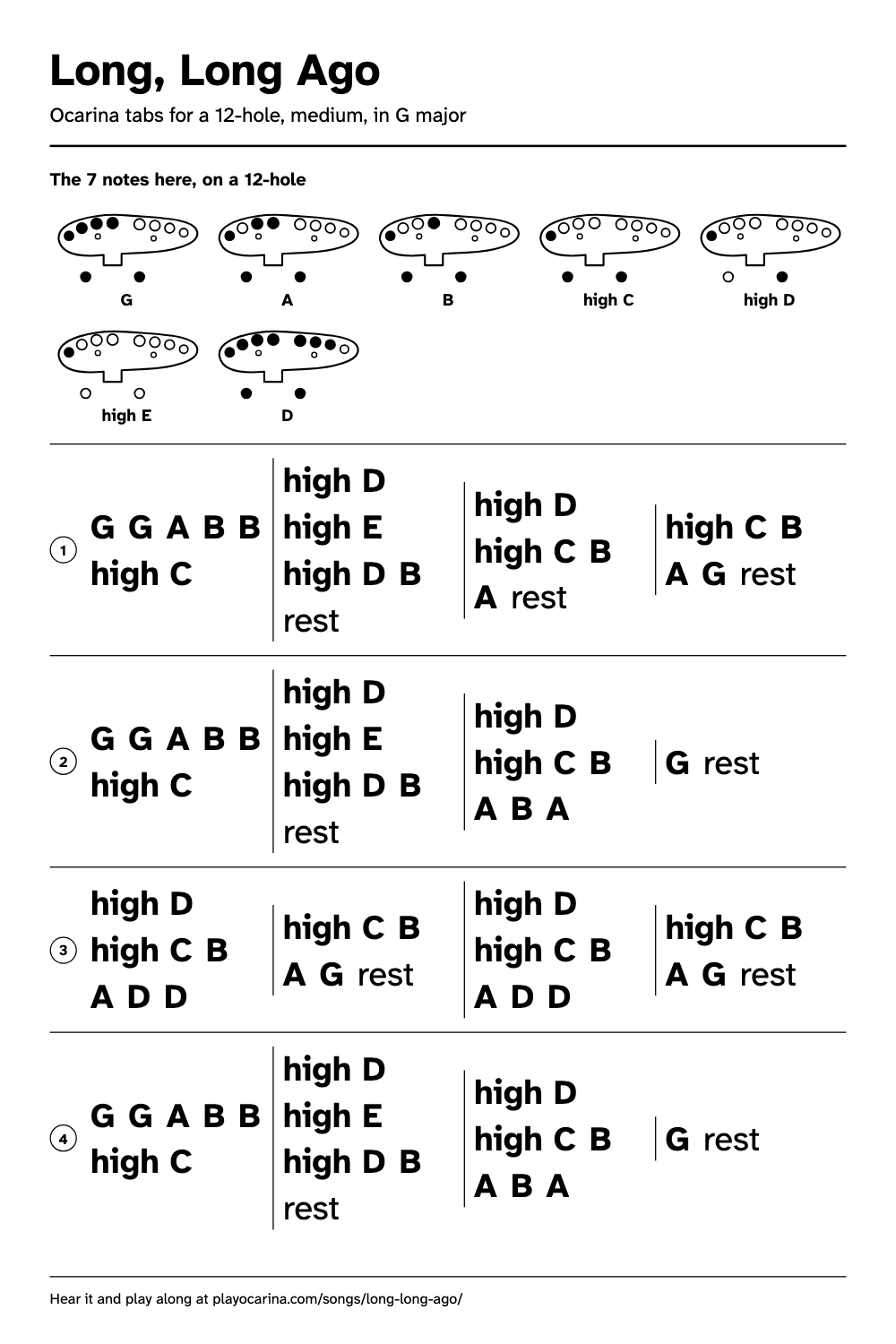
What is the tricky spot in Long, Long Ago?
The drop from a long A down to the low D, which comes twice in the second half of the tune and is followed at once by a second quick D. On a 12-hole, Long, Long Ago goes from A to D: you cover the left ring, right index, right middle and right ring. On a 6-hole, you cover the left middle and right index.
Practise the two-note drop on its own before you add the tune. On a 6-hole the A has just the left index finger and both thumbs down, while the low D adds the left middle finger and the right index finger, so two fingers have to land together, on time. Lift off the A, put the fingers down in one movement and blow gently: the low D is the quietest note in the song, and too much air makes it squeal or jump up. The two D's that follow are half a beat each, so tongue the second one lightly instead of letting them blur into a single long note.
Where do you breathe in Long, Long Ago?
Breathe in the one-beat rest that ends each line of the tune, and in the two beats of rest after the G at the end of the second line and the last G. The long G that closes line two and the final G are two beats each, so take a full breath before them and let them fade rather than push.
Which ocarina can play Long, Long Ago?
A 4-hole ocarina cannot reach high D and high E, so play Long, Long Ago in this key on a 12-hole or 6-hole ocarina in C. On an ocarina in G or F, use the same fingerings: the tune sounds in a different key, which is fine when you play alone. Each linked chart has every fingering for its ocarina, and you can check your notes with a tuner such as our free ocarina tuner.
The 7 notes here, on a 12-holeHoles in words, with a picture
| Note | Holes to cover | Picture |
|---|---|---|
| G | Cover every main hole but the right index, right middle, right ring and right pinky | |
| A | Cover the left pinky, left middle, left index, left thumb and right thumb | |
| B | Cover the left pinky, left index, left thumb and right thumb | |
| high C | Cover the left pinky, left thumb and right thumb | |
| high D | Cover the left pinky and right thumb | |
| high E | Cover the left pinky | |
| D | Cover every main hole but the right pinky |
Drawn as you see it while playing: mouthpiece towards you, left hand on the left.
| Note | Holes to cover | Picture |
|---|---|---|
| G | Cover every hole but the left middle and right middle | |
| A | Cover the left index, left thumb and right thumb | |
| B | Cover the right middle, left thumb and right thumb | |
| high C | Cover the left thumb and right thumb | |
| high D | Cover the left thumb | |
| high E | All holes open | |
| D | Cover every hole but the right middle |
Drawn as you see it while playing: mouthpiece towards you, left hand on the left.
Who wrote Long, Long Ago, and when did it first go on sale?
Wikipedia dates the song to 1833 and credits it to the English songwriter Thomas Haynes Bayly. The earliest edition we found is Cramer, Addison & Beale's London ballad, and a London trade advertisement of 28 February 1839 lists it there as a new ballad by Bayly. His name is the only one on it, as it is on a New York edition of 1845 that says "composed by Th. H. Bayly". Bayly died on 22 April 1839, about two months after that advertisement. In bars 9 to 12 the 1839 singer's line slurs two notes onto the first word; we play the single note that a 1909 songbook prints there, which keeps the tune plain. Wikipedia adds that the tune later took new words and became a 1942 dance-band hit. We show the melody only. Music: Thomas Haynes Bayly (1797-1839), the ballad as printed under his name in London in 1839.