When Johnny Comes Marching Home on the ocarina
On a 12-hole it starts A, E, A, A. Medium, 57 notes, in A minor.
Goes up to high E, so it does not fit a 4-hole.
When Johnny Comes Marching Home
Bar 1 of 16
What are the notes for When Johnny Comes Marching Home?
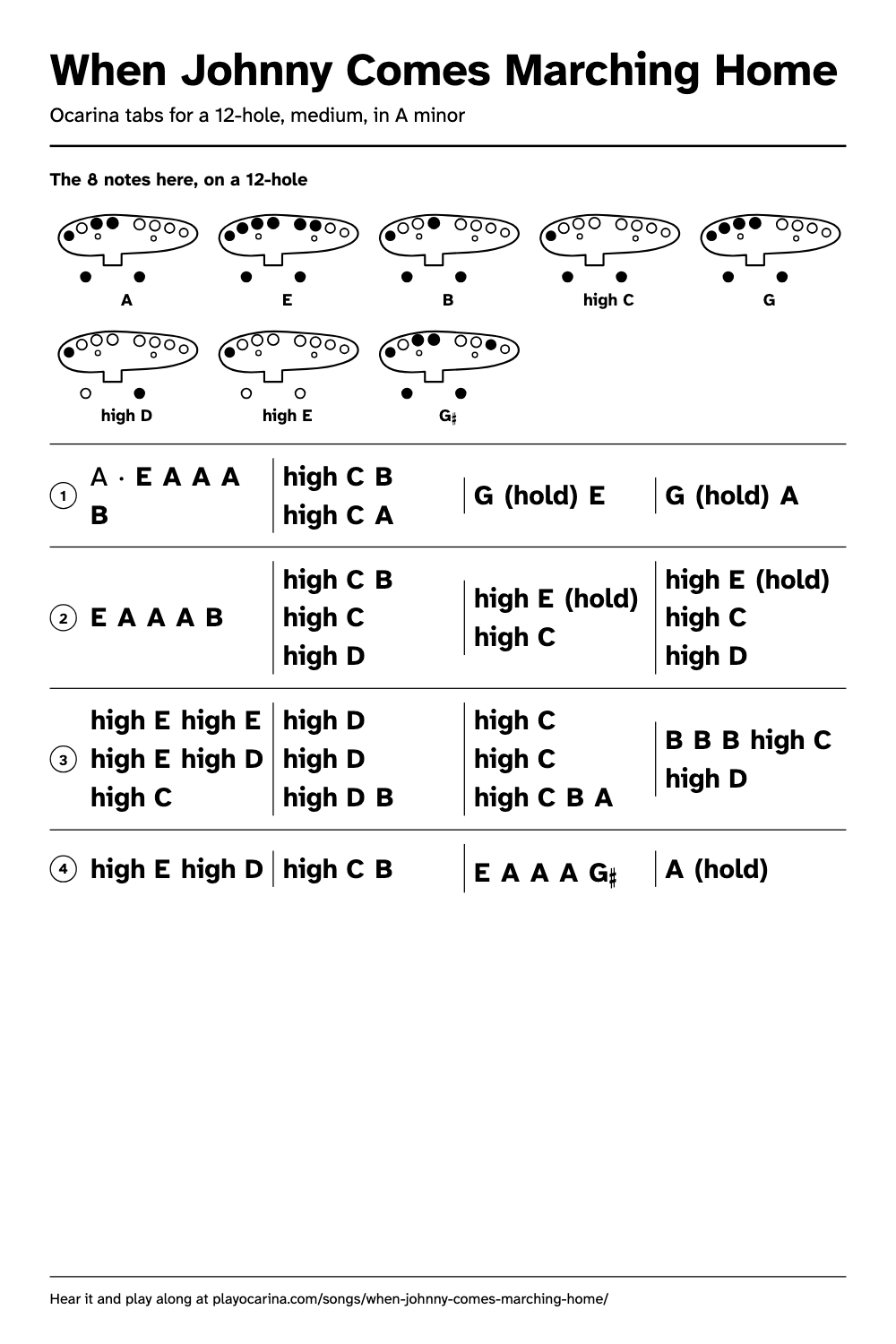
On a 12-hole. Read left to right, a line at a time.
- A EAAABhigh CBhigh CAG(hold)EG(hold)A
- EAAABTricky spot:high CBhigh Chigh Dhigh E(hold)high Chigh E(hold)high Chigh D
- high Ehigh Ehigh Ehigh Dhigh Chigh Dhigh Dhigh DBhigh Chigh Chigh CBABBBhigh Chigh D
- high Ehigh Dhigh CBEAAAG♯A(hold)
When Johnny Comes Marching Home is a brisk 6/8 march that starts on one quick A, then E, A, A, A and B. Here are the verse and chorus of the 1863 sheet music in A minor, sixteen bars from E up to high E, with G♯ the only sharp. A 12-hole or a 6-hole ocarina in C plays it, and the long tied notes give you time to breathe.
What is the tricky spot in When Johnny Comes Marching Home?
The two quick notes just before the run of high E's: a C and a D that last only half a beat together. On a 12-hole, When Johnny Comes Marching Home goes from high C to high D: you lift the left thumb. On a 6-hole, you lift the right thumb.
They come after a high E that is held for two and a half beats, so you have time to get your fingers ready while it sounds. Practise the C and D on their own first, slowly, lifting and closing the fingers cleanly, then add the E that follows. Each note is a quarter of a beat, so think of them as one small flick on the way to the E, not two separate notes.
Where do you breathe in When Johnny Comes Marching Home?
Breathe on the long tied notes: the two long G's near the start and the two long high E's at the top of the tune. After the second tied E comes the longest stretch with no long note, four bars that fall from high E to A and climb back, so take a good breath at the end of that tied E, before its quick C and D.
Which ocarina can play When Johnny Comes Marching Home?
A 4-hole ocarina cannot reach high D and high E, so play When Johnny Comes Marching Home in this key on a 12-hole or 6-hole ocarina in C. On an ocarina in G or F, use the same fingerings: the tune sounds in a different key, which is fine when you play alone. Each linked chart has every fingering for its ocarina, and you can check your notes with a tuner such as our free ocarina tuner.
The 8 notes here, on a 12-holeHoles in words, with a picture
| Note | Holes to cover | Picture |
|---|---|---|
| A | Cover the left pinky, left middle, left index, left thumb and right thumb | |
| E | Cover every main hole but the right ring and right pinky | |
| B | Cover the left pinky, left index, left thumb and right thumb | |
| high C | Cover the left pinky, left thumb and right thumb | |
| G | Cover every main hole but the right index, right middle, right ring and right pinky | |
| high D | Cover the left pinky and right thumb | |
| high E | Cover the left pinky | |
| G♯ | Cover every main hole but the left ring, right index, right middle and right pinky |
Drawn as you see it while playing: mouthpiece towards you, left hand on the left.
| Note | Holes to cover | Picture |
|---|---|---|
| A | Cover the left index, left thumb and right thumb | |
| E | Cover every hole but the right index | |
| B | Cover the right middle, left thumb and right thumb | |
| high C | Cover the left thumb and right thumb | |
| G | Cover every hole but the left middle and right middle | |
| high D | Cover the left thumb | |
| high E | All holes open | |
| G♯ | Cover every hole but the left middle and right index |
Drawn as you see it while playing: mouthpiece towards you, left hand on the left.
Who is Louis Lambert on the cover of When Johnny Comes Marching Home?
The cover of the 1863 sheet music says "Words and Music by Louis Lambert" and that the tune was played in the "Soldier's Return March" by Gilmore's Band. Lambert was a pen name: the library record lists the bandleader Patrick Gilmore as the composer, and Wikipedia says Gilmore later described the music as a tune he had heard someone humming, not one he made up. An 1883 Boston songbook prints the same tune, and Gilmore died in 1892. Our tabs follow the Boston printing, in G minor there, moved up here to A minor. We show the melody only. Music: Patrick S. Gilmore (1829-1892), who published it as Louis Lambert, 1863.