Maple Leaf Rag on the ocarina
On a 12-hole it starts C, G, C, E. Hard, 51 notes, in C major.
Goes down to low B, so it does not fit a 6-hole or 4-hole.
Maple Leaf Rag
Bar 1 of 10
What are the notes for Maple Leaf Rag?
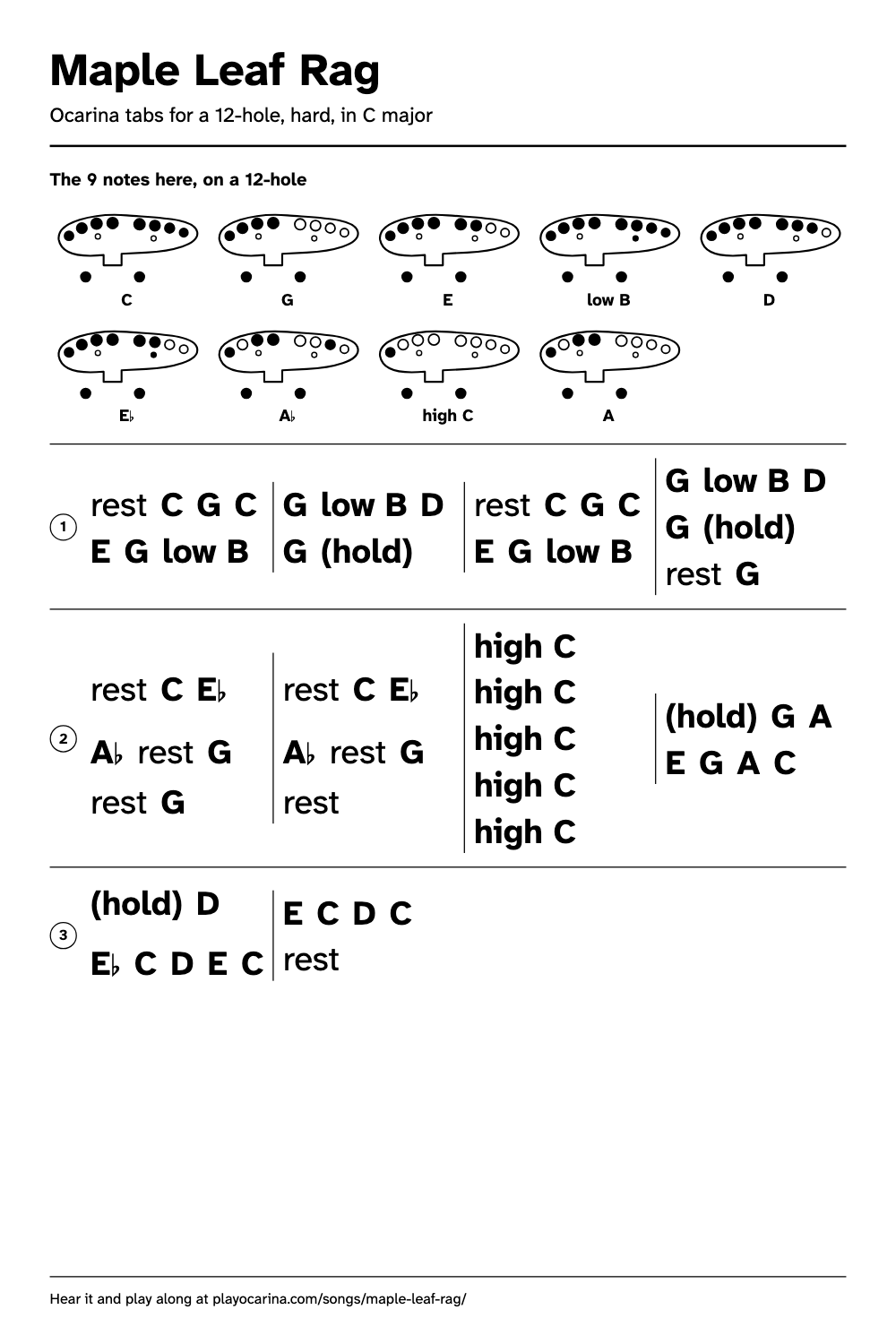
On a 12-hole. Read left to right, a line at a time.
- Tricky spot:restCGCEGlow BGlow BDG(hold)restCGCEGlow BGlow BDG(hold)restG
- restCE♭A♭restGrestGrestCE♭A♭restGresthigh Chigh Chigh Chigh Chigh C(hold)GAEGAC
- (hold)DE♭CDECECDCrest
Maple Leaf Rag is Scott Joplin's piano rag of 1899, and this page plays its main theme, simplified: the first six bars of the rag's opening 16-bar section, then its last four, moved from A flat major up to C major. It starts with a tiny rest and a quick run of short notes, and it goes from low B to high C, so it needs a 12-hole ocarina. It is a hard tune: fast sixteenth notes, tied notes and the short rests that make it bounce.
What is the tricky spot in Maple Leaf Rag?
The drop from high G to low B at the end of the first bar and again at the start of the second: a sixth down, at sixteenth-note speed. On a 12-hole, Maple Leaf Rag goes from G to low B: you cover the right index, right middle, right ring, right pinky and right sub-hole.
For high G only your left hand and both thumbs are down; low B needs all ten main holes sealed plus the right sub-hole, so the whole right hand drops at once. Practise the pair alone as a drop and a catch: land the right hand on the beat, then add the notes before and after. The same bars come round again in the third and fourth bars, so the pattern is worth drilling slowly. Low B is the lowest note in the tune, so give it a gentle, steady breath. The other awkward notes are the E flat and A flat in the fifth and sixth bars, each a cross-fingering, so learn those two fingerings on their own first.
Where do you breathe in Maple Leaf Rag?
The best places to breathe are the eighth rest that closes the sixth bar, just before the tune jumps to its closing phrase, and the last rest at the very end. The sixteenth rests inside the bars are too short for a breath, so treat each one as a small gap between tongued notes.
Which ocarina can play Maple Leaf Rag?
A 6-hole or 4-hole ocarina cannot reach low B, so play Maple Leaf Rag in this key on a 12-hole ocarina in C. On an ocarina in G or F, use the same fingerings: the tune sounds in a different key, which is fine when you play alone. The linked chart has every fingering, and you can check your notes with a tuner such as our free ocarina tuner.
The 9 notes here, on a 12-holeHoles in words, with a picture
| Note | Holes to cover | Picture |
|---|---|---|
| C | Cover every main hole | |
| G | Cover every main hole but the right index, right middle, right ring and right pinky | |
| E | Cover every main hole but the right ring and right pinky | |
| low B | Cover every main hole, plus the right sub-hole | |
| D | Cover every main hole but the right pinky | |
| E♭ | Cover every main hole but the right ring and right pinky, plus the right sub-hole | |
| A♭ | Cover every main hole but the left ring, right index, right middle and right pinky | |
| high C | Cover the left pinky, left thumb and right thumb | |
| A | Cover the left pinky, left middle, left index, left thumb and right thumb |
Drawn as you see it while playing: mouthpiece towards you, left hand on the left.
Which part of the Maple Leaf Rag do these tabs play?
The main theme, but not all of it. Scott Joplin's Maple Leaf Rag came out in 1899 as a piano piece, and our tabs follow the first edition, published by John Stark & Son in Sedalia, Missouri, and marked "Tempo di marcia", a march tempo. They take the top line of the right hand in the opening 16-bar section: its first six bars, then its last four, moved up from Joplin's A flat major to C major to fit the ocarina. The bars left out are a climb of four octaves and a copy of the closing phrase an octave higher, too wide for any ocarina. A later St. Louis printing has the same music on its first page. Joplin died in 1917. We show the melody only. Music: Scott Joplin (1868-1917), the first strain of his Maple Leaf Rag, 1899.
