My Old Kentucky Home on the ocarina
On a 12-hole it starts B, B, B, G. Medium, 112 notes, in G major.
Goes up to high E, so it does not fit a 4-hole.
My Old Kentucky Home
Bar 1 of 24
What are the notes for My Old Kentucky Home?
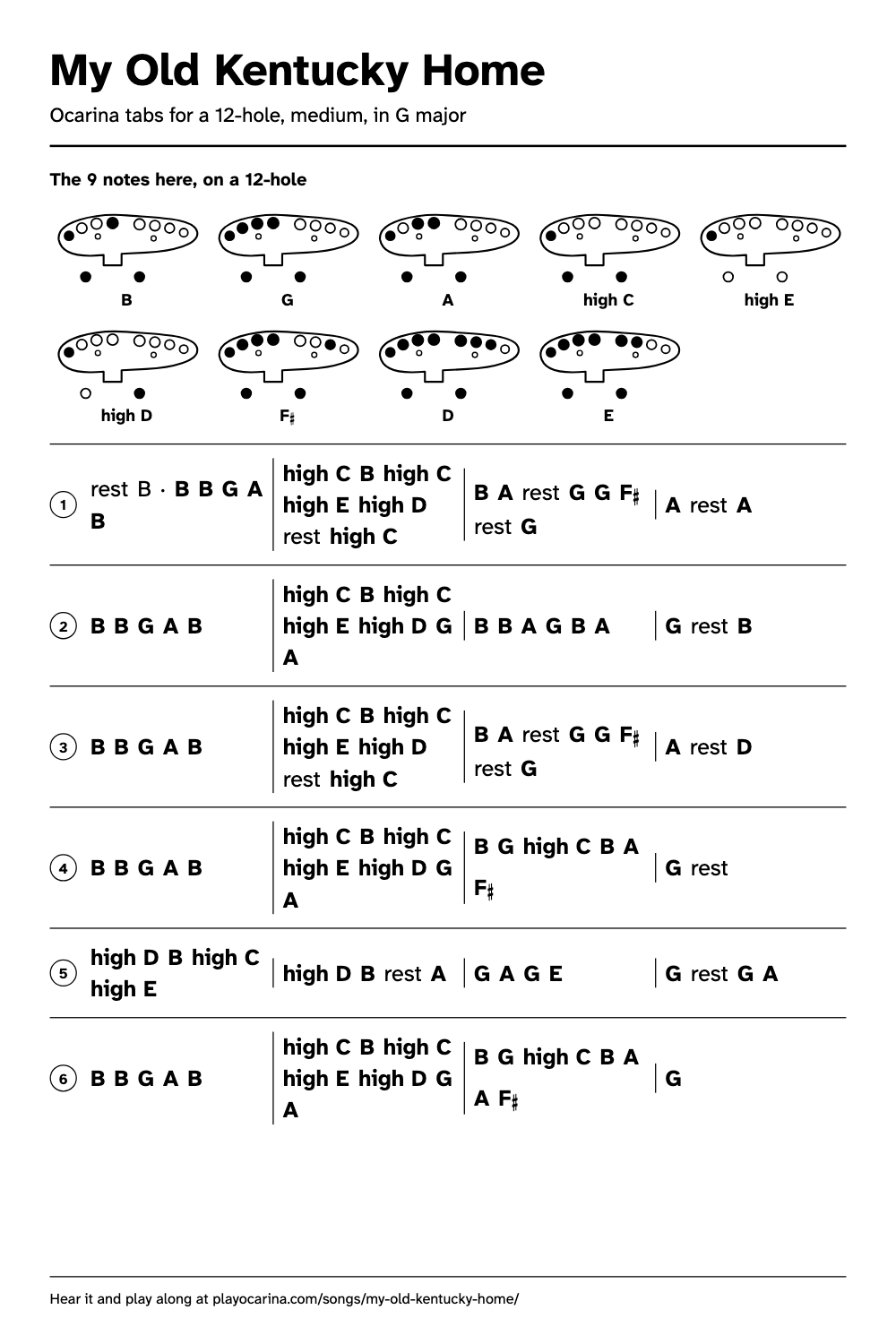
On a 12-hole. Read left to right, a line at a time.
- restB BBGABTricky spot:high CBhigh Chigh Ehigh Dresthigh CBArestGGF♯restGArestA
- BBGABhigh CBhigh Chigh Ehigh DGABBAGBAGrestB
- BBGABhigh CBhigh Chigh Ehigh Dresthigh CBArestGGF♯restGArestD
- BBGABhigh CBhigh Chigh Ehigh DGABGhigh CBAF♯Grest
- high DBhigh Chigh Ehigh DBrestAGAGEGrestGA
- BBGABhigh CBhigh Chigh Ehigh DGABGhigh CBAAF♯G
My Old Kentucky Home opens on three B's, then drops to G and climbs back through A to B. Here it is in G major, a 16-bar verse followed by an 8-bar chorus, from D up to high E, with F♯ the only sharp. Foster's 1853 sheet music marks it Poco adagio, rather slow, and writes a lot of small rests into the tune.
What is the tricky spot in My Old Kentucky Home?
The leap from high C up to high E, which comes in the second bar of each four-bar line of the verse and twice in the chorus, straight after a quick note. On a 12-hole or 6-hole, My Old Kentucky Home goes from high C to high E: you lift the left thumb and right thumb.
High C has both thumb holes and the left little finger covered; high E has only the little finger covered, so both thumbs lift together as you go up, skipping the D between. Practise C to E alone, slowly, then add the long D that follows, which puts the right thumb back down. The next jump is just as wide: after that D the tune falls a fifth to G in bars 6 and 14, and the left ring, middle and index fingers and the left thumb all go down at once. The only sharp, F♯, is G with the right ring finger added, so the G, G, F♯, G in bars 3 and 11 moves one finger.
Where do you breathe in My Old Kentucky Home?
The tune leaves plenty of room: breathe in the rests, the three-beat A that ends the fourth bar, the three-beat G in the eighth bar, the two beats of rest in the twelfth bar and the three beats of rest before the chorus. The high E needs a little more air than the notes around it, so ease off on the D after it.
Which ocarina can play My Old Kentucky Home?
A 4-hole ocarina cannot reach high D and high E, so play My Old Kentucky Home in this key on a 12-hole or 6-hole ocarina in C. On an ocarina in G or F, use the same fingerings: the tune sounds in a different key, which is fine when you play alone. Each linked chart has every fingering for its ocarina, and you can check your notes with a tuner such as our free ocarina tuner.
The 9 notes here, on a 12-holeHoles in words, with a picture
| Note | Holes to cover | Picture |
|---|---|---|
| B | Cover the left pinky, left index, left thumb and right thumb | |
| G | Cover every main hole but the right index, right middle, right ring and right pinky | |
| A | Cover the left pinky, left middle, left index, left thumb and right thumb | |
| high C | Cover the left pinky, left thumb and right thumb | |
| high E | Cover the left pinky | |
| high D | Cover the left pinky and right thumb | |
| F♯ | Cover every main hole but the right index, right middle and right pinky | |
| D | Cover every main hole but the right pinky | |
| E | Cover every main hole but the right ring and right pinky |
Drawn as you see it while playing: mouthpiece towards you, left hand on the left.
| Note | Holes to cover | Picture |
|---|---|---|
| B | Cover the right middle, left thumb and right thumb | |
| G | Cover every hole but the left middle and right middle | |
| A | Cover the left index, left thumb and right thumb | |
| high C | Cover the left thumb and right thumb | |
| high E | All holes open | |
| high D | Cover the left thumb | |
| F♯ | Cover every hole but the left middle | |
| D | Cover every hole but the right middle | |
| E | Cover every hole but the right index |
Drawn as you see it while playing: mouthpiece towards you, left hand on the left.
How did Foster's song get to be Kentucky's?
It came out in January 1853 from Firth, Pond & Co. in New York, which sold it as a "plantation melody" for Christy's Minstrels; the cover of the 1853 sheet music says "As sung by Christy's Minstrels". Our tabs follow that printing, which gives one tune for the verse and a four-part chorus with the tune marked as the air. A tenth edition carries the same plate number and the same music. Later, the preamble of a 1928 Act of the Kentucky legislature said the song "has immortalized Kentucky throughout the civilized world". Foster's original words include a term now seen as offensive, and in 1986 the Kentucky House and Senate each passed a resolution to say "people" in its place when the song is used there. Foster died in 1864. We show the melody only. Music: Stephen Foster (1826-1864), words and music, 1853.