Crown Him with Many Crowns on the ocarina
On a 12-hole it starts C, C, C, E. Medium, 53 notes, in C major.
Crown Him with Many Crowns
Bar 1 of 16
What are the notes for Crown Him with Many Crowns?
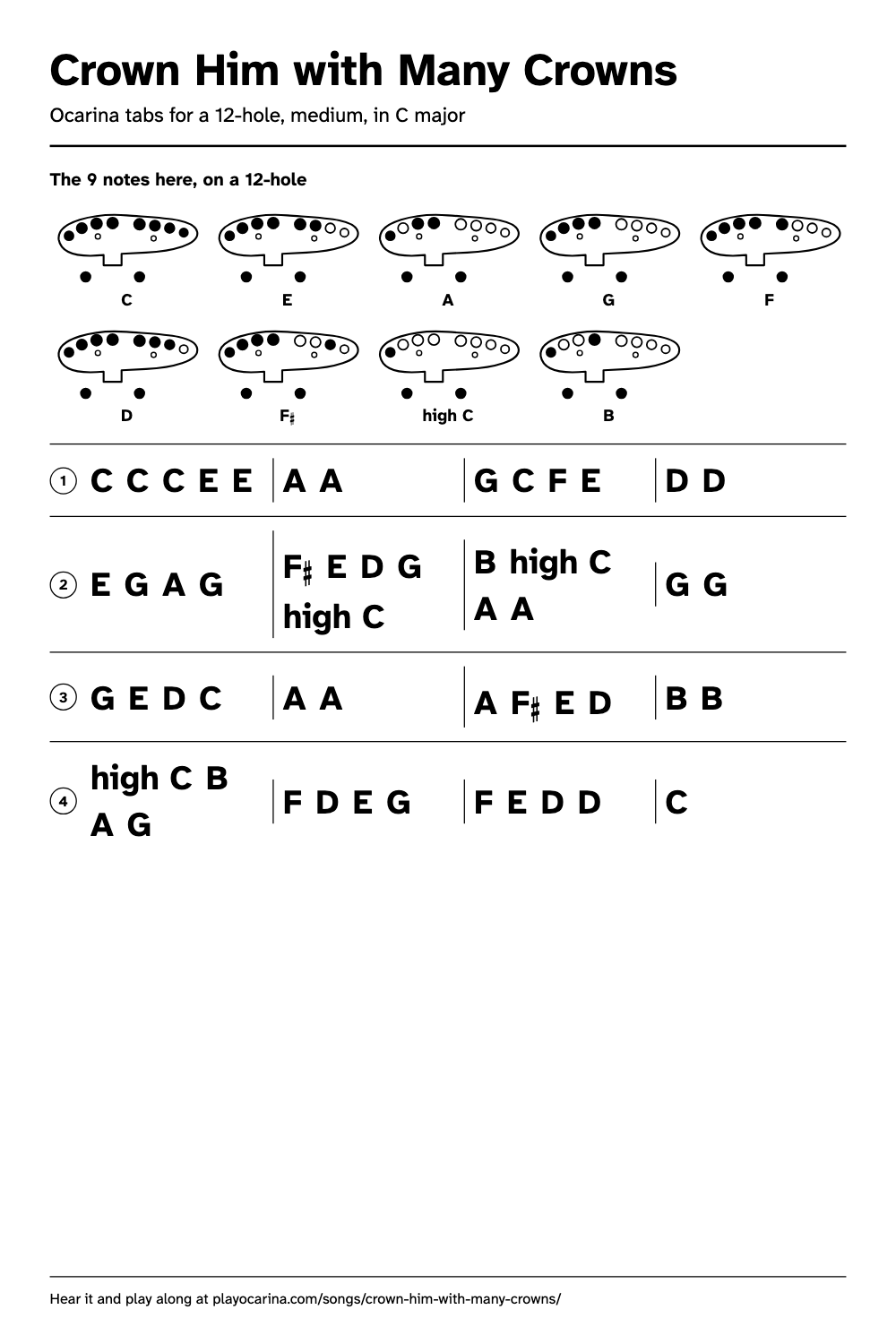
On a 12-hole. Read left to right, a line at a time.
- CCCEEAAGCFEDD
- EGAGF♯EDGhigh CBhigh CAAGG
- GEDCAATricky spot:AF♯EDBB
- high CBAGFDEGFEDDC
Crown Him with Many Crowns in C major starts on three C's, climbs to E and a long A, and stays between C and high C. It has one note outside the key, F♯, which a 4-hole, a 6-hole and a 12-hole can all play, so all three fit. The tune moves in long, steady notes and ends each line on a held one.
What is the tricky spot in Crown Him with Many Crowns?
The drop from A to F♯ in the eleventh bar. F♯ is the one note outside C major, and it also opens the sixth bar. On a 12-hole, Crown Him with Many Crowns goes from A to F♯: you cover the left ring and right ring. On a 6-hole or 4-hole, you cover the right middle and right index.
Practise the four notes of the eleventh bar, A, F♯, E and D, slowly and on their own before the whole tune. The F♯ takes more fingers than the notes around it, so get every finger down before you blow: if it squeaks, or sounds close to F or to G, one hole is not fully covered. A tuner shows which way it is off. Keep the air steady through the change, because a note with several fingers moving tends to wobble.
Where do you breathe in Crown Him with Many Crowns?
Breathe at the end of the three-beat notes in the second, fourth, eighth, tenth and twelfth bars, taking the breath quickly so the one-beat note after each starts on time. The thirteenth and fourteenth bars have no held note, and neither does the one after, until the last C, so take a fuller breath on the three-beat B in the twelfth bar.
Which ocarina can play Crown Him with Many Crowns?
Any 12-hole, 6-hole or 4-hole ocarina in C plays Crown Him with Many Crowns in this key. On an ocarina in G or F, use the same fingerings: the tune sounds in a different key, which is fine when you play alone. Each linked chart has every fingering for its ocarina, and you can check your notes with a tuner such as our free ocarina tuner.
The 9 notes here, on a 12-holeHoles in words, with a picture
| Note | Holes to cover | Picture |
|---|---|---|
| C | Cover every main hole | |
| E | Cover every main hole but the right ring and right pinky | |
| A | Cover the left pinky, left middle, left index, left thumb and right thumb | |
| G | Cover every main hole but the right index, right middle, right ring and right pinky | |
| F | Cover every main hole but the right middle, right ring and right pinky | |
| D | Cover every main hole but the right pinky | |
| F♯ | Cover every main hole but the right index, right middle and right pinky | |
| high C | Cover the left pinky, left thumb and right thumb | |
| B | Cover the left pinky, left index, left thumb and right thumb |
Drawn as you see it while playing: mouthpiece towards you, left hand on the left.
| Note | Holes to cover | Picture |
|---|---|---|
| C | Cover every hole | |
| E | Cover every hole but the right index | |
| A | Cover the left index, left thumb and right thumb | |
| G | Cover every hole but the left middle and right middle | |
| F | Cover every hole but the right middle and right index | |
| D | Cover every hole but the right middle | |
| F♯ | Cover every hole but the left middle | |
| high C | Cover the left thumb and right thumb | |
| B | Cover the right middle, left thumb and right thumb |
Drawn as you see it while playing: mouthpiece towards you, left hand on the left.
| Note | Holes to cover | Picture |
|---|---|---|
| C | Cover every hole | |
| E | Cover every hole but the right index | |
| A | Cover the left index | |
| G | Cover the left index and right index | |
| F | Cover the left middle and left index | |
| D | Cover every hole but the right middle | |
| F♯ | Cover every hole but the left middle | |
| high C | All holes open | |
| B | Cover the right middle |
Drawn as you see it while playing: mouthpiece towards you, left hand on the left.
Who wrote the tune of Crown Him with Many Crowns?
The tune is called Diademata, from the Greek word for crowns, and it is by Sir George Elvey, organist of St George's Chapel, Windsor, from 1835 until 1882; he died in 1893. The earliest printing we found is in the Appendix to Hymns Ancient and Modern, whose preface is dated September 1868, and its index of tunes names Elvey as composer. A later edition of the same book says he wrote the tune for that Appendix. The words are older: the hymn dates from 1851, by Matthew Bridges, with more verses added later by Godfrey Thring, and the 1868 book prints five stanzas. Our tabs follow the top voice of that page. It is printed in E major, with four half notes to the bar, so we have moved it to C major and halved the note values to suit the ocarina; the tune itself is unchanged. We show the melody only. Music: the tune "Diademata" by Sir George Job Elvey (1816-1893), first printed in 1868; words by Matthew Bridges (1800-1894) and Godfrey Thring (1823-1903).