Old MacDonald Had a Farm on the ocarina
On a 12-hole it starts G, G, G, D. Easy, 59 notes, in G major.
Old MacDonald Had a Farm
Bar 1 of 16
What are the notes for Old MacDonald Had a Farm?
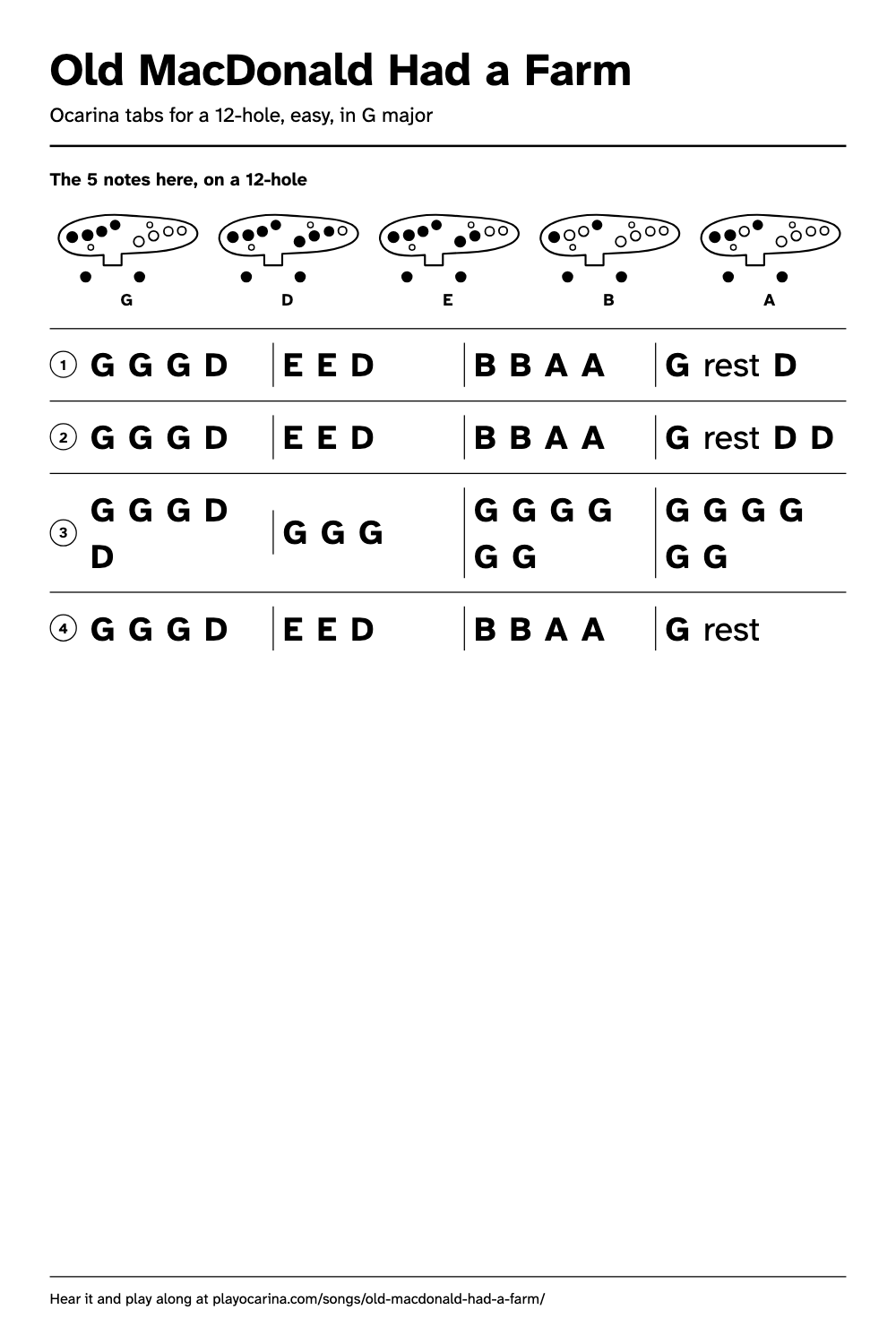
On a 12-hole. Read left to right, a line at a time.
- Tricky spot:GGGDEEDBBAAGrestD
- GGGDEEDBBAAGrestDD
- GGGDDGGGGGGGGGGGGGGG
- GGGDEEDBBAAGrest
Old MacDonald Had a Farm is mostly one note: the opening G comes three times, and the whole middle of the song, the chick, chick part, is repeated G's. Here it is in G major, 16 bars from D up to high B, with no sharps or flats, so it fits every ocarina from a 12-hole to a 4-hole pendant.
What is the tricky spot in Old MacDonald Had a Farm?
The drop from G to D inside the first bar, the biggest fall in the song, straight after three G's. On a 12-hole, Old MacDonald Had a Farm goes from G to D: you cover the right index, right middle and right ring. On a 6-hole or 4-hole, you cover the left middle.
The other jump is up from the D to B that starts E-I-E-I-O, a sixth, so practise D to B on its own too. Practise G, G, G, D, and keep the breath gentle on the low D: too much air and it goes sharp. The repeated G's in the second half are tongued, not fingered: keep your fingers still and start each note with a soft "tu", and make the quick pairs, two eighth notes, half as long as the single ones.
Where do you breathe in Old MacDonald Had a Farm?
Breathe on the rest at the end of each four-bar refrain, after the long G. The chick, chick part is four bars of quick G's: take a fuller breath on the rest before it and play through to the end.
Which ocarina can play Old MacDonald Had a Farm?
Any 12-hole, 6-hole or 4-hole ocarina in C plays Old MacDonald Had a Farm in this key. On an ocarina in G or F, use the same fingerings: the tune sounds in a different key, which is fine when you play alone. Each linked chart has every fingering for its ocarina, and you can check your notes with a tuner such as our free ocarina tuner.
The 5 notes here, on a 12-holeHoles in words, with a picture
| Note | Holes to cover | Picture |
|---|---|---|
| G | Cover every main hole but the right index, right middle, right ring and right pinky | |
| D | Cover every main hole but the right pinky | |
| E | Cover every main hole but the right ring and right pinky | |
| B | Cover the left pinky, left index, left thumb and right thumb | |
| A | Cover the left pinky, left middle, left index, left thumb and right thumb |
Drawn as you see it while playing: mouthpiece towards you, left hand on the left.
| Note | Holes to cover | Picture |
|---|---|---|
| G | Cover every hole but the left middle and right middle | |
| D | Cover every hole but the right middle | |
| E | Cover every hole but the right index | |
| B | Cover the right middle, left thumb and right thumb | |
| A | Cover the left index, left thumb and right thumb |
Drawn as you see it while playing: mouthpiece towards you, left hand on the left.
| Note | Holes to cover | Picture |
|---|---|---|
| G | Cover the left index and right index | |
| D | Cover every hole but the right middle | |
| E | Cover every hole but the right index | |
| B | Cover the right middle | |
| A | Cover the left index |
Drawn as you see it while playing: mouthpiece towards you, left hand on the left.
How old is Old MacDonald?
The tune is traditional, and neither of the two oldest printings with music that we found names a composer or arranger. Our tabs follow the Boy Scout Song Book of 1920, where page 50 sets the song with a chick, a duck and then a Ford car that goes rattle-rattle, and The Golden Book of Favorite Songs, 1923, prints it as "MacDonald's Farm" in B flat. Both books print the fourth note of the song, on the last syllable of MacDonald, and the matching note when that line comes back, as another G; we play the D that almost everyone sings there, and every other note is the same. Wikipedia says the song is attributed to Thomas d'Urfey's opera of 1706 and was standardised only in the twentieth century, which fits two printings from the 1920s. We show the melody only. Music: traditional children's song; the oldest printings with music we found are American, 1920 and 1923.