Over the Hills and Far Away on the ocarina
On a 12-hole it starts D, G, B, A. Medium, 73 notes, in A minor.
Goes up to high D, so it does not fit a 4-hole.
Over the Hills and Far Away
Bar 1 of 16
What are the notes for Over the Hills and Far Away?
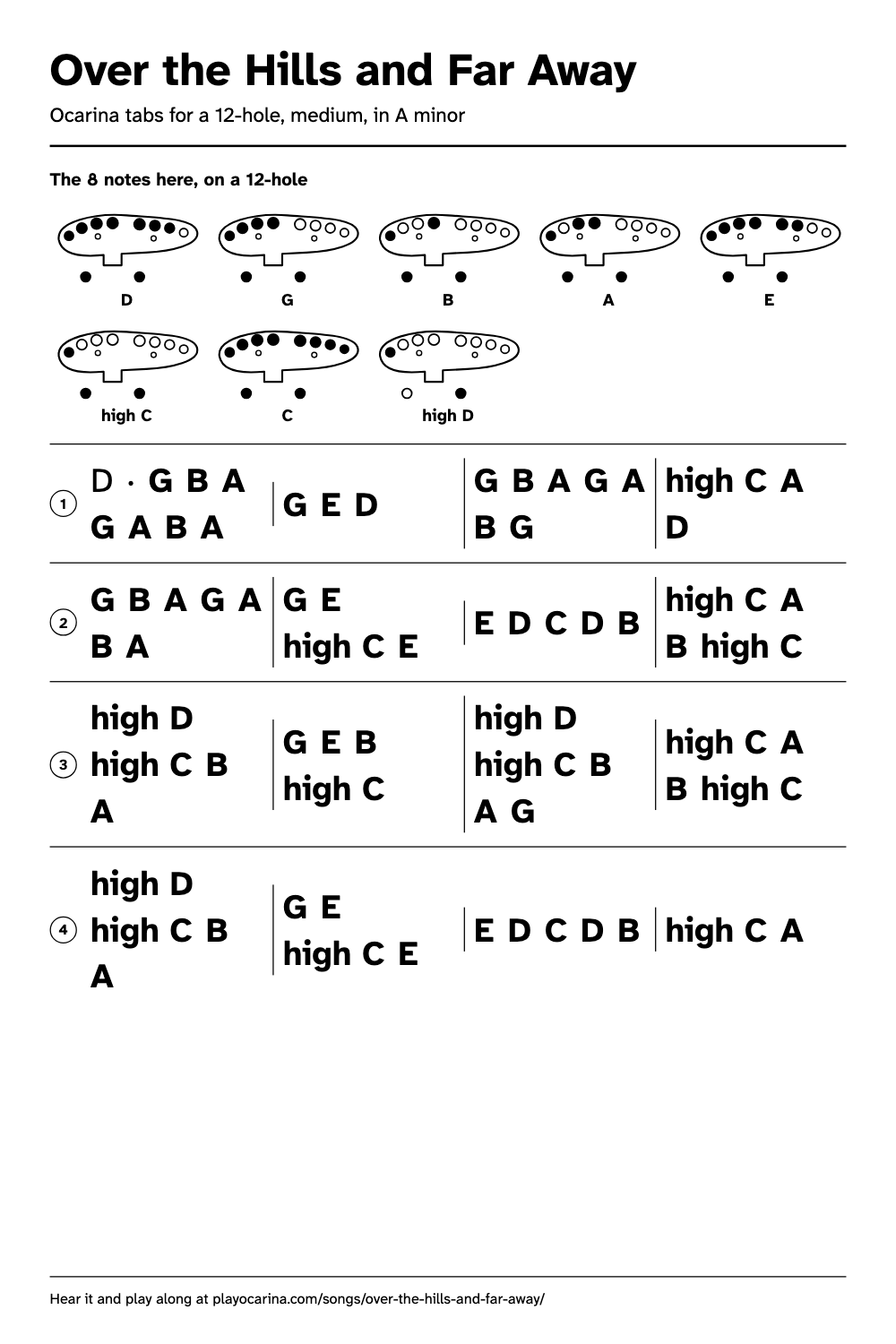
On a 12-hole. Read left to right, a line at a time.
- D GBAGABAGEDGBAGABGhigh CAD
- GBAGABATricky spot:GEhigh CEEDCDBhigh CABhigh C
- high Dhigh CBAGEBhigh Chigh Dhigh CBAGhigh CABhigh C
- high Dhigh CBAGEhigh CEEDCDBhigh CA
Over the Hills and Far Away comes in two halves of eight bars, and both close with the same three bars, ending on a long A. The first half circles G, B, A, G in quick pairs and dips to a long E; the second opens on high D and walks down, D, C, B, A. Here it is in A minor, from C up to high D, with no sharps or flats.
What is the tricky spot in Over the Hills and Far Away?
The leap from E up to high C in the sixth bar, held for a beat and a half and then dropped straight back to E. On a 12-hole, Over the Hills and Far Away goes from E to high C: you lift the left ring, left middle, left index, right index and right middle. On a 6-hole, you lift the left middle, right middle and left index.
The same bar closes the second half, so you meet it twice. On the E, get ready for the jump, then give high C a firmer, faster breath (more on high notes) and soften it again for the low E. The bar after it runs down E, D, C and then jumps from D up to B, another sixth, before the long A: play those two bars slowly until both leaps land in tune. In the first half, tongue the quick pairs, B A, G A, B A, lightly and evenly with a "du" so they do not run together.
Where do you breathe in Over the Hills and Far Away?
After the long two-beat notes: the E in the second bar, and the A that ends each line of four bars. Take the fullest breath at the double bar in the middle, because the second half opens on high D, which wants a firm, steady stream of air.
Which ocarina can play Over the Hills and Far Away?
A 4-hole ocarina cannot reach high D, so play Over the Hills and Far Away in this key on a 12-hole or 6-hole ocarina in C. On an ocarina in G or F, use the same fingerings: the tune sounds in a different key, which is fine when you play alone. Each linked chart has every fingering for its ocarina, and you can check your notes with a tuner such as our free ocarina tuner.
The 8 notes here, on a 12-holeHoles in words, with a picture
| Note | Holes to cover | Picture |
|---|---|---|
| D | Cover every main hole but the right pinky | |
| G | Cover every main hole but the right index, right middle, right ring and right pinky | |
| B | Cover the left pinky, left index, left thumb and right thumb | |
| A | Cover the left pinky, left middle, left index, left thumb and right thumb | |
| E | Cover every main hole but the right ring and right pinky | |
| high C | Cover the left pinky, left thumb and right thumb | |
| C | Cover every main hole | |
| high D | Cover the left pinky and right thumb |
Drawn as you see it while playing: mouthpiece towards you, left hand on the left.
| Note | Holes to cover | Picture |
|---|---|---|
| D | Cover every hole but the right middle | |
| G | Cover every hole but the left middle and right middle | |
| B | Cover the right middle, left thumb and right thumb | |
| A | Cover the left index, left thumb and right thumb | |
| E | Cover every hole but the right index | |
| high C | Cover the left thumb and right thumb | |
| C | Cover every hole | |
| high D | Cover the left thumb |
Drawn as you see it while playing: mouthpiece towards you, left hand on the left.
Where does the tune of Over the Hills and Far Away come from?
From the years around 1700. The song goes back to at least the late 1600s, and a version close to one of its early printings is in George Farquhar's 1706 play The Recruiting Officer. Our tabs follow the 1706 volume of Pills to Purge Melancholy (London, printed by W. Pearson), where the tune stands on page 99 over a love song, "Jockey's Lamentation", and three pages later a recruiting song is set "To the foregoing Tune". So the lover and the soldiers share one tune. The 1719 edition prints the same notes. The page has no sharps or flats and ends on D; the tabs move it up a fifth, to A, so it sits between C and high D, and play each half once, as printed. The nursery rhyme Tom, Tom, the Piper's Son names it as the one tune the piper could play, and it was given new words for the Sharpe television series in the 1990s. We show the melody only. Music: traditional English song, anonymous, in print by 1706.