Come Thou Fount on the ocarina
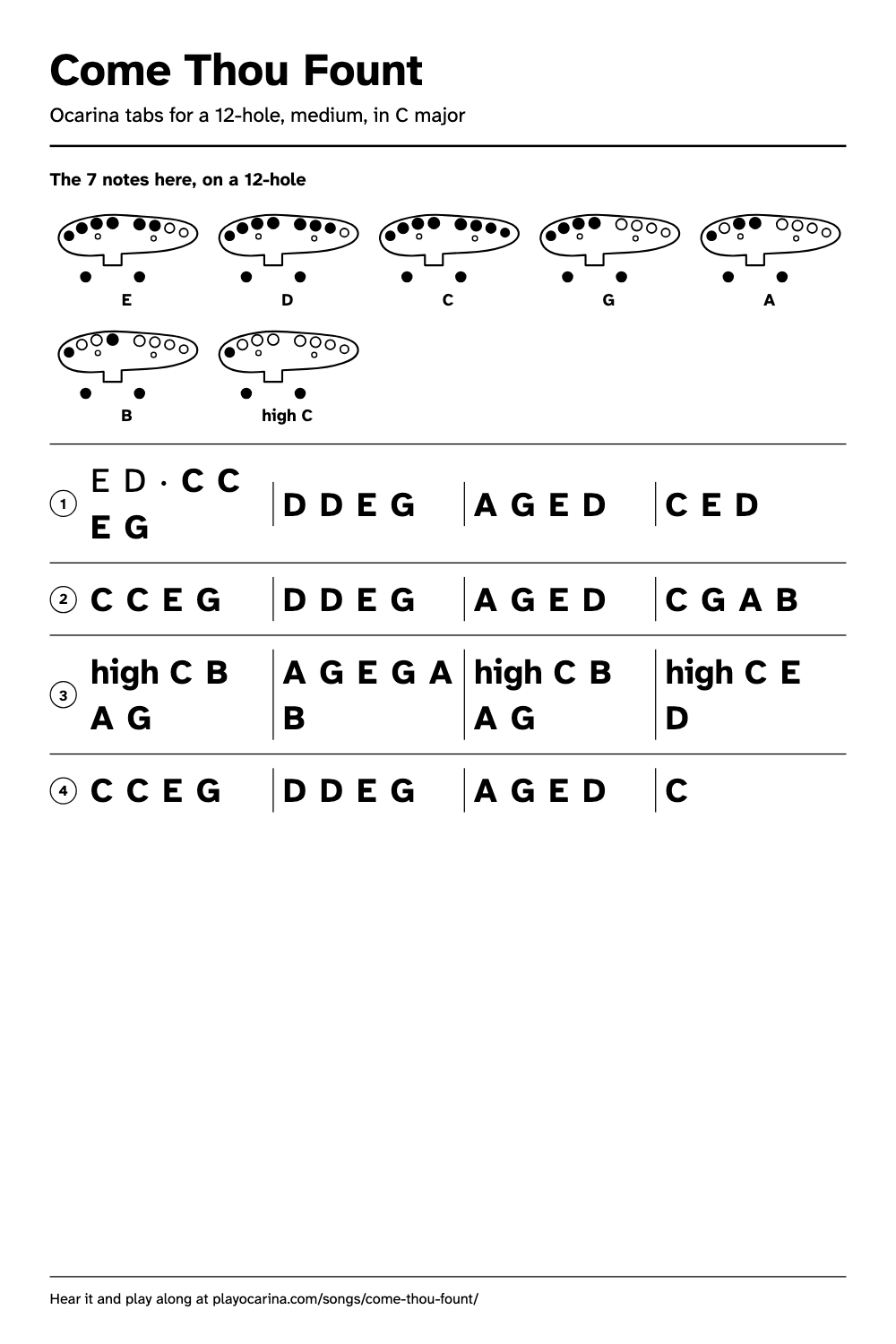
On a 12-hole it starts E, D, C, C. Medium, 63 notes, in C major.
Come Thou Fount
Bar 1 of 16
What are the notes for Come Thou Fount?
On a 12-hole. Read left to right, a line at a time.
- ED CCEGDDEGAGEDCED
- CCEGDDEGAGEDCGAB
- high CBAGAGEGABhigh CBAGTricky spot:high CED
- CCEGDDEGAGEDC
Come Thou Fount, sung in America to the tune Nettleton, opens with a quick E and D falling to two steady C's. In C major it runs from C to high C with no sharps or flats, so it fits a 12-hole, a 6-hole and a 4-hole ocarina. It is in three, and the same four-bar line comes three times: at the start, straight after it, and to finish.
What is the tricky spot in Come Thou Fount?
The drop from the long high C at the end of the third line down to E, where the opening line comes back. On a 12-hole, Come Thou Fount goes from high C to E: you cover the left ring, left middle, left index, right index and right middle. On a 6-hole or 4-hole, you cover the left middle, right middle and left index.
That high C is the top of the hymn, and the tune leaps to it from a G. Before it come two quick runs of G, A and B, at the ends of bars 8 and 10: a short G, then two sixteenths that should sound like one flick of the fingers into the C. Play the run slowly at first, keeping the fingers close to the holes. After the two-beat high C the tune falls a sixth to E, so ease the breath off as you drop or the E comes out sharp and loud. Everywhere else the eighth-note pairs, such as E and G or E and D, lead into the next bar: keep them light and even.
Where do you breathe in Come Thou Fount?
Each line ends on a two-beat note, C or the high C, and the next line starts straight after with two quick notes, so take the breath at the end of the long note and cut it a little short. The third line climbs to the top of the tune; a full breath before it helps the high C stay steady.
Which ocarina can play Come Thou Fount?
Any 12-hole, 6-hole or 4-hole ocarina in C plays Come Thou Fount in this key. On an ocarina in G or F, use the same fingerings: the tune sounds in a different key, which is fine when you play alone. Each linked chart has every fingering for its ocarina, and you can check your notes with a tuner such as our free ocarina tuner.
The 7 notes here, on a 12-holeHoles in words, with a picture
| Note | Holes to cover | Picture |
|---|---|---|
| E | Cover every main hole but the right ring and right pinky | |
| D | Cover every main hole but the right pinky | |
| C | Cover every main hole | |
| G | Cover every main hole but the right index, right middle, right ring and right pinky | |
| A | Cover the left pinky, left middle, left index, left thumb and right thumb | |
| B | Cover the left pinky, left index, left thumb and right thumb | |
| high C | Cover the left pinky, left thumb and right thumb |
Drawn as you see it while playing: mouthpiece towards you, left hand on the left.
| Note | Holes to cover | Picture |
|---|---|---|
| E | Cover every hole but the right index | |
| D | Cover every hole but the right middle | |
| C | Cover every hole | |
| G | Cover every hole but the left middle and right middle | |
| A | Cover the left index, left thumb and right thumb | |
| B | Cover the right middle, left thumb and right thumb | |
| high C | Cover the left thumb and right thumb |
Drawn as you see it while playing: mouthpiece towards you, left hand on the left.
| Note | Holes to cover | Picture |
|---|---|---|
| E | Cover every hole but the right index | |
| D | Cover every hole but the right middle | |
| C | Cover every hole | |
| G | Cover the left index and right index | |
| A | Cover the left index | |
| B | Cover the right middle | |
| high C | All holes open |
Drawn as you see it while playing: mouthpiece towards you, left hand on the left.
Who wrote the tune of Come Thou Fount?
Nobody knows for sure. The words are Robert Robinson's, written in the late 1750s when he was about 22; he died in 1790. The tune, "Nettleton", is an American folk tune that first appears in Wyeth's Repository of Sacred Music, Part Second, in 1813, there in F for two voices, tenor and bass, with a revival chorus. Its music editor, Elkanah Kelsey Dare, who died in 1826, may have collected it; John Wyeth, who died in 1858, was the printer. The tune bears the name of Asahel Nettleton, who also published music, so some credit it to him. Our tabs follow hymn 19 of The Methodist Hymnal of 1905, which puts the tune in the top voice in E flat and credits it to "John Wyeth"; we leave out the Amen. In Britain the same words are often sung to another tune, "Normandy". We show the melody only. Music: the American tune "Nettleton", first printed in Wyeth's Repository of Sacred Music, Part Second (1813); words by Robert Robinson (1735-1790).