Pathétique Sonata Adagio on the ocarina
On a 12-hole it starts F♯, E, A, G. Medium, 23 notes, in D major.
Goes up to high E, so it does not fit a 4-hole.
Pathétique Sonata Adagio
Bar 1 of 8
What are the notes for the Pathétique Sonata Adagio?
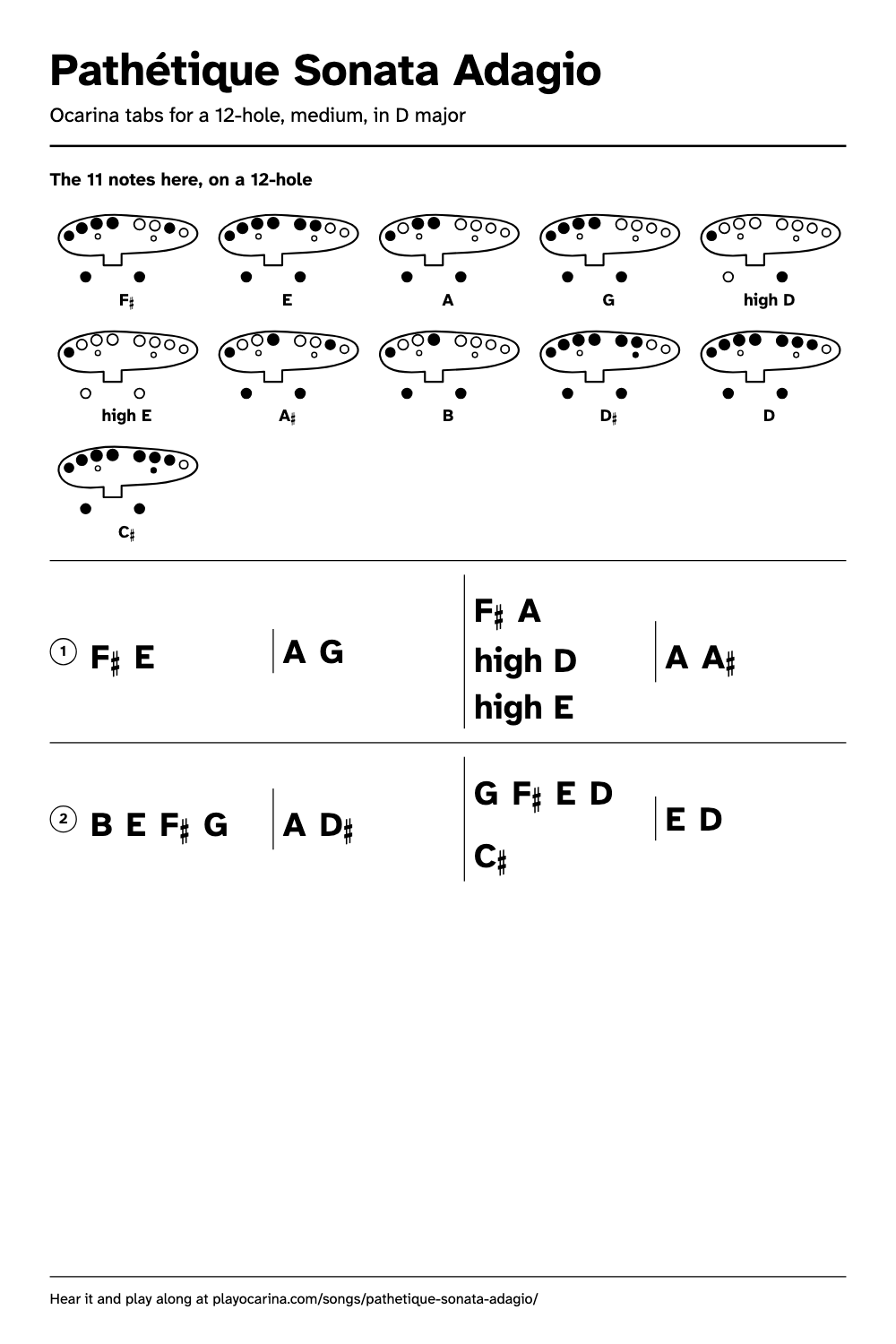
On a 12-hole. Read left to right, a line at a time.
- F♯EAGF♯Ahigh Dhigh ETricky spot:AA♯
- BEF♯GAD♯GF♯EDC♯ED
The Adagio of Beethoven's Pathétique Sonata is a slow song for the piano's right hand: two calm notes a step apart, a leap up to a long held note, a climb to the top of the tune, and a gentle walk back down to the home note. Here is its main theme, simplified to the right hand's top line of the first 8 bars, in 2/4, moved to D major, from C♯ up to the high E. It fits a 6-hole or 12-hole ocarina.
What is the tricky part of the Pathétique Sonata Adagio?
The two chromatic steps. In bar 4 the long A slides up through A♯ to B, and in bar 6 the A drops to D♯ before the tune turns back up to G. On a 12-hole, the Pathétique Sonata Adagio goes from A to A♯: you swap hands: lift the left middle and cover the right ring. On a 6-hole, you swap hands: lift the left index and cover the right index.
Practise A, A♯, B slowly until the middle note sits halfway between the other two, then the drop from A to D♯ and the step on to G. Bar 3 is the other stretch: F♯, A, D, E climbs to the top of the tune in four even eighths, so give the high D and E enough breath. The sixteenths in bars 5 and 7 are quick only on paper: the piece is marked Adagio, slow, and our player starts at 50 beats a minute.
Where do you breathe in the Pathétique Sonata Adagio?
Take a full breath before you start: the first four bars are one long line. Breathe again after the D♯ in bar 6, before the run down in bar 7.
Which ocarina can play the Pathétique Sonata Adagio?
A 4-hole ocarina cannot reach high D and high E, so play the Pathétique Sonata Adagio in this key on a 12-hole or 6-hole ocarina in C. On an ocarina in G or F, use the same fingerings: the tune sounds in a different key, which is fine when you play alone. Each linked chart has every fingering for its ocarina, and you can check your notes with a tuner such as our free ocarina tuner.
The 11 notes here, on a 12-holeHoles in words, with a picture
| Note | Holes to cover | Picture |
|---|---|---|
| F♯ | Cover every main hole but the right index, right middle and right pinky | |
| E | Cover every main hole but the right ring and right pinky | |
| A | Cover the left pinky, left middle, left index, left thumb and right thumb | |
| G | Cover every main hole but the right index, right middle, right ring and right pinky | |
| high D | Cover the left pinky and right thumb | |
| high E | Cover the left pinky | |
| A♯ | Cover the left pinky, left index, right ring, left thumb and right thumb | |
| B | Cover the left pinky, left index, left thumb and right thumb | |
| D♯ | Cover every main hole but the right ring and right pinky, plus the right sub-hole | |
| D | Cover every main hole but the right pinky | |
| C♯ | Cover every main hole but the right pinky, plus the right sub-hole |
Drawn as you see it while playing: mouthpiece towards you, left hand on the left.
| Note | Holes to cover | Picture |
|---|---|---|
| F♯ | Cover every hole but the left middle | |
| E | Cover every hole but the right index | |
| A | Cover the left index, left thumb and right thumb | |
| G | Cover every hole but the left middle and right middle | |
| high D | Cover the left thumb | |
| high E | All holes open | |
| A♯ | Cover the right index, left thumb and right thumb | |
| B | Cover the right middle, left thumb and right thumb | |
| D♯ | Cover the left middle, right middle, left index, left thumb and right thumb; half-cover the right index | |
| D | Cover every hole but the right middle | |
| C♯ | Cover the left middle, left index, right index, left thumb and right thumb; half-cover the right middle |
Drawn as you see it while playing: mouthpiece towards you, left hand on the left.
Where does the Pathétique Adagio theme come from?
Beethoven wrote the sonata in 1798 and published it in 1799, dedicated to his friend Prince Karl von Lichnowsky; the name Grande sonate pathétique came from the publisher. In the slow movement the theme is played three times, always in A♭ major, with two wandering episodes between, and the piano's right hand plays the melody over a soft murmur of sixteenth notes. Our tabs follow the right hand's top line in bars 1 to 8 of an early Zürich printing by Nägeli, where the sonata is "Sonata I" of a pair: those 8 bars are the whole theme once, ending on the home note just before the right hand plays it again an octave higher. The printing has it in A♭ major; our tabs move every note up an octave and a major third to D major, write the short dotted run in bar 5 as even sixteenths, end on the home note without the three-note lead-in to the repeat, and leave out the ornament, the inner notes and the accompaniment. Beethoven died in 1827. Music: Ludwig van Beethoven (1770-1827), the main theme of the Adagio cantabile, the second movement of his Piano Sonata No. 8, Op. 13, the Pathétique, published 1799.