Polly Wolly Doodle on the ocarina
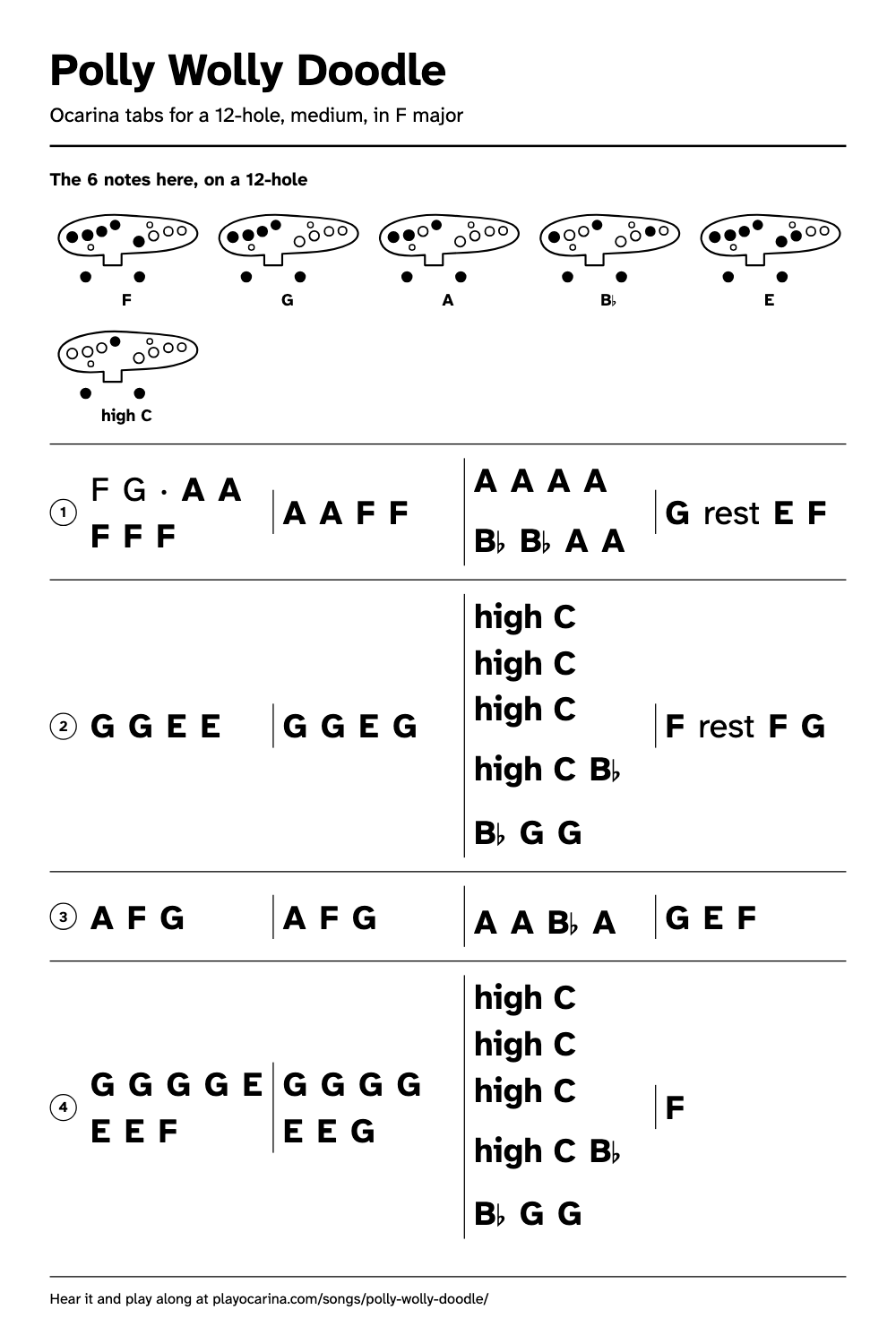
On a 12-hole it starts F, G, A, A. Medium, 78 notes, in F major.
Polly Wolly Doodle
Bar 1 of 16
What are the notes for Polly Wolly Doodle?
On a 12-hole. Read left to right, a line at a time.
- FG AAFFFAAFFAAAAB♭B♭AAGrestEF
- GGEETricky spot:GGEGhigh Chigh Chigh Chigh CB♭B♭GGFrestFG
- AFGAFGAAB♭AGEF
- GGGGEEEFGGGGEEGhigh Chigh Chigh Chigh CB♭B♭GGF
Polly Wolly Doodle is a quick, bouncy song in four-beat bars, and each 'Sing polly wolly doodle all the day' is a bar of short repeated notes: four A's, two B flats and two A's in bar 3, then four high C's, two B flats and two G's in bars 7 and 15. Here it is in F major, from E up to high C, which a 4-hole, 6-hole or 12-hole ocarina in C can play: the verse and the 'Fare thee well' chorus as a Northwestern University song book printed them in 1917.
What is the tricky spot in Polly Wolly Doodle?
The end of bars 6 and 14, where the tune jumps from G up to four quick high C's. On a 12-hole, Polly Wolly Doodle goes from G to high C: you lift the left ring, left middle and left index. On a 6-hole or 4-hole, you lift the left index and right index.
High C needs only a little more air than G; tongue the four C's lightly with a short 'du' on each, fingers still, so they stay even and do not run together. The two B flats that follow are the song's one cross-fingered note on a 12-hole, so learn that fingering on its own first. In the chorus the 'Fare thee well' A is held for three beats twice; count them, then let the quick F and G lead into the next A.
Where do you breathe in Polly Wolly Doodle?
The verse ends each half on a long note before a rest: breathe after the G in bar 4 and the F in bar 8. The chorus has shorter phrases: breathe after the second held A in bar 10, after the held G in bar 12 and once more at the end of bar 14, after the two E's and before the G that leads up to the high C's.
Which ocarina can play Polly Wolly Doodle?
Any 12-hole, 6-hole or 4-hole ocarina in C plays Polly Wolly Doodle in this key. On an ocarina in G or F, use the same fingerings: the tune sounds in a different key, which is fine when you play alone. Each linked chart has every fingering for its ocarina, and you can check your notes with a tuner such as our free ocarina tuner.
The 6 notes here, on a 12-holeHoles in words, with a picture
| Note | Holes to cover | Picture |
|---|---|---|
| F | Cover every main hole but the right middle, right ring and right pinky | |
| G | Cover every main hole but the right index, right middle, right ring and right pinky | |
| A | Cover the left pinky, left middle, left index, left thumb and right thumb | |
| B♭ | Cover the left pinky, left index, right ring, left thumb and right thumb | |
| E | Cover every main hole but the right ring and right pinky | |
| high C | Cover the left pinky, left thumb and right thumb |
Drawn as you see it while playing: mouthpiece towards you, left hand on the left.
| Note | Holes to cover | Picture |
|---|---|---|
| F | Cover every hole but the right middle and right index | |
| G | Cover every hole but the left middle and right middle | |
| A | Cover the left index, left thumb and right thumb | |
| B♭ | Cover the right index, left thumb and right thumb | |
| E | Cover every hole but the right index | |
| high C | Cover the left thumb and right thumb |
Drawn as you see it while playing: mouthpiece towards you, left hand on the left.
| Note | Holes to cover | Picture |
|---|---|---|
| F | Cover the left middle and left index | |
| G | Cover the left index and right index | |
| A | Cover the left index | |
| B♭ | Cover the right index | |
| E | Cover every hole but the right index | |
| high C | All holes open |
Drawn as you see it while playing: mouthpiece towards you, left hand on the left.
Where does Polly Wolly Doodle come from?
Polly Wolly Doodle is an American minstrel song, first sung by Dan Emmett's Virginia Minstrels in New York in 1843, and it later became a children's song. These tabs follow the tune as a Northwestern University song book printed it in 1917, moved up an octave so an ocarina in C plays it, as our own arrangement. That printing's third verse uses a racial slur, which is one reason this page teaches the tune and leaves out the verses' words. Music: American minstrel song, often credited to Dan Emmett (1815-1904).