Polovtsian Dances on the ocarina
On a 12-hole it starts D, D, A, G. Medium, 53 notes, in A minor.
Goes down to low A, so it does not fit a 6-hole or 4-hole.
Polovtsian Dances
Bar 1 of 8
What are the notes for the Polovtsian Dances theme?
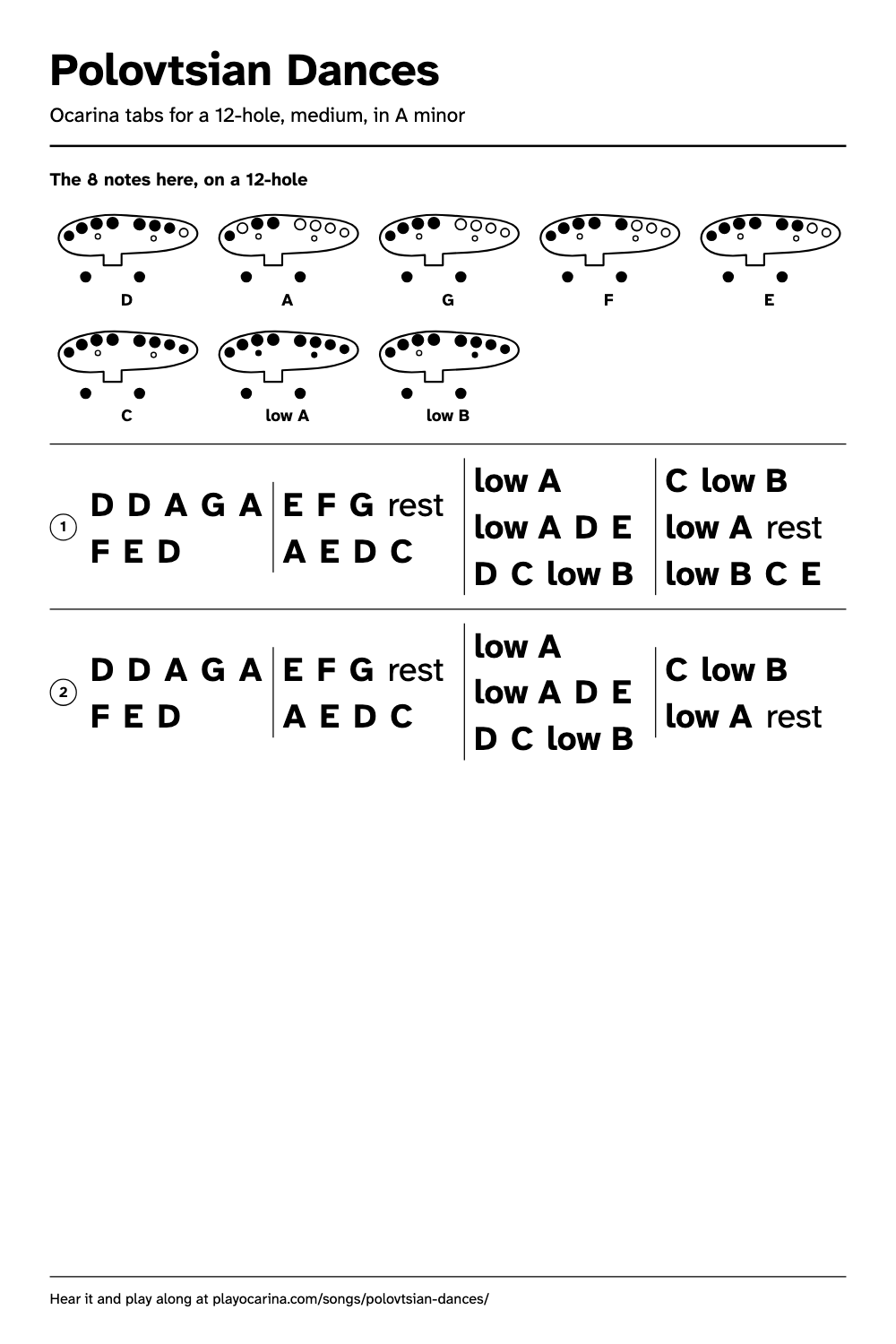
On a 12-hole. Read left to right, a line at a time.
- Tricky spot:DDAGAFEDEFGrestAEDClow Alow ADEDClow BClow Blow Arestlow BCE
- DDAGAFEDEFGrestAEDClow Alow ADEDClow BClow Blow Arest
The Polovtsian Dances theme opens with two short D's and a leap up to a long high A, then falls back in quick notes: G, A, F, E, D. It is the slow, flowing dance of the maidens from Borodin's opera Prince Igor, moved from F sharp minor to A minor so that it needs no sharps or flats, and it runs from low A to high A on a 12-hole ocarina. This is the theme, eight bars: four bars, then the same four again, ending on a long low A instead of a climb. The grace notes of the oboe part are left out.
What is the tricky spot in the Polovtsian Dances theme?
The leap in the first bar, where two short D's jump up a fifth to a long high A: the highest note in the theme. On a 12-hole, the Polovtsian Dances theme goes from D to A: you lift the left ring, right index, right middle and right ring.
Start the high A with a firm, even breath and hold it for a beat and a half before it falls into the quick G, A, F, E, D: those five notes fit into the last beat and a half of the bar, so give each a light touch and keep your fingers close to the holes. The second bar starts with a quick E, F that slides into a long G. The low A and low B in the third and fourth bars are the other hard notes: for the low A, cover every hole including both sub-holes, and for the B above it lift the left sub-hole. Practise A, B, C on their own until the sub-holes feel automatic, since the fourth bar drops to the low A and climbs back through B and C.
Where do you breathe in the Polovtsian Dances theme?
Breathe at the short rest in the second bar, before the high A, and again at the rest in the fourth bar, after the long low A. Both rests are only half a beat, so take a quick, small breath and keep the next phrase soft. The last bar holds the low A for a beat and a half, then is silent for two beats: let the note fade and do not cut it off.
Which ocarina can play the Polovtsian Dances theme?
A 6-hole or 4-hole ocarina cannot reach low A and low B, so play the Polovtsian Dances theme in this key on a 12-hole ocarina in C. On an ocarina in G or F, use the same fingerings: the tune sounds in a different key, which is fine when you play alone. The linked chart has every fingering, and you can check your notes with a tuner such as our free ocarina tuner.
The 8 notes here, on a 12-holeHoles in words, with a picture
| Note | Holes to cover | Picture |
|---|---|---|
| D | Cover every main hole but the right pinky | |
| A | Cover the left pinky, left middle, left index, left thumb and right thumb | |
| G | Cover every main hole but the right index, right middle, right ring and right pinky | |
| F | Cover every main hole but the right middle, right ring and right pinky | |
| E | Cover every main hole but the right ring and right pinky | |
| C | Cover every main hole | |
| low A | Cover every main hole, plus the left sub-hole and right sub-hole | |
| low B | Cover every main hole, plus the right sub-hole |
Drawn as you see it while playing: mouthpiece towards you, left hand on the left.
Which part of Prince Igor is the Polovtsian Dances tune from?
It is the Gliding Dance of the Maidens, in the Polovtsian Dances of Borodin's opera Prince Igor, number 17 in the vocal score. Borodin died in 1887 with the opera unfinished, and Rimsky-Korsakov and Glazunov prepared the performing version of 1890; they died in 1908 and 1936. Wikipedia lists the dance as Andantino, 4/4, in F sharp minor. Our tabs follow the vocal score printed by M. P. Belaieff in Leipzig, with 1889 on its cover, where the chorus sings the tune and the piano part gives it to the oboe. Its heading is "Danse de jeunes filles aux mouvements ondulants", a dance of young girls with wave-like movements. IMSLP's copy of the same page has the same notes. We took the chorus line with its two short rests, moved it from F sharp minor to A minor and left out the oboe's grace notes. We show the melody only. Music: Alexander Borodin (1833-1887), the Gliding Dance of the Maidens from the Polovtsian Dances in his opera Prince Igor, finished after his death by Rimsky-Korsakov and Glazunov.