Radetzky March on the ocarina
On a 12-hole it starts A, G♯, A, A. Medium, 81 notes, in F major.
Goes up to high E, so it does not fit a 4-hole.
Radetzky March
Bar 1 of 16
What are the notes for the Radetzky March?
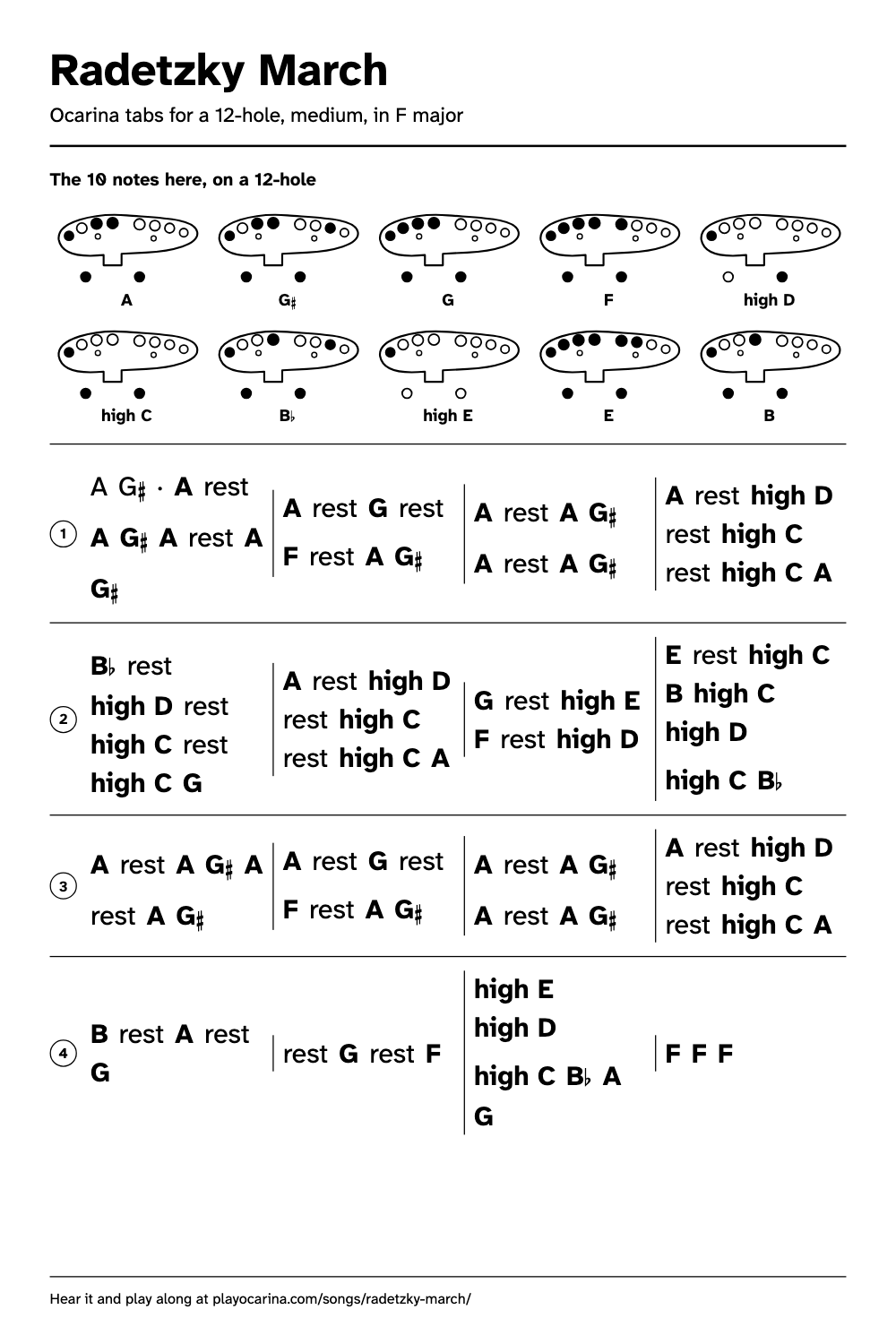
On a 12-hole. Read left to right, a line at a time.
- AG♯ ArestAG♯ArestAG♯ArestGrestFrestAG♯ArestAG♯ArestAG♯Aresthigh Dresthigh Cresthigh CA
- B♭resthigh Dresthigh Cresthigh CGAresthigh Dresthigh Cresthigh CATricky spot:Gresthigh EFresthigh DEresthigh CBhigh Chigh Dhigh CB♭
- ArestAG♯ArestAG♯ArestGrestFrestAG♯ArestAG♯ArestAG♯Aresthigh Dresthigh Cresthigh CA
- BrestArestGrestGrestFhigh Ehigh Dhigh CB♭AGFFF
The Radetzky March tune starts with a quick A and G♯, then bounces on short A's, most of them followed by a little rest, before it climbs to high D and back. Here is the march's first strain, simplified to one line: a pickup and 16 bars of 4/4 in F major, from E up to high E. It fits a 12-hole or 6-hole ocarina.
What is the hardest part of the Radetzky March?
The seventh bar, four leaps in a row: G up to high E, down almost an octave to F, up to high D, then down to E at the start of the next bar. On a 12-hole, the Radetzky March goes from high E to F: you cover the left ring, left middle, left index, right index, left thumb and right thumb. On a 6-hole, you cover the left middle, left index, left thumb and right thumb.
Practise that bar on its own, slowly: G, high E, F, high D, E. Blow a little faster for each high note and relax the air for each low one, and do not lift the fingers one at a time on the way, or the notes in between will sound. Everywhere else the tune is short notes with rests between them, which the printing marks staccato: start each one with a light "tu" and stop it by stopping the air, not by moving a finger. The G♯ always sits between two A's, so once the A to G♯ change is smooth, most of the tune is under your fingers. The printing marks the piece only Marcia, a march; our player starts at 100 beats a minute.
Where do you breathe in the Radetzky March?
The tune is full of short rests, so take small breaths in them rather than one big one: after the low E at the start of bar 8, halfway through, and in the one-beat rest at the start of bar 14, after the long G.
Which ocarina can play the Radetzky March?
A 4-hole ocarina cannot reach high D and high E, so play the Radetzky March in this key on a 12-hole or 6-hole ocarina in C. On an ocarina in G or F, use the same fingerings: the tune sounds in a different key, which is fine when you play alone. Each linked chart has every fingering for its ocarina, and you can check your notes with a tuner such as our free ocarina tuner.
The 10 notes here, on a 12-holeHoles in words, with a picture
| Note | Holes to cover | Picture |
|---|---|---|
| A | Cover the left pinky, left middle, left index, left thumb and right thumb | |
| G♯ | Cover every main hole but the left ring, right index, right middle and right pinky | |
| G | Cover every main hole but the right index, right middle, right ring and right pinky | |
| F | Cover every main hole but the right middle, right ring and right pinky | |
| high D | Cover the left pinky and right thumb | |
| high C | Cover the left pinky, left thumb and right thumb | |
| B♭ | Cover the left pinky, left index, right ring, left thumb and right thumb | |
| high E | Cover the left pinky | |
| E | Cover every main hole but the right ring and right pinky | |
| B | Cover the left pinky, left index, left thumb and right thumb |
Drawn as you see it while playing: mouthpiece towards you, left hand on the left.
| Note | Holes to cover | Picture |
|---|---|---|
| A | Cover the left index, left thumb and right thumb | |
| G♯ | Cover every hole but the left middle and right index | |
| G | Cover every hole but the left middle and right middle | |
| F | Cover every hole but the right middle and right index | |
| high D | Cover the left thumb | |
| high C | Cover the left thumb and right thumb | |
| B♭ | Cover the right index, left thumb and right thumb | |
| high E | All holes open | |
| E | Cover every hole but the right index | |
| B | Cover the right middle, left thumb and right thumb |
Drawn as you see it while playing: mouthpiece towards you, left hand on the left.
Where does the Radetzky March tune come from?
Johann Strauss I wrote the march for its first performance in Vienna on 31 August 1848, to celebrate Field Marshal Radetzky's victory at Custoza; he had already used the tune in his Jubel-Quadrille. Since 1946 the Vienna Philharmonic has played it as an encore at its New Year's Concert, and audiences often clap along. Our tabs follow the right hand of Strauss's own piano version in the first edition from the Vienna publisher Haslinger, whose title page dedicates the march to the imperial army. They take its first strain, the 16 bars after the loud four-bar opening, moved up from D major to F major; for the two bars where the right hand plays in octaves we keep the lower note, and we leave out the quick grace notes. The note just under each repeated A, printed as E sharp in D major, becomes G♯ in our key. Strauss died in 1849. We show the melody only. Music: Johann Strauss I (1804-1849), the first strain of his Radetzky March, Op. 228, 1848.