Beethoven Symphony No. 7 Allegretto on the ocarina
On a 12-hole it starts D, D, D, D. Medium, 38 notes, in G minor.
Beethoven Symphony No. 7 Allegretto
Bar 1 of 16
What are the notes for the Beethoven Symphony No. 7 Allegretto?
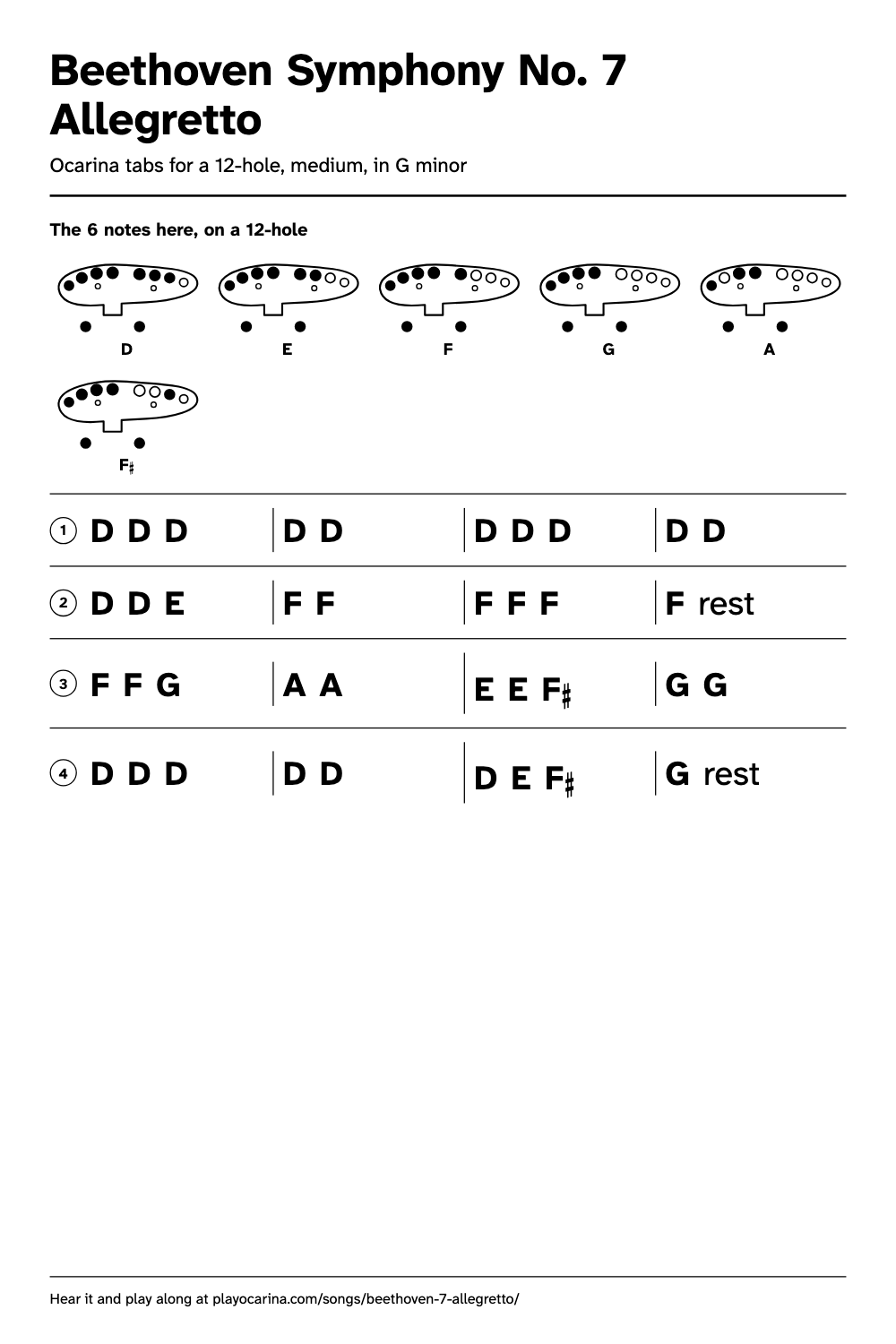
On a 12-hole. Read left to right, a line at a time.
- DDDDDDDDDD
- DDEFFFFFFrest
- FFGAATricky spot:EEF♯GG
- DDDDDDEF♯Grest
The Allegretto from Beethoven's Seventh Symphony opens on one note played again and again, D, D, D, in a long, short, short, long, long rhythm, before the tune climbs slowly through E, F, G and A. Here is its main theme, simplified to the single line the second violins play, 16 bars of 2/4 in G minor, from D up to A. It fits a 4-hole, 6-hole or 12-hole ocarina.
What is the tricky part of the Beethoven Symphony No. 7 Allegretto?
Telling F from F♯. The first half of the tune sits on plain F for four bars, then the second half climbs E, F♯, G twice, so your fingers have to switch between the two. On a 12-hole, the Beethoven Symphony No. 7 Allegretto goes from E to F♯: you lift the right index and right middle and cover the right ring. On a 6-hole or 4-hole, you swap hands: lift the left middle and cover the right index.
Play the climb E, F♯, G slowly until the F♯ is in tune, then the end of the tune, D, E, F♯, G, which uses the same fingers. The other half of the work is rhythm: almost every bar is either a long note and two quick ones or two long notes, and the opening bars repeat one pitch, so keep the tongue light and even and let the fingers rest. The score marks it Allegretto at 76 beats a minute, a walking pace, and our player starts at that speed.
Where do you breathe in the Beethoven Symphony No. 7 Allegretto?
Each half ends on a bar with a one-beat rest, after the F in bar 8 and the G in bar 16: breathe there. In the opening four bars of D, a quick breath after bar 4 also works, since the tune starts the same rhythm again.
Which ocarina can play the Beethoven Symphony No. 7 Allegretto?
Any 12-hole, 6-hole or 4-hole ocarina in C plays the Beethoven Symphony No. 7 Allegretto in this key. On an ocarina in G or F, use the same fingerings: the tune sounds in a different key, which is fine when you play alone. Each linked chart has every fingering for its ocarina, and you can check your notes with a tuner such as our free ocarina tuner.
The 6 notes here, on a 12-holeHoles in words, with a picture
| Note | Holes to cover | Picture |
|---|---|---|
| D | Cover every main hole but the right pinky | |
| E | Cover every main hole but the right ring and right pinky | |
| F | Cover every main hole but the right middle, right ring and right pinky | |
| G | Cover every main hole but the right index, right middle, right ring and right pinky | |
| A | Cover the left pinky, left middle, left index, left thumb and right thumb | |
| F♯ | Cover every main hole but the right index, right middle and right pinky |
Drawn as you see it while playing: mouthpiece towards you, left hand on the left.
| Note | Holes to cover | Picture |
|---|---|---|
| D | Cover every hole but the right middle | |
| E | Cover every hole but the right index | |
| F | Cover every hole but the right middle and right index | |
| G | Cover every hole but the left middle and right middle | |
| A | Cover the left index, left thumb and right thumb | |
| F♯ | Cover every hole but the left middle |
Drawn as you see it while playing: mouthpiece towards you, left hand on the left.
| Note | Holes to cover | Picture |
|---|---|---|
| D | Cover every hole but the right middle | |
| E | Cover every hole but the right index | |
| F | Cover the left middle and left index | |
| G | Cover the left index and right index | |
| A | Cover the left index | |
| F♯ | Cover every hole but the left middle |
Drawn as you see it while playing: mouthpiece towards you, left hand on the left.
Why does the Allegretto theme repeat the same note?
Because the tune is mostly a rhythm. Beethoven opens the movement with the violas and cellos playing it, and in the score the cellos and basses change the chord underneath while the top note stays put; at the premiere in Vienna on 8 December 1813, the audience made the orchestra play this movement again on the spot. Then the second violins take the theme over while the violas and cellos play a second, singing melody against it. Our tabs follow the second violins in bars 27 to 42 of the full score in Breitkopf & Härtel's complete edition of Beethoven's works, printed in Leipzig in 1863: their two eight-bar phrases are the whole theme, played as one line. The score has it in A minor; our tabs move every note up a seventh, to G minor, which needs one sharp, F♯, and leave out the second melody and the chords. Beethoven died in 1827. Music: Ludwig van Beethoven (1770-1827), the main theme of the Allegretto, the second movement of his Symphony No. 7, 1812.