Skye Boat Song on the ocarina
On a 12-hole it starts D, E, D, G. Easy, 31 notes, in G major.
Goes up to high D, so it does not fit a 4-hole.
Skye Boat Song
Bar 1 of 8
What are the notes for the Skye Boat Song?
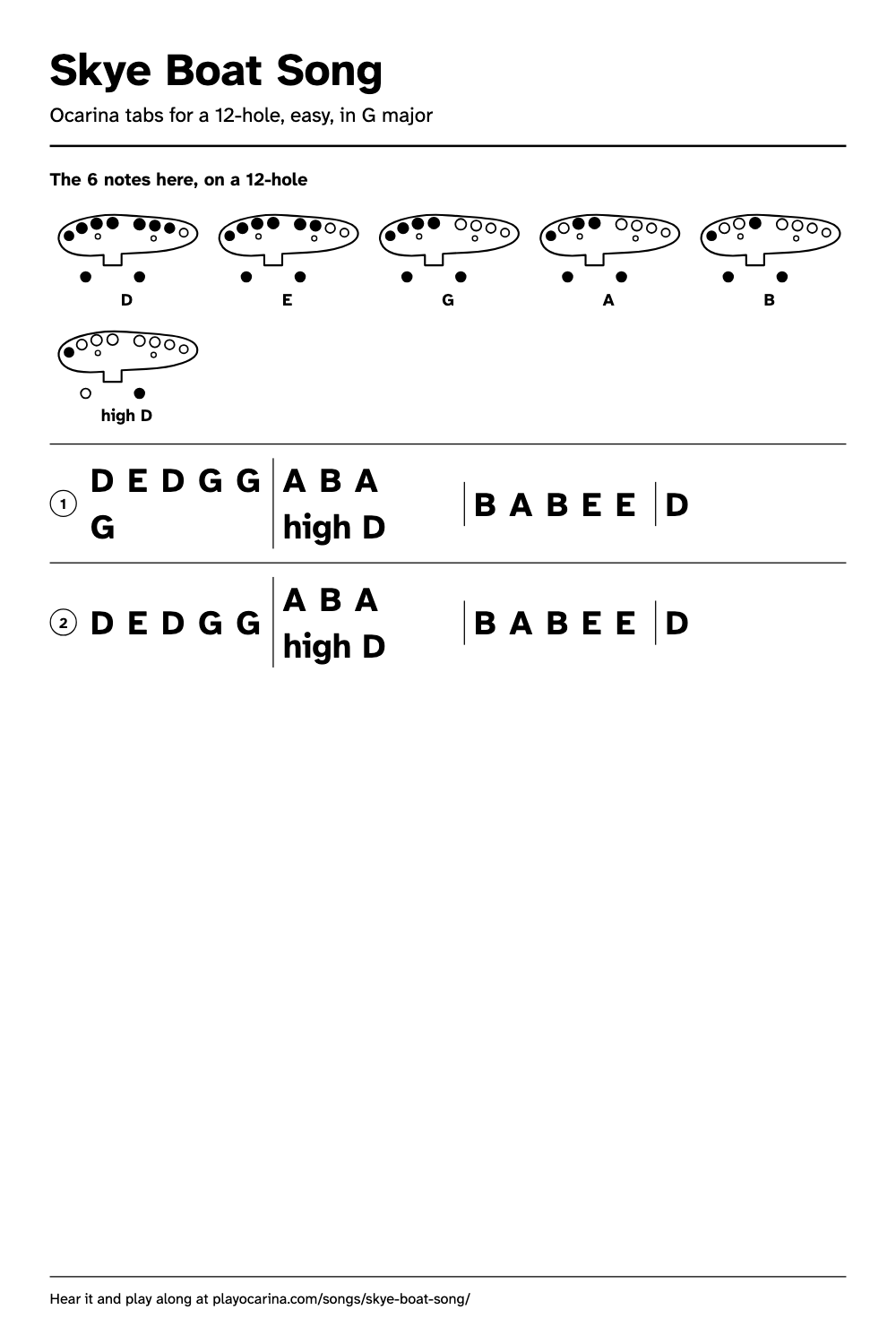
On a 12-hole. Read left to right, a line at a time.
- DEDGGGABAhigh DTricky spot:BABEED
- DEDGGABAhigh DBABEED
The Skye Boat Song starts with a rocking D, E, D, steps up to G and A, and reaches a long high D in its second bar. This is the chorus, in G major from D up to high D, and it never needs the F sharp of that key, so there are no sharps or flats to finger. Its two lines are almost the same: learn the first and you nearly have the second.
What is the tricky spot in the Skye Boat Song?
The fall from B down to E in the third bar of each line, the widest jump in the chorus. On a 12-hole, the Skye Boat Song goes from B to E: you cover the left ring, left middle, right index and right middle. On a 6-hole, you cover the left middle and left index.
The bar opens with a quick B, A, B and then drops a fifth to a long E. Lift the fingers for E together, so no note sounds on the way down, and ease the breath as you land: E needs much less air than the B just before it. The other note to watch is the high D held for a beat and a half in the second bar of each line; give it a firm, steady stream so it does not go flat as it lasts. The whole tune swings in long-short pairs, a dotted note then a quick one, like the rocking of a boat: tongue the short note lightly, and in the first bar keep the two very quick G's even.
Where do you breathe in the Skye Boat Song?
Each line ends on a D held for a whole bar. Let that D go a little early and breathe there; the second line then needs no breath until its own last D.
Which ocarina can play the Skye Boat Song?
A 4-hole ocarina cannot reach high D, so play the Skye Boat Song in this key on a 12-hole or 6-hole ocarina in C. On an ocarina in G or F, use the same fingerings: the tune sounds in a different key, which is fine when you play alone. Each linked chart has every fingering for its ocarina, and you can check your notes with a tuner such as our free ocarina tuner.
The 6 notes here, on a 12-holeHoles in words, with a picture
| Note | Holes to cover | Picture |
|---|---|---|
| D | Cover every main hole but the right pinky | |
| E | Cover every main hole but the right ring and right pinky | |
| G | Cover every main hole but the right index, right middle, right ring and right pinky | |
| A | Cover the left pinky, left middle, left index, left thumb and right thumb | |
| B | Cover the left pinky, left index, left thumb and right thumb | |
| high D | Cover the left pinky and right thumb |
Drawn as you see it while playing: mouthpiece towards you, left hand on the left.
| Note | Holes to cover | Picture |
|---|---|---|
| D | Cover every hole but the right middle | |
| E | Cover every hole but the right index | |
| G | Cover every hole but the left middle and right middle | |
| A | Cover the left index, left thumb and right thumb | |
| B | Cover the right middle, left thumb and right thumb | |
| high D | Cover the left thumb |
Drawn as you see it while playing: mouthpiece towards you, left hand on the left.
Where does the tune of the Skye Boat Song come from?
From a Highland rowing song. Anne Campbell MacLeod heard the air in the 1870s, and Harold Boulton wrote the English words. The air is adapted from a Gaelic song William Ross made around 1782, and the song was first published in 1884, in Songs of the North. That book heads it "Four bars taken down from Hebridean boatmen, four bars added by A. C. MacLeod". Our tabs follow Laura Alexandrine Smith's The Music of the Waters, London, 1888, which quotes the song from Songs of the North by permission and prints the tune on a staff of its own, with no piano part. We play it an octave higher than Smith prints it, in the same key, so it lies from D to high D. We give the chorus only: in Smith's verse three bars differ from the verse in Songs of the North and from the one sung today, so it is left out. In the song, the chorus comes back after each verse. MacLeod died in 1921 and Boulton in 1935. We show the melody only. Music: Highland rowing air noted down by Anne Campbell MacLeod (1855-1921); words by Sir Harold Boulton (1859-1935).