The Water Is Wide on the ocarina
On a 12-hole it starts C, F, F, G. Medium, 39 notes, in F major.
The Water Is Wide
Bar 1 of 8
What are the notes for The Water Is Wide?
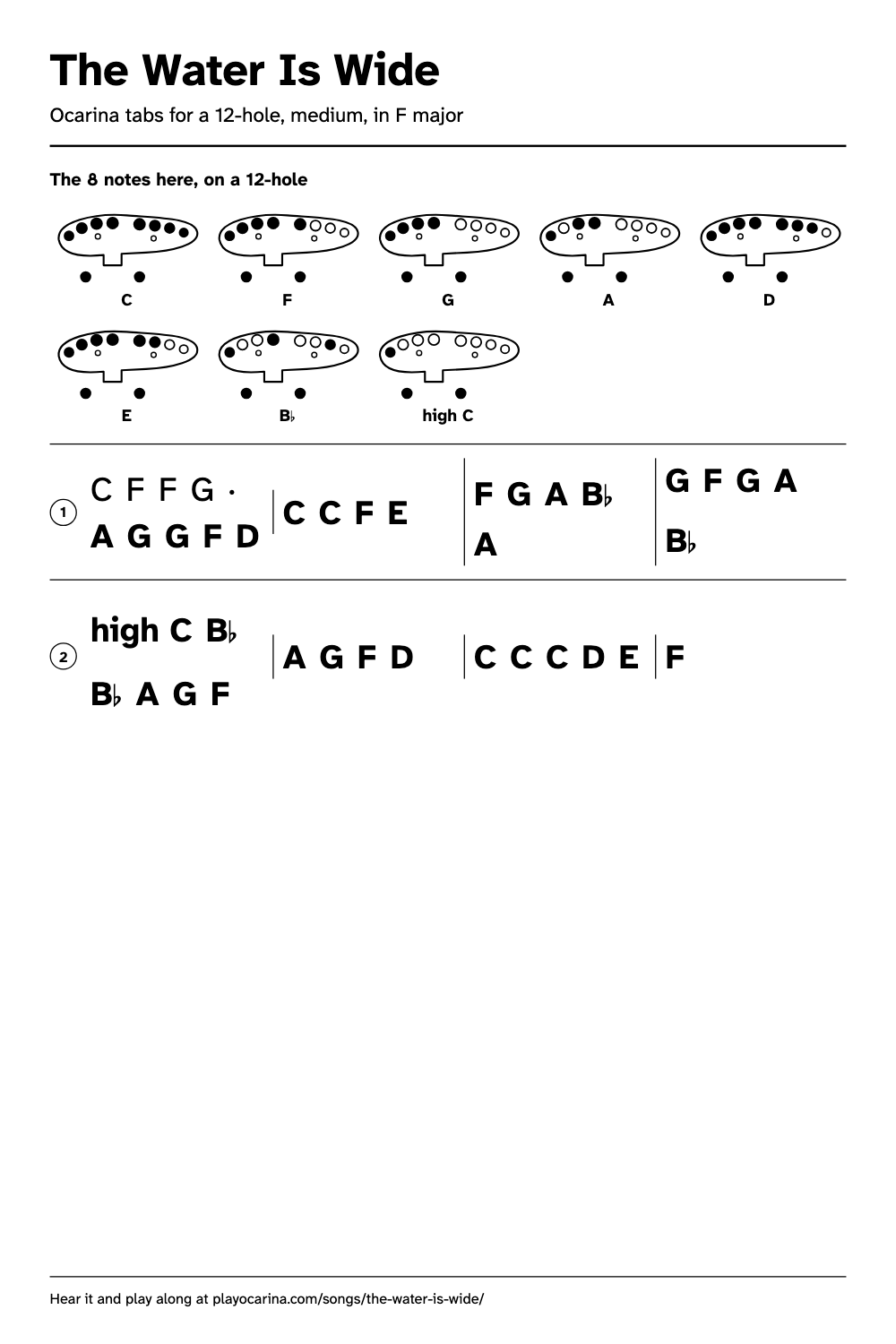
On a 12-hole. Read left to right, a line at a time.
- CFFG AGGFDCCFEFGAB♭ATricky spot:GFGAB♭
- high CB♭B♭AGFAGFDCCCDEF
The Water Is Wide opens with C, F, F, G rising to a long A, then steps back down to a long C. Here is one verse in F major, from C up to high C, with one flat: B flat, which comes four times near the top of the tune. The 1906 book writes it in 3/2, six quarter-note beats to a bar, and each of its four lines ends on a note held for three of them.
What is the tricky spot in The Water Is Wide?
The climb from B flat to high C, the highest note in the song, where the second half begins; it then steps straight back down to two B flats. On a 12-hole, The Water Is Wide goes from B♭ to high C: you lift the left index and right ring. On a 6-hole or 4-hole, you lift the right index.
B flat is the only note that needs a cross-fingering, so practise the little run A, B flat, high C, B flat, B flat slowly until the fingers change together. Give high C a touch more air than the notes around it and hold it for its full two beats. Most pairs of quick notes are slurred on the 1906 page, two notes to one syllable: tongue the first and let the second follow on the same breath, the way a singer would phrase it.
Where do you breathe in The Water Is Wide?
Breathe after the long notes that close the first three lines: the long C, the long G and the long A. Hold each one for its full three beats first, then take the breath just before the next line starts.
Which ocarina can play The Water Is Wide?
Any 12-hole, 6-hole or 4-hole ocarina in C plays The Water Is Wide in this key. On an ocarina in G or F, use the same fingerings: the tune sounds in a different key, which is fine when you play alone. Each linked chart has every fingering for its ocarina, and you can check your notes with a tuner such as our free ocarina tuner.
The 8 notes here, on a 12-holeHoles in words, with a picture
| Note | Holes to cover | Picture |
|---|---|---|
| C | Cover every main hole | |
| F | Cover every main hole but the right middle, right ring and right pinky | |
| G | Cover every main hole but the right index, right middle, right ring and right pinky | |
| A | Cover the left pinky, left middle, left index, left thumb and right thumb | |
| D | Cover every main hole but the right pinky | |
| E | Cover every main hole but the right ring and right pinky | |
| B♭ | Cover the left pinky, left index, right ring, left thumb and right thumb | |
| high C | Cover the left pinky, left thumb and right thumb |
Drawn as you see it while playing: mouthpiece towards you, left hand on the left.
| Note | Holes to cover | Picture |
|---|---|---|
| C | Cover every hole | |
| F | Cover every hole but the right middle and right index | |
| G | Cover every hole but the left middle and right middle | |
| A | Cover the left index, left thumb and right thumb | |
| D | Cover every hole but the right middle | |
| E | Cover every hole but the right index | |
| B♭ | Cover the right index, left thumb and right thumb | |
| high C | Cover the left thumb and right thumb |
Drawn as you see it while playing: mouthpiece towards you, left hand on the left.
| Note | Holes to cover | Picture |
|---|---|---|
| C | Cover every hole | |
| F | Cover the left middle and left index | |
| G | Cover the left index and right index | |
| A | Cover the left index | |
| D | Cover every hole but the right middle | |
| E | Cover every hole but the right index | |
| B♭ | Cover the right index | |
| high C | All holes open |
Drawn as you see it while playing: mouthpiece towards you, left hand on the left.
Where does the tune of The Water Is Wide come from?
It is an English folk song, and Cecil Sharp published it in Folk Songs from Somerset in 1906; the tune on that page is the one people sing today. His notes in that book say the words and air came from Mrs. Cox of High Ham, and that he had noted the song in Somerset five times, "tunes and words varying considerably"; the editors called it "O Waly, Waly" because the words were so close to the Scottish ballad of that name. Our tabs follow the voice line on the 1906 page, without the piano part: the first verse once, moved from G major up to F so that it sits between C and high C. The page writes out a second verse with small changes and then repeats; we leave those out. Sharp died in 1924. We show the melody only. Music: traditional English folk song (O Waly, Waly), words and air from Mrs Cox of High Ham, Somerset, noted by Cecil Sharp (1859-1924).