Tchaikovsky Piano Concerto No. 1 on the ocarina
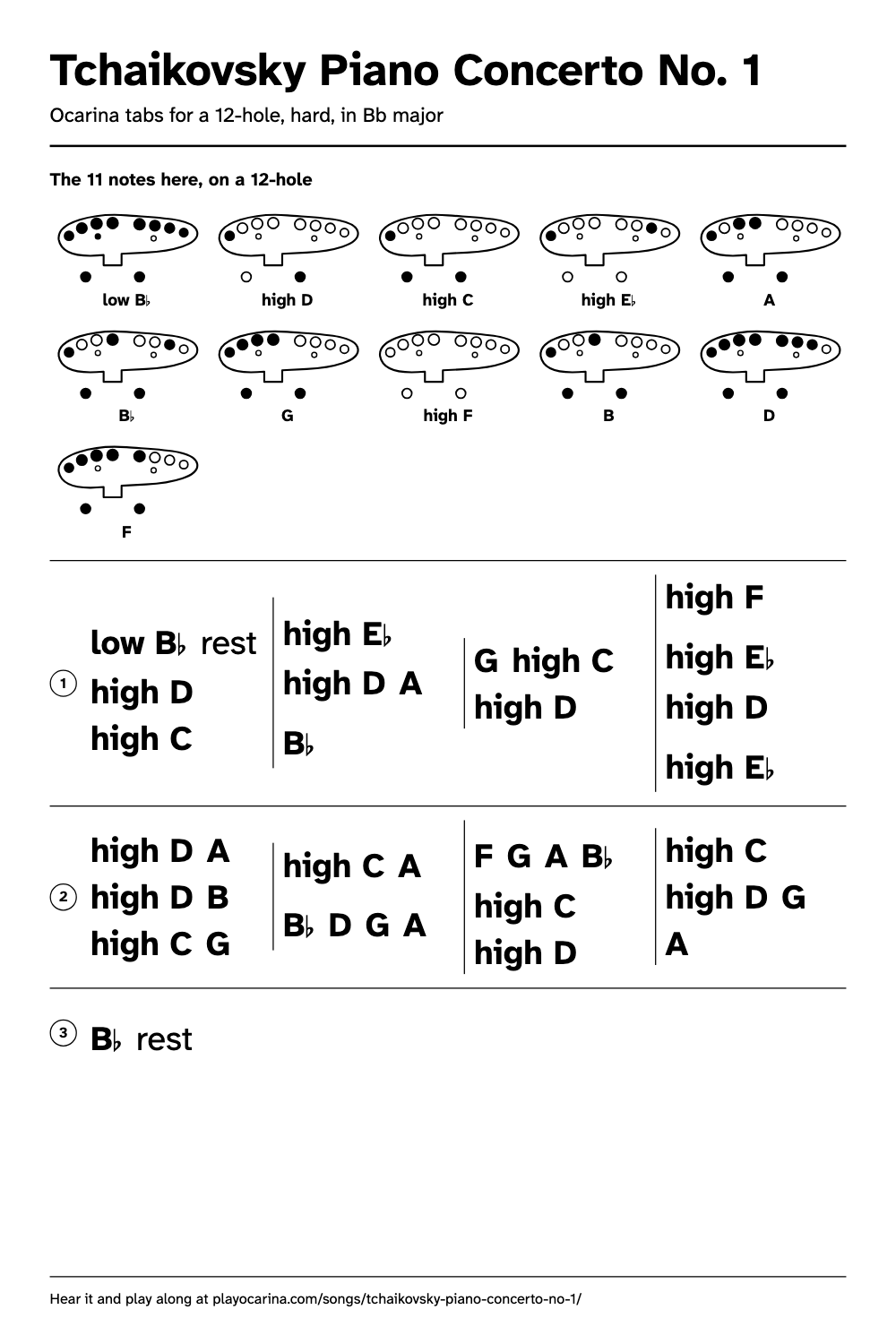
On a 12-hole it starts low B♭, high D, high C, high E♭. Hard, 37 notes, in Bb major.
Goes up to high F, so it does not fit a 6-hole or 4-hole.
Tchaikovsky Piano Concerto No. 1
Bar 1 of 9
What are the notes for Tchaikovsky's Piano Concerto No. 1?
On a 12-hole. Read left to right, a line at a time.
- Tricky spot:low B♭resthigh Dhigh Chigh E♭high DAB♭Ghigh Chigh Dhigh Fhigh E♭high Dhigh E♭
- high DAhigh DBhigh CGhigh CAB♭DGAFGAB♭high Chigh Dhigh Chigh DGA
- B♭rest
This is the main theme of Tchaikovsky's Piano Concerto No. 1: the broad string tune that opens the first movement, played over the piano's loud chords. Here it is in B-flat major, in the printed rhythm: bars 16 to 24 of the movement, the second half of the violins' first statement, which begins exactly as the first half does and runs on to the close. It spans B♭ to high F, the top note of a 12-hole ocarina.
What is the hardest part of the Tchaikovsky Piano Concerto theme?
The very first move: a short low B♭, a breath of silence, then a leap of a tenth up to a long high D. On a 12-hole, Tchaikovsky's Piano Concerto No. 1 goes from low B♭ to high D: you lift the left ring, left middle, left index, right index, right middle, right ring, right pinky, left thumb and left sub-hole.
The score gives the low B♭ only an eighth and then an eighth rest, so the jump has a moment to prepare: use it to set your fingers for high D and blow a little faster. The second half of the excerpt is a stream of even eighths that turns on a B♮ in the fifth bar, the one note outside the key; finger it slowly a few times on its own before you play the run at speed. Each long note in the first four bars carries the weight, so lean into it and let the short note after it fall away.
Which ocarina can play Tchaikovsky's Piano Concerto No. 1?
A 6-hole ocarina cannot reach low B♭ and high F, and a 4-hole ocarina cannot reach low B♭, high D, high E♭ and high F, so play Tchaikovsky's Piano Concerto No. 1 in this key on a 12-hole ocarina in C. On an ocarina in G or F, use the same fingerings: the tune sounds in a different key, which is fine when you play alone. The linked chart has every fingering, and you can check your notes with a tuner such as our free ocarina tuner.
The 11 notes here, on a 12-holeHoles in words, with a picture
| Note | Holes to cover | Picture |
|---|---|---|
| low B♭ | Cover every main hole, plus the left sub-hole | |
| high D | Cover the left pinky and right thumb | |
| high C | Cover the left pinky, left thumb and right thumb | |
| high E♭ | Cover the left pinky and right ring | |
| A | Cover the left pinky, left middle, left index, left thumb and right thumb | |
| B♭ | Cover the left pinky, left index, right ring, left thumb and right thumb | |
| G | Cover every main hole but the right index, right middle, right ring and right pinky | |
| high F | All holes open | |
| B | Cover the left pinky, left index, left thumb and right thumb | |
| D | Cover every main hole but the right pinky | |
| F | Cover every main hole but the right middle, right ring and right pinky |
Drawn as you see it while playing: mouthpiece towards you, left hand on the left.
Why does the famous theme never come back in the concerto?
Tchaikovsky wrote it only for the introduction. The big D-flat major tune belongs to the opening section and never returns later in the concerto, which long made the introduction a puzzle for analysts; the rest of the movement is built on other themes. Our tabs follow the first violins in Jurgenson's full score, moved from D-flat major up to B-flat major so it fits a 12-hole ocarina. Jurgenson first issued that score, plate 2590, in 1879, after Tchaikovsky's first revision of the concerto. Tchaikovsky died in 1893. We show the melody only. Music: Pyotr Ilyich Tchaikovsky (1840-1893), the main theme of the first movement of his Piano Concerto No. 1, 1875.