The British Grenadiers on the ocarina
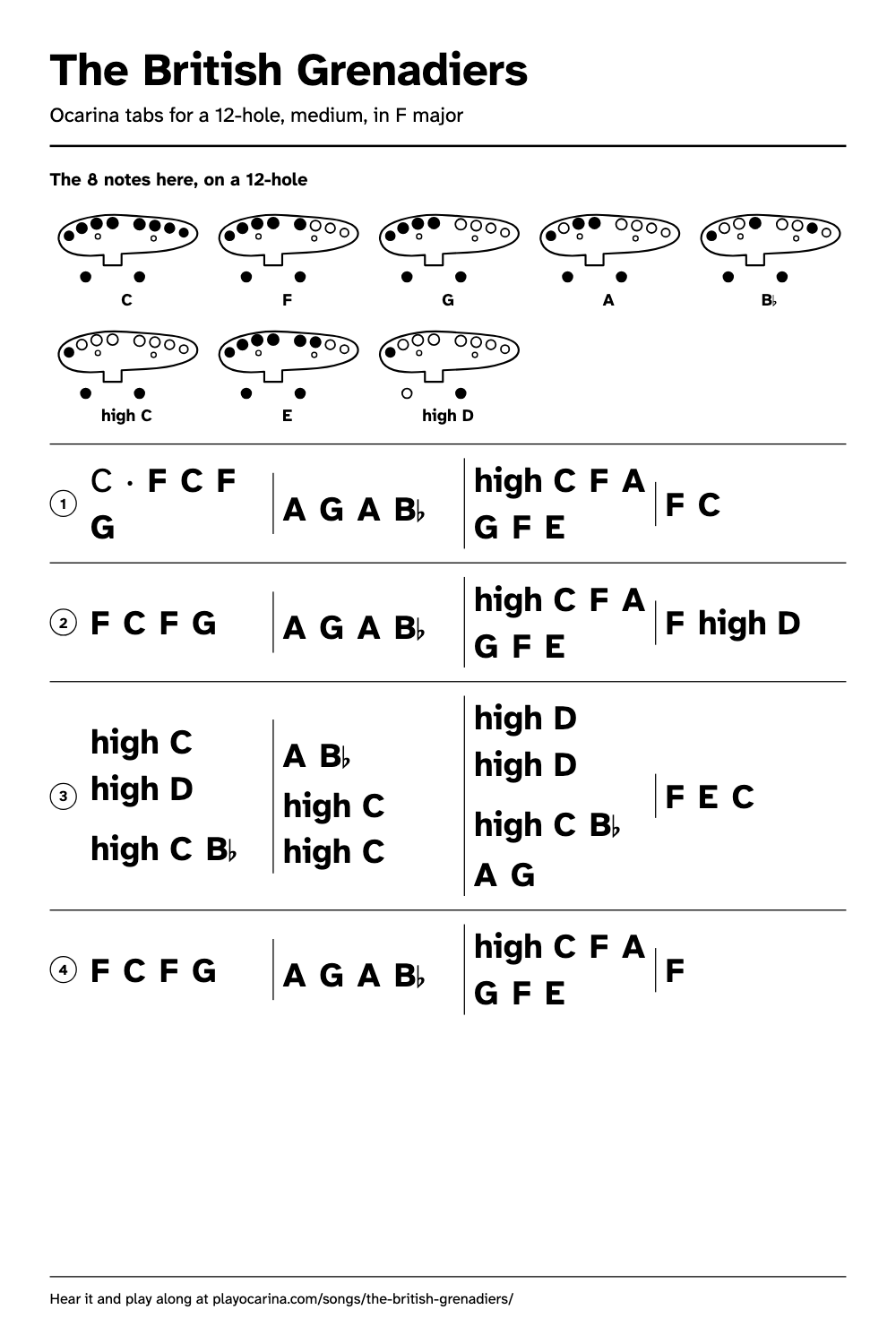
On a 12-hole it starts C, F, C, F. Medium, 65 notes, in F major.
Goes up to high D, so it does not fit a 4-hole.
The British Grenadiers
Bar 1 of 16
What are the notes for The British Grenadiers?
On a 12-hole. Read left to right, a line at a time.
- C FCFGAGAB♭high CFAGFEFC
- FCFGAGAB♭high CFAGFETricky spot:Fhigh D
- high Chigh Dhigh CB♭AB♭high Chigh Chigh Dhigh Dhigh CB♭AGFEC
- FCFGAGAB♭high CFAGFEF
The British Grenadiers is a brisk march in four. It starts on C, then goes F, C, F, G and up to a long A, and both halves end on a long F. Here it is in F major, from C up to high D, with one flat, B flat. The second half climbs to sit around high C and high D, and its last four bars bring back the opening phrase note for note.
What is the tricky spot in The British Grenadiers?
The jump from the long F that closes the first half up to high D, the single note that opens the second half. On a 12-hole, The British Grenadiers goes from F to high D: you lift the left ring, left middle, left index, right index and left thumb. On a 6-hole, you lift the left middle, left index and right thumb.
Use the last beat of the long F to get ready, then give high D a firmer, faster breath (more on high notes) and keep it up, because the next two bars circle around high C and high D without a break. The other thing to drill is the quick pair A, B flat that leads up to high C four times in the song: B flat is a cross-fingered note, so play A, B flat, C slowly until the change is smooth, then bring it up to speed. The runs of four quick notes, A, G, F, E and later high C, B flat, A, G, should be tongued evenly with a light "du" so each note is heard.
Where do you breathe in The British Grenadiers?
On the long F at the end of each half, and on the shorter F before the last four bars. Let each F go a beat early and breathe in that gap rather than in the middle of a run. The second half has no long note until that F, so fill up well before the jump to high D.
Which ocarina can play The British Grenadiers?
A 4-hole ocarina cannot reach high D, so play The British Grenadiers in this key on a 12-hole or 6-hole ocarina in C. On an ocarina in G or F, use the same fingerings: the tune sounds in a different key, which is fine when you play alone. Each linked chart has every fingering for its ocarina, and you can check your notes with a tuner such as our free ocarina tuner.
The 8 notes here, on a 12-holeHoles in words, with a picture
| Note | Holes to cover | Picture |
|---|---|---|
| C | Cover every main hole | |
| F | Cover every main hole but the right middle, right ring and right pinky | |
| G | Cover every main hole but the right index, right middle, right ring and right pinky | |
| A | Cover the left pinky, left middle, left index, left thumb and right thumb | |
| B♭ | Cover the left pinky, left index, right ring, left thumb and right thumb | |
| high C | Cover the left pinky, left thumb and right thumb | |
| E | Cover every main hole but the right ring and right pinky | |
| high D | Cover the left pinky and right thumb |
Drawn as you see it while playing: mouthpiece towards you, left hand on the left.
| Note | Holes to cover | Picture |
|---|---|---|
| C | Cover every hole | |
| F | Cover every hole but the right middle and right index | |
| G | Cover every hole but the left middle and right middle | |
| A | Cover the left index, left thumb and right thumb | |
| B♭ | Cover the right index, left thumb and right thumb | |
| high C | Cover the left thumb and right thumb | |
| E | Cover every hole but the right index | |
| high D | Cover the left thumb |
Drawn as you see it while playing: mouthpiece towards you, left hand on the left.
How old is the tune of The British Grenadiers?
Nobody knows exactly. It turns up in a 1728 collection of dance tunes as "The New Bath", and it has been the quick march of the Royal Artillery since 1716. William Chappell printed it in Popular Music of the Olden Time (London, 1855) "as played by the band of the Grenadier Guards", and wrote that next to the national anthems "there is not any tune of a more spirit-stirring character". Our tabs follow his page, moved from G major to F major, a tone lower and an octave higher, so the march sits between C and high D. Chappell opens the second half with one note, high D in our key, under two words of the verse; Heart Songs (Boston, 1909), which heads the tune "16th Century", has two quicker notes there, and we kept Chappell's single note. His page repeats the second half as a chorus, and the tabs play it once. We show the melody only. Music: traditional English march, composer unknown; the tune dates from the 17th century.