The Last Rose of Summer on the ocarina
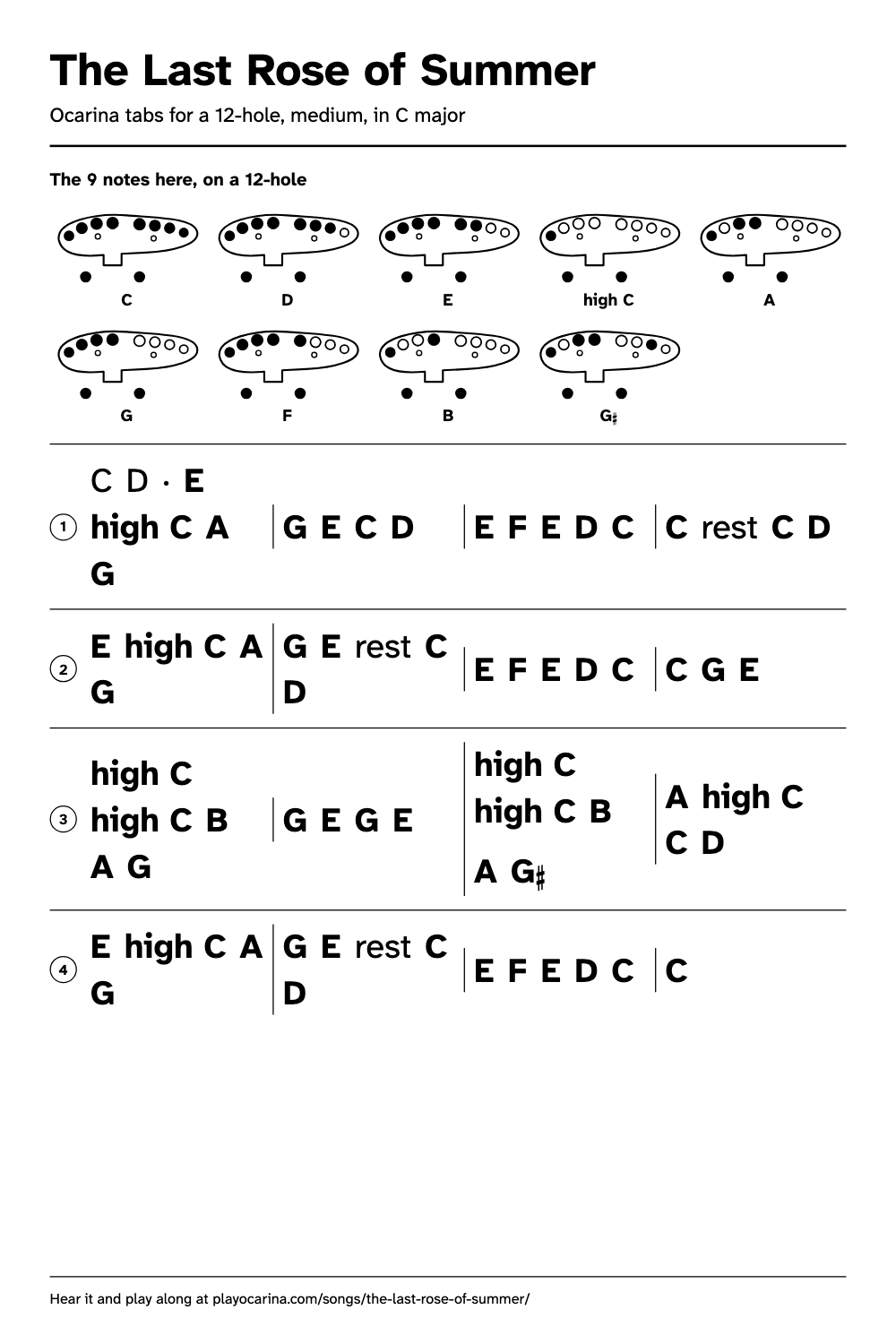
On a 12-hole it starts C, D, E, high C. Medium, 66 notes, in C major.
The Last Rose of Summer
Bar 1 of 16
What are the notes for The Last Rose of Summer?
On a 12-hole. Read left to right, a line at a time.
- Tricky spot:CD Ehigh CAGGECDEFEDCCrestCD
- Ehigh CAGGErestCDEFEDCCGE
- high Chigh CBAGGEGEhigh Chigh CBAG♯Ahigh CCD
- Ehigh CAGGErestCDEFEDCC
The Last Rose of Summer opens with a quick C and D that lead into E, then jumps straight up to high C. Here it is in C major, from C up to high C, with one sharp: a single G sharp near the end of the third phrase, on its way up to A. It is a slow tune in 3/4, and three of its four phrases start with the same long-short pickup, a dotted C followed by a quick D.
What is the tricky spot in The Last Rose of Summer?
The jump from E up to high C on the second beat of the first full bar, a sixth, which the tune makes again at the start of the second and last phrases. On a 12-hole, The Last Rose of Summer goes from E to high C: you lift the left ring, left middle, left index, right index and right middle. On a 6-hole or 4-hole, you lift the left middle, right middle and left index.
Practise E to high C on its own, slowly, until high C sounds clean the moment it starts: lift the fingers together and push the air a little faster as you land. High C then falls to A and G in a long-short pair, so let the breath relax after the top note. The third phrase has the other hard moment: it ends on high C and the tune drops a full octave to low C for the pickup, so take that low C gently or it will crack.
Where do you breathe in The Last Rose of Summer?
The 1813 page gives the singer short rests after the first phrase and halfway through the second and last phrases: breathe in those, and after the long C that closes the second phrase. The third phrase has no rest: cut its last high C a little short and breathe there, just before the dotted C and D bring the opening back.
Which ocarina can play The Last Rose of Summer?
Any 12-hole, 6-hole or 4-hole ocarina in C plays The Last Rose of Summer in this key. On an ocarina in G or F, use the same fingerings: the tune sounds in a different key, which is fine when you play alone. Each linked chart has every fingering for its ocarina, and you can check your notes with a tuner such as our free ocarina tuner.
The 9 notes here, on a 12-holeHoles in words, with a picture
| Note | Holes to cover | Picture |
|---|---|---|
| C | Cover every main hole | |
| D | Cover every main hole but the right pinky | |
| E | Cover every main hole but the right ring and right pinky | |
| high C | Cover the left pinky, left thumb and right thumb | |
| A | Cover the left pinky, left middle, left index, left thumb and right thumb | |
| G | Cover every main hole but the right index, right middle, right ring and right pinky | |
| F | Cover every main hole but the right middle, right ring and right pinky | |
| B | Cover the left pinky, left index, left thumb and right thumb | |
| G♯ | Cover every main hole but the left ring, right index, right middle and right pinky |
Drawn as you see it while playing: mouthpiece towards you, left hand on the left.
| Note | Holes to cover | Picture |
|---|---|---|
| C | Cover every hole | |
| D | Cover every hole but the right middle | |
| E | Cover every hole but the right index | |
| high C | Cover the left thumb and right thumb | |
| A | Cover the left index, left thumb and right thumb | |
| G | Cover every hole but the left middle and right middle | |
| F | Cover every hole but the right middle and right index | |
| B | Cover the right middle, left thumb and right thumb | |
| G♯ | Cover every hole but the left middle and right index |
Drawn as you see it while playing: mouthpiece towards you, left hand on the left.
| Note | Holes to cover | Picture |
|---|---|---|
| C | Cover every hole | |
| D | Cover every hole but the right middle | |
| E | Cover every hole but the right index | |
| high C | All holes open | |
| A | Cover the left index | |
| G | Cover the left index and right index | |
| F | Cover the left middle and left index | |
| B | Cover the right middle | |
| G♯ | Cover the right middle and left index |
Drawn as you see it while playing: mouthpiece towards you, left hand on the left.
Which old Irish air is The Last Rose of Summer sung to?
Thomas Moore wrote the poem in 1805, and it is sung to an old Irish tune, "Aisling an Óigfhear" or "The Young Man's Dream", which Edward Bunting wrote down in 1792 from the playing of the harper Denis Hempson. Words and tune came out together in No. 5 of A Selection of Irish Melodies, published in London by J. Power, where the song's heading calls its air "Groves of Blarney". Moore's note at the front of that number is dated December 1813; the piano part is by Sir John Stevenson, who died in 1833. Our tabs follow the voice line on the 1813 page, moved up from E major to C major so that it sits between C and high C. That page decorates the tune with small grace notes, a turn and a pause; we leave those out, with the piano's opening and closing bars, and play every main note as printed. In 1847 Friedrich von Flotow used the tune in his opera Martha. We show the melody only. Music: traditional Irish air (Aisling an Óigfhear, printed as the Groves of Blarney), words by Thomas Moore (1779-1852).