The Swan on the ocarina
On a 12-hole it starts high C, B, E, A. Medium, 19 notes, in C major.
Goes up to high E, so it does not fit a 4-hole. Goes down to low A, so it does not fit a 6-hole.
The Swan
Bar 1 of 4
What are the notes for the Swan?
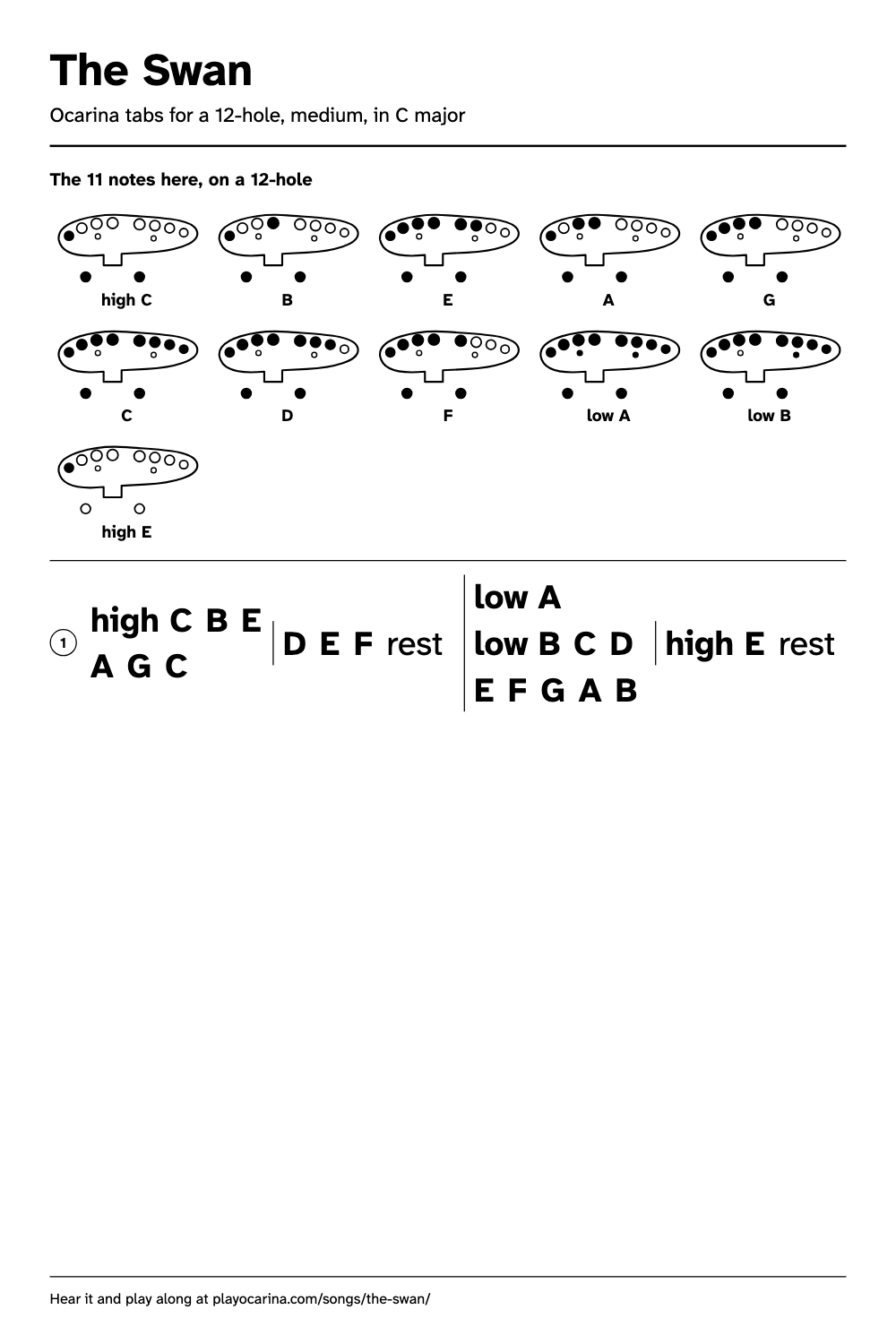
On a 12-hole. Read left to right, a line at a time.
- high CBEAGCDEFrestTricky spot:low Alow BCDEFGABhigh Erest
This is the main theme of The Swan by Saint-Saëns, the cello's opening phrase: high C falling to B, then E, A, G and C, a long D, and a slow scale that climbs from low A to end on a held high E. Here are its first four bars, bars 2 to 5 of the cello part, in the printed rhythm of slow 6/4, moved from G major to C major so the phrase fits a 12-hole ocarina. The longer piece goes past the range of one ocarina.
How do you play the long scale in The Swan?
The top of the scale in the third bar: after eight quick notes from low A up to B, the tune leaps a fourth to the long high E. On a 12-hole, the Swan goes from B to high E: you lift the left index, left thumb and right thumb.
The scale is all white notes, A, B, C, D, E, F, G, A, B, so lift one finger at a time and keep the air steady as you climb; play it slowly first and count two quick notes to each beat. The high E that ends the phrase is held for three and a half beats, so take a full breath at the rest after the F in the second bar, and save some air for the end. Every bar here is six slow beats, so the long notes, the opening high C, the D and the F, need their full count.
Which ocarina can play the Swan?
A 6-hole ocarina cannot reach low A and low B, and a 4-hole ocarina cannot reach low A, low B and high E, so play the Swan in this key on a 12-hole ocarina in C. On an ocarina in G or F, use the same fingerings: the tune sounds in a different key, which is fine when you play alone. The linked chart has every fingering, and you can check your notes with a tuner such as our free ocarina tuner.
The 11 notes here, on a 12-holeHoles in words, with a picture
| Note | Holes to cover | Picture |
|---|---|---|
| high C | Cover the left pinky, left thumb and right thumb | |
| B | Cover the left pinky, left index, left thumb and right thumb | |
| E | Cover every main hole but the right ring and right pinky | |
| A | Cover the left pinky, left middle, left index, left thumb and right thumb | |
| G | Cover every main hole but the right index, right middle, right ring and right pinky | |
| C | Cover every main hole | |
| D | Cover every main hole but the right pinky | |
| F | Cover every main hole but the right middle, right ring and right pinky | |
| low A | Cover every main hole, plus the left sub-hole and right sub-hole | |
| low B | Cover every main hole, plus the right sub-hole | |
| high E | Cover the left pinky |
Drawn as you see it while playing: mouthpiece towards you, left hand on the left.
Why was The Swan the only part of The Carnival of the Animals printed in Saint-Saëns's lifetime?
Saint-Saëns wrote The Carnival of the Animals in 1886 and would not let it be published while he lived; The Swan, a cello melody over rippling piano figures, was the one exception, published in 1887 in his own arrangement for cello and piano. In 1905 Mikhail Fokine made it the dance The Dying Swan, which Anna Pavlova performed some 4,000 times. Our tabs follow the cello part of that edition from Durand & Schoenewerk in Paris, read from the tenor clef. Saint-Saëns died in 1921, and the whole suite was published in 1922. We show the melody only. Music: Camille Saint-Saëns (1835-1921), Le Cygne from The Carnival of the Animals, 1886.