The Trout (Die Forelle) on the ocarina
On a 12-hole it starts F, B♭, B♭, high D. Hard, 148 notes, in Bb major.
Goes up to high E♭, so it does not fit a 4-hole.
The Trout (Die Forelle)
Bar 1 of 43
What are the notes for The Trout?
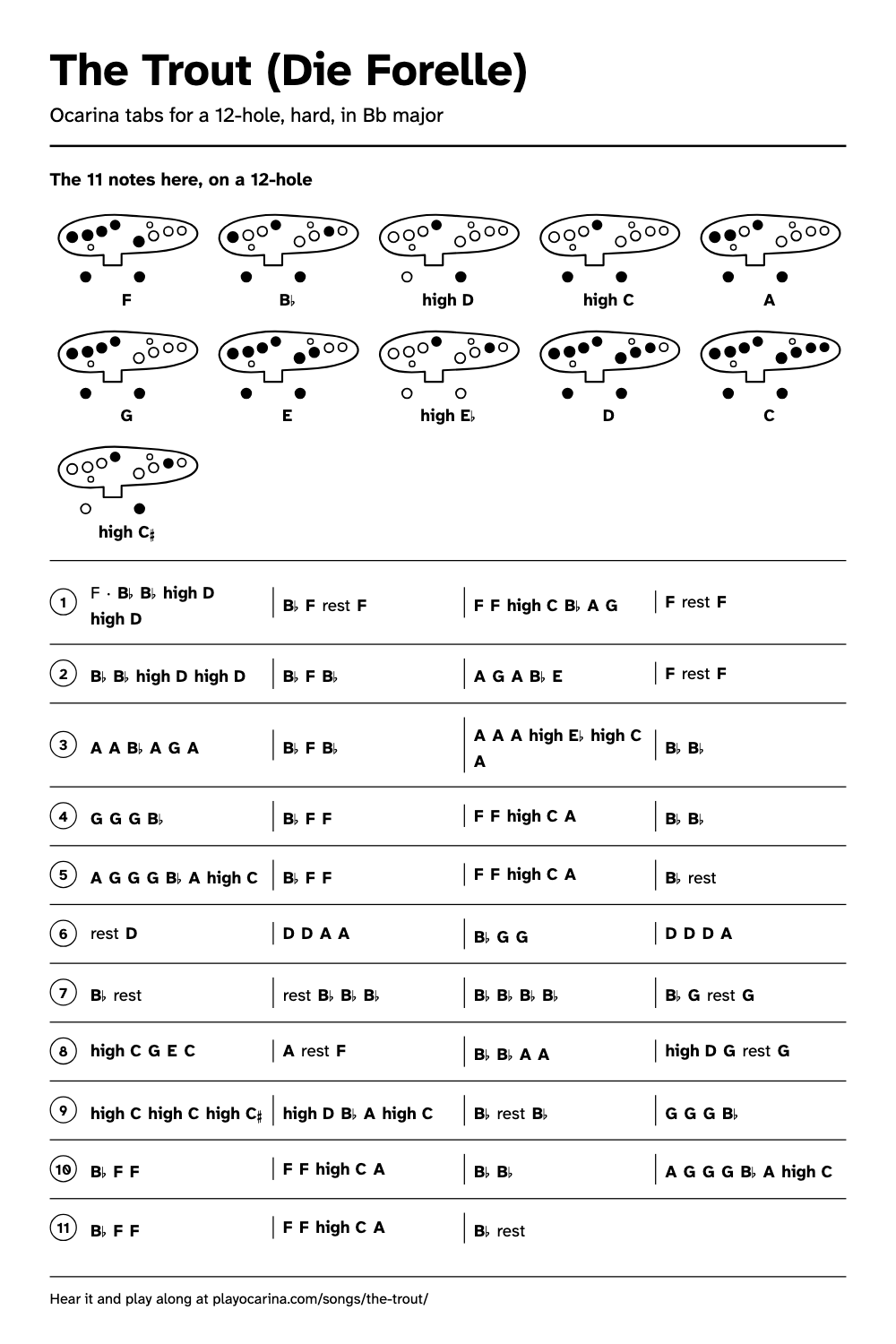
On a 12-hole. Read left to right, a line at a time.
- F B♭B♭high Dhigh DB♭FrestFFFhigh CB♭AGFrestF
- B♭B♭high Dhigh DB♭FB♭AGAB♭EFrestF
- AAB♭AGAB♭FB♭Tricky spot:AAAhigh E♭high CAB♭B♭
- GGGB♭B♭FFFFhigh CAB♭B♭
- AGGGB♭Ahigh CB♭FFFFhigh CAB♭rest
- restDDDAAB♭GGDDDA
- B♭restrestB♭B♭B♭B♭B♭B♭B♭B♭GrestG
- high CGECArestFB♭B♭AAhigh DGrestG
- high Chigh Chigh C♯high DB♭Ahigh CB♭restB♭GGGB♭
- B♭FFFFhigh CAB♭B♭AGGGB♭Ahigh C
- B♭FFFFhigh CAB♭rest
The Trout is Schubert's quick, bright song in 2/4: a lead-in F climbs to two B flats and two D's, and small runs of sixteenth notes keep it moving. Here it is in B flat major, the first verse and then the third, where the middle of the tune changes, 43 bars from low C up to high E flat. That range fits a 12-hole or a 6-hole ocarina in C. B flat is the note the tune keeps coming home to, so get its cross-fingering comfortable before you start.
What is the tricky spot in The Trout?
The 11th bar, where a quick sixteenth leaps from A up to high E flat, the top note of the song, and runs straight back down through C to A. On a 12-hole, The Trout goes from A to high E♭: you lift the left middle, left index, left thumb and right thumb and cover the right ring. On a 6-hole, you lift the left index, left thumb and right thumb and cover the right middle.
High E flat is a cross-fingering on a C ocarina and comes for only a quarter of a beat, so practise A to high E flat and back slowly until the fingers move together, then bring it up to speed with a little more air on the top note. The other hard spot is in the changed middle of the third verse: in bar 29 a held high C falls through G and E to low C inside one beat. Play it one note to a count first, and ease off the air so the low C does not squeak; the E there is a plain E, not the E flat of the key. The first verse's sixteenth runs, such as F, F, C, B flat, A, G in the third bar, want a light "du" tongue so the notes stay apart.
Where do you breathe in The Trout?
Breathe where the singer does: in the short rests after the F in bars 2, 4 and 8, and after each long B flat that closes a line, in bars 12 and 16, taking the B flat a little short. Take a fuller breath in the rest at the end of bar 20, before the third verse. In the third verse, breathe in the rests in bars 25, 28, 30, 32 and 35 and after the long B flat in bar 39, then play the last four bars in one breath.
Which ocarina can play The Trout?
A 4-hole ocarina cannot reach high C♯, high D and high E♭, so play The Trout in this key on a 12-hole or 6-hole ocarina in C. On an ocarina in G or F, use the same fingerings: the tune sounds in a different key, which is fine when you play alone. Each linked chart has every fingering for its ocarina, and you can check your notes with a tuner such as our free ocarina tuner.
The 11 notes here, on a 12-holeHoles in words, with a picture
| Note | Holes to cover | Picture |
|---|---|---|
| F | Cover every main hole but the right middle, right ring and right pinky | |
| B♭ | Cover the left pinky, left index, right ring, left thumb and right thumb | |
| high D | Cover the left pinky and right thumb | |
| high C | Cover the left pinky, left thumb and right thumb | |
| A | Cover the left pinky, left middle, left index, left thumb and right thumb | |
| G | Cover every main hole but the right index, right middle, right ring and right pinky | |
| E | Cover every main hole but the right ring and right pinky | |
| high E♭ | Cover the left pinky and right ring | |
| D | Cover every main hole but the right pinky | |
| C | Cover every main hole | |
| high C♯ | Cover the left pinky, right ring and right thumb |
Drawn as you see it while playing: mouthpiece towards you, left hand on the left.
| Note | Holes to cover | Picture |
|---|---|---|
| F | Cover every hole but the right middle and right index | |
| B♭ | Cover the right index, left thumb and right thumb | |
| high D | Cover the left thumb | |
| high C | Cover the left thumb and right thumb | |
| A | Cover the left index, left thumb and right thumb | |
| G | Cover every hole but the left middle and right middle | |
| E | Cover every hole but the right index | |
| high E♭ | Cover the right middle | |
| D | Cover every hole but the right middle | |
| C | Cover every hole | |
| high C♯ | Cover the right middle and left thumb |
Drawn as you see it while playing: mouthpiece towards you, left hand on the left.
Who wrote The Trout?
Franz Schubert, who wrote the song in early 1817 to a poem that Christian Friedrich Daniel Schubart wrote in 1782; it was first published on 9 December 1820, in a supplement to the Wiener Zeitung. In 1819 a commission for a chamber piece led to his Trout Quintet, whose fourth movement is a set of variations on the song. Our tabs follow the voice line of a Boston printing by Oliver Ditson from about 1863, which sets English words, headed One May Day in the Morning, above the German ones, in D flat major. Its first two verses share their notes and the third changes in the middle, so we play the first and the third, move them to B flat major and leave out the piano. We show the melody only. Music: Franz Schubert (1797-1828), Die Forelle, D. 550, 1817, to a poem by Christian Friedrich Daniel Schubart.