Were You There on the ocarina
On a 12-hole it starts low A, D, F♯, F♯. Medium, 47 notes, in D major.
Goes up to high D, so it does not fit a 4-hole. Goes down to low A, so it does not fit a 6-hole.
Were You There
Bar 1 of 14
What are the notes for Were You There?
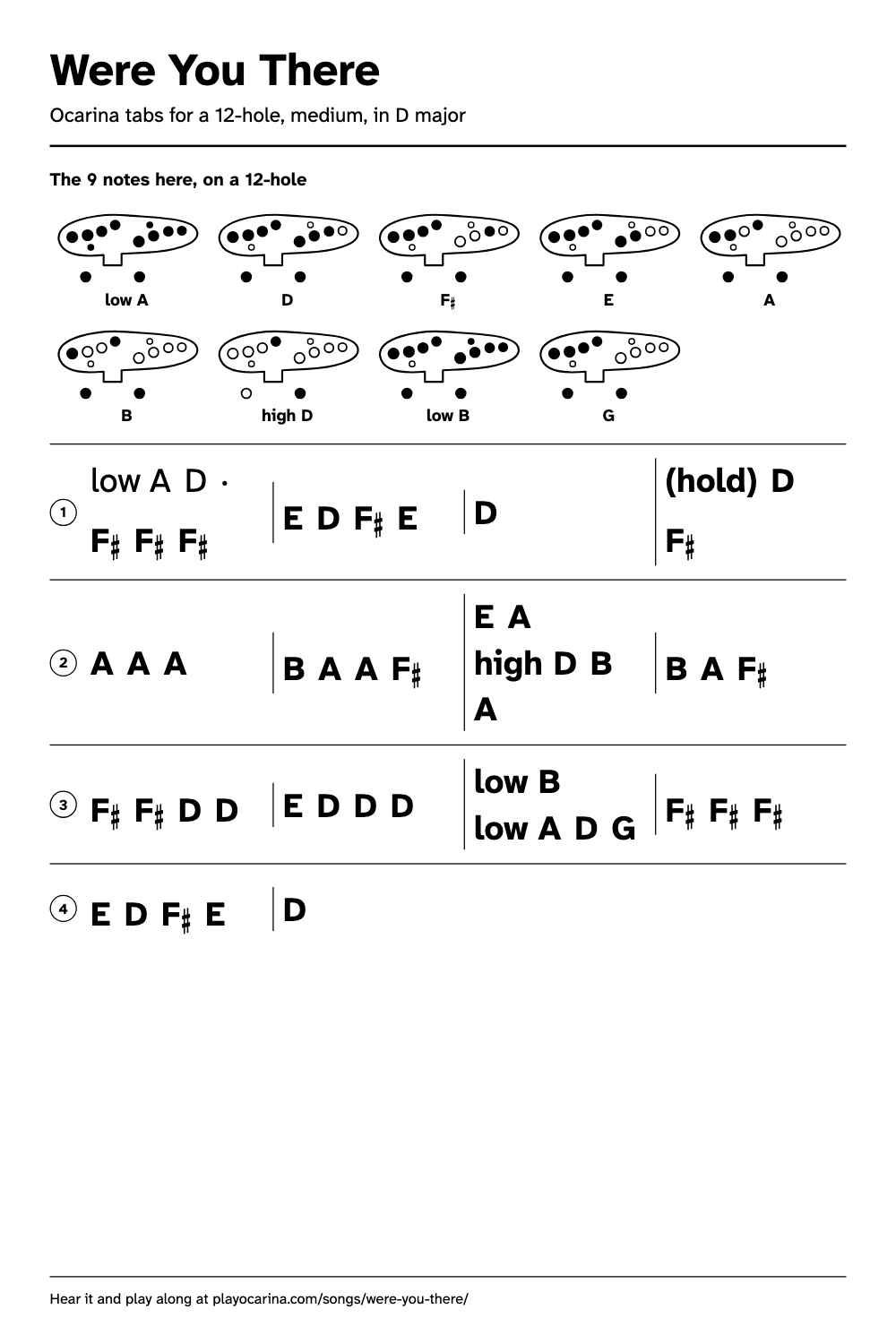
On a 12-hole. Read left to right, a line at a time.
- low AD F♯F♯F♯EDF♯ED(hold)DF♯
- AAABAAF♯Tricky spot:EAhigh DBABAF♯
- F♯F♯DDEDDDlow Blow ADGF♯F♯F♯
- EDF♯ED
Were You There is an African-American spiritual in slow four-beat bars, and it opens on a low A that leaps to D and then to a held F sharp. Here it is in D major, from low A up to high D, which a 12-hole ocarina in C can play: one verse, the top line as Frederick J. Work printed it in 1907.
What is the tricky spot in Were You There?
The start of the third line, where the tune jumps from A up to a held high D, then falls through B back to A. On a 12-hole, Were You There goes from A to high D: you lift the left middle, left index and left thumb.
On Work's page the A lasts a beat, the high D three quarters of a beat with a pause mark over it, and the B a quarter of a beat, then A comes back. Give the high D firmer air than the A before it, let it ring a little longer than written, and play all four notes in one breath. Practise A, high D, B, A slowly before you bring it up to speed. Four bars later the tune drops to low B and low A, which use the sub-holes: ease the air off, but keep enough of it that the low A does not sag flat.
Where do you breathe in Were You There?
Breathe after the long D that ends the first line, before the two notes that start the second. The second line ends on an E with a pause mark over it: breathe there, before the leap to high D. Take the next breath after the three D's that end the third line, before the last line drops to low B and low A and climbs back up.
Which ocarina can play Were You There?
A 6-hole ocarina cannot reach low A and low B, and a 4-hole ocarina cannot reach low A, low B and high D, so play Were You There in this key on a 12-hole ocarina in C. On an ocarina in G or F, use the same fingerings: the tune sounds in a different key, which is fine when you play alone. The linked chart has every fingering, and you can check your notes with a tuner such as our free ocarina tuner.
The 9 notes here, on a 12-holeHoles in words, with a picture
| Note | Holes to cover | Picture |
|---|---|---|
| low A | Cover every main hole, plus the left sub-hole and right sub-hole | |
| D | Cover every main hole but the right pinky | |
| F♯ | Cover every main hole but the right index, right middle and right pinky | |
| E | Cover every main hole but the right ring and right pinky | |
| A | Cover the left pinky, left middle, left index, left thumb and right thumb | |
| B | Cover the left pinky, left index, left thumb and right thumb | |
| high D | Cover the left pinky and right thumb | |
| low B | Cover every main hole, plus the right sub-hole | |
| G | Cover every main hole but the right index, right middle, right ring and right pinky |
Drawn as you see it while playing: mouthpiece towards you, left hand on the left.
Where does Were You There come from?
Were You There is an African-American spiritual, likely composed by enslaved African Americans in the 19th century. It was first printed in 1899, in William E. Barton's Old Plantation Hymns, with a different opening. These tabs follow Folk Songs of the American Negro, edited by Frederick J. Work and published in Nashville in 1907, whose first line climbs A, D, F sharp the way the song is sung today. Work printed it in four parts; the tabs take the top line, moved from G major to D major. Music: traditional African-American spiritual.