A Mighty Fortress Is Our God on the ocarina
On a 12-hole it starts high C, high C, high C, G. Medium, 71 notes, in C major.
A Mighty Fortress Is Our God
Bar 1 of 32
What are the notes for A Mighty Fortress Is Our God?
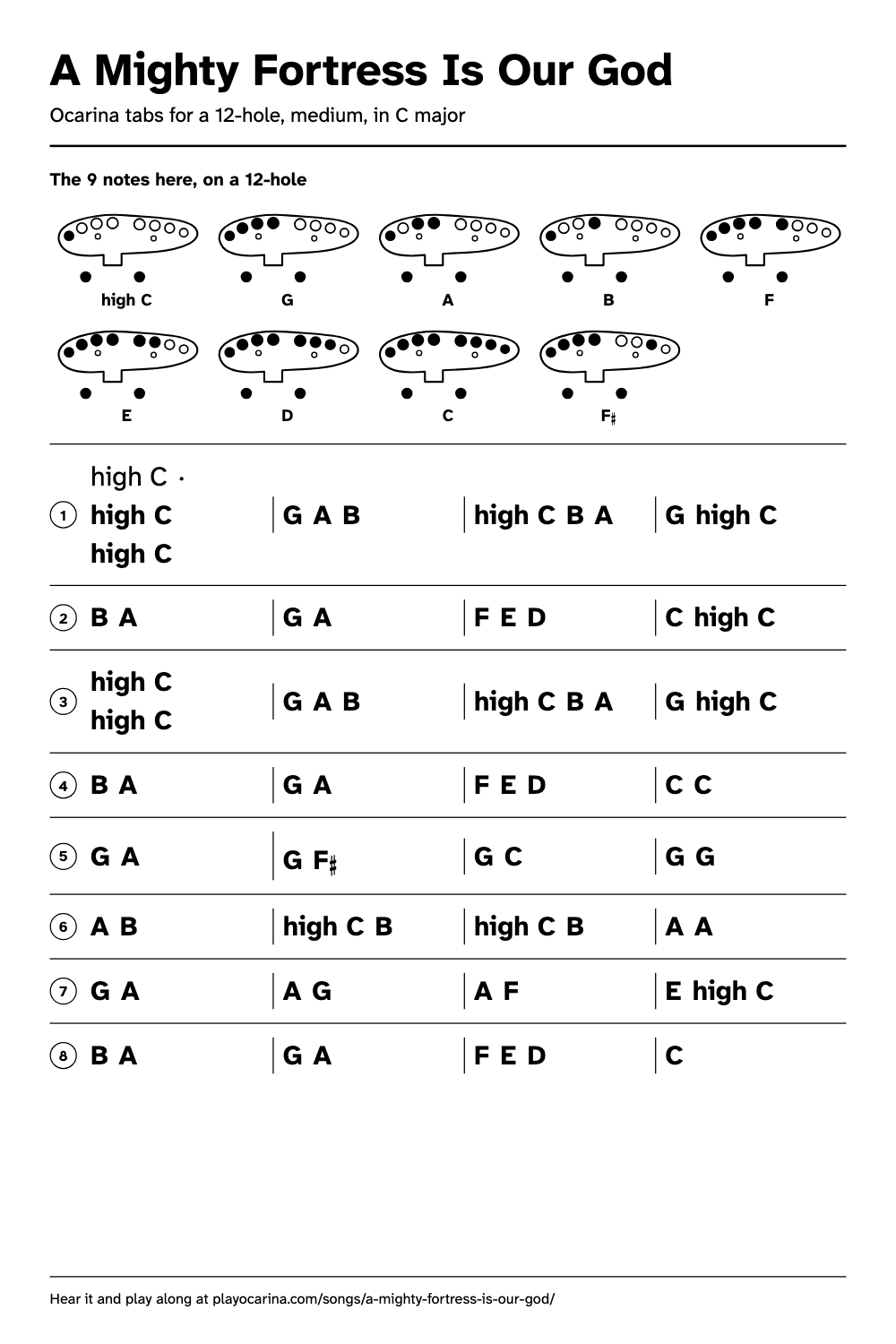
On a 12-hole. Read left to right, a line at a time.
- high C high Chigh CGABhigh CBAGhigh C
- BAGAFEDTricky spot:Chigh C
- high Chigh CGABhigh CBAGhigh C
- BAGAFEDCC
- GAGF♯GCGG
- ABhigh CBhigh CBAA
- GAAGAFEhigh C
- BAGAFEDC
A Mighty Fortress Is Our God in C major uses nine notes from C up to high C, with F♯ as the only sharp, so it fits a 12-hole, a 6-hole and a 4-hole pendant. It opens on three high Cs, then walks down and up the scale. The first two lines are played twice, which makes the whole tune 32 bars at a steady walking pace.
What is the tricky spot in A Mighty Fortress Is Our God?
The jump of an octave from the lowest C up to high C, where the second line ends and the tune starts over. On a 12-hole, A Mighty Fortress Is Our God goes from C to high C: you lift the left ring, left middle, left index, right index, right middle, right ring and right pinky. On a 6-hole or 4-hole, you lift the left middle, right middle, left index and right index.
On a 12-hole, low C has all ten main holes covered and high C has only the left pinky and both thumbs down, so seven fingers lift at once. On a 4-hole or 6-hole pendant it is every finger hole covered, then every one open. You have one beat to make the move, so lift all the fingers in one quick motion rather than one by one, and ease the air for the high note: the breath that suits low C makes high C sharp. Practise the pair on its own, slowly. The only sharp, F♯, comes once, in the third line between two Gs: on a 12-hole it is G with the right ring finger added, and on a pendant it is G with the right middle finger added.
Where do you breathe in A Mighty Fortress Is Our God?
The print pauses on the last note of each line, and those pauses are your breaths. Our tabs give each one a single beat, so take the breath by cutting that note a little short, and the next line starts on time. The first two lines come round twice, so the first four breaths fall in the same places. The final C is the last note of the tune: hold it as long as your breath allows.
Which ocarina can play A Mighty Fortress Is Our God?
Any 12-hole, 6-hole or 4-hole ocarina in C plays A Mighty Fortress Is Our God in this key. On an ocarina in G or F, use the same fingerings: the tune sounds in a different key, which is fine when you play alone. Each linked chart has every fingering for its ocarina, and you can check your notes with a tuner such as our free ocarina tuner.
The 9 notes here, on a 12-holeHoles in words, with a picture
| Note | Holes to cover | Picture |
|---|---|---|
| high C | Cover the left pinky, left thumb and right thumb | |
| G | Cover every main hole but the right index, right middle, right ring and right pinky | |
| A | Cover the left pinky, left middle, left index, left thumb and right thumb | |
| B | Cover the left pinky, left index, left thumb and right thumb | |
| F | Cover every main hole but the right middle, right ring and right pinky | |
| E | Cover every main hole but the right ring and right pinky | |
| D | Cover every main hole but the right pinky | |
| C | Cover every main hole | |
| F♯ | Cover every main hole but the right index, right middle and right pinky |
Drawn as you see it while playing: mouthpiece towards you, left hand on the left.
| Note | Holes to cover | Picture |
|---|---|---|
| high C | Cover the left thumb and right thumb | |
| G | Cover every hole but the left middle and right middle | |
| A | Cover the left index, left thumb and right thumb | |
| B | Cover the right middle, left thumb and right thumb | |
| F | Cover every hole but the right middle and right index | |
| E | Cover every hole but the right index | |
| D | Cover every hole but the right middle | |
| C | Cover every hole | |
| F♯ | Cover every hole but the left middle |
Drawn as you see it while playing: mouthpiece towards you, left hand on the left.
| Note | Holes to cover | Picture |
|---|---|---|
| high C | All holes open | |
| G | Cover the left index and right index | |
| A | Cover the left index | |
| B | Cover the right middle | |
| F | Cover the left middle and left index | |
| E | Cover every hole but the right index | |
| D | Cover every hole but the right middle | |
| C | Cover every hole | |
| F♯ | Cover every hole but the left middle |
Drawn as you see it while playing: mouthpiece towards you, left hand on the left.
Is this the tune Martin Luther wrote?
Not quite, which is why hymnbooks differ. Luther wrote the words and the tune between 1527 and 1529, and he died in 1546. Wikipedia says his own tune was strongly rhythmic, and that a later form with notes of equal length is the one most churches know. Our tabs follow that even form as the Presbyterian Hymnal gives it in its 1909 printing: it credits the tune to Luther, marks the pattern 8.7.8.7.6.6.6.6.7, gives nearly every note the same length and pauses on the last note of each line. A Methodist hymnal of 1905 and a 1911 songbook for prayer meetings print the same tune in the same even form, and Hymnary.org says it had settled into that shape by Bach's day. The hymnals' four-part harmonies are not used. We show the melody only. Music: Martin Luther (1483-1546), words and tune, written between 1527 and 1529.