Danse Macabre on the ocarina
On a 12-hole it starts D, G, G, F. Medium, 36 notes, in G minor.
Danse Macabre
Bar 1 of 16
What are the notes for Danse Macabre?
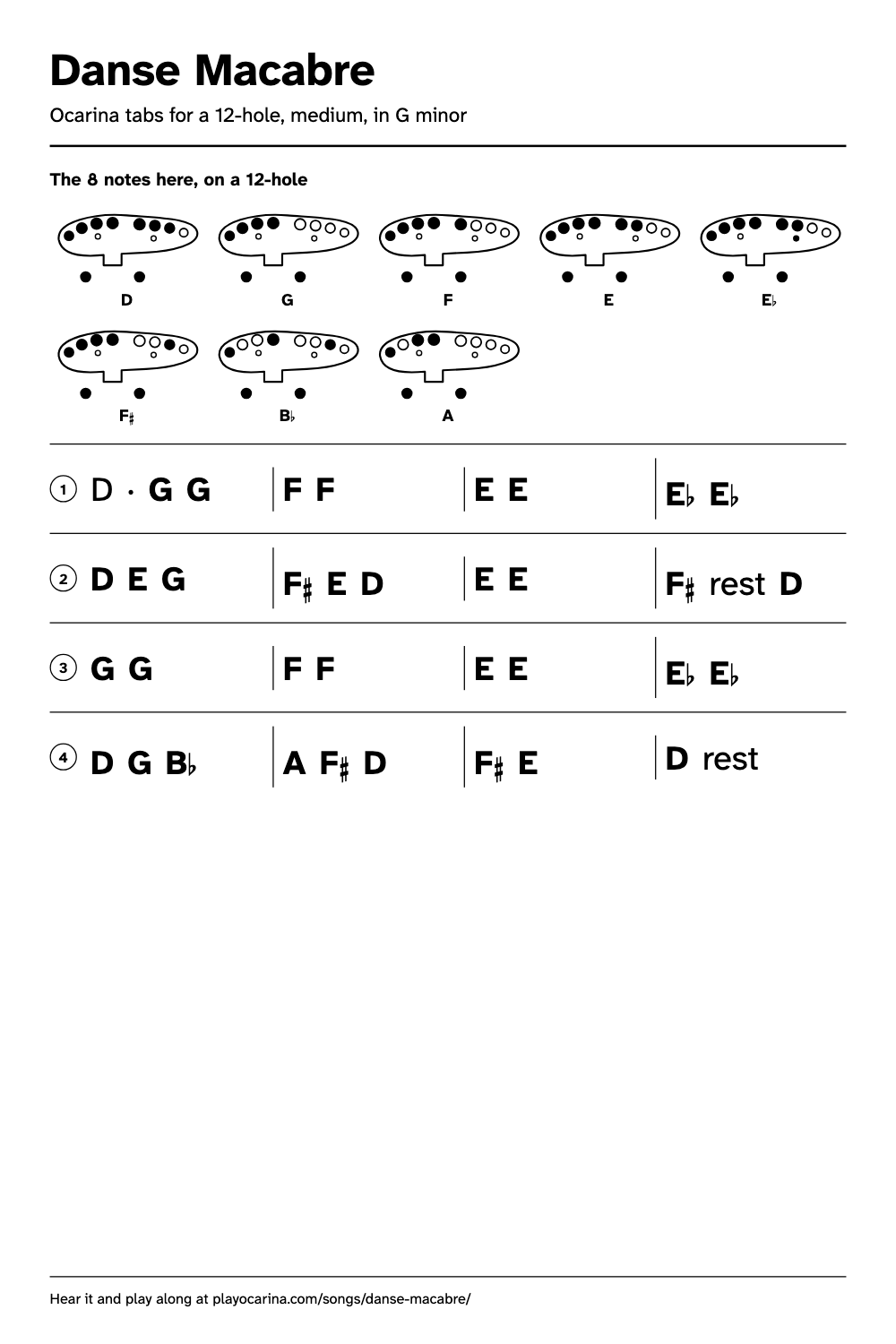
On a 12-hole. Read left to right, a line at a time.
- D GGFFEETricky spot:E♭E♭
- DEGF♯EDEEF♯restD
- GGFFEEE♭E♭
- DGB♭AF♯DF♯EDrest
This is the second theme of Saint-Saëns's Danse Macabre, the slow, sliding waltz tune the solo violin plays after the flute's first theme: a long G, then F, E, E♭ and D, a half step at a time. It is in G minor as printed, raised an octave, in the printed rhythm: the 16 bars marked largamente in the composer's own violin and piano version, with the D that leads into them. It runs from D to B♭.
How do you play the sliding notes in Danse Macabre?
The bottom of the slide, where the tune has come down from G through F and E to E♭ and then steps to D: four fingerings a half step apart. On a 12-hole, Danse Macabre goes from E♭ to D: you lift the right sub-hole and cover the right ring. On a 6-hole or 4-hole, you lift the right middle and cover the right index.
Each bar of the slide is a long note and a short repeat of it, so you have two beats to settle each new fingering before you play it again. Learn G, F, E, E♭ as a scale first, slowly, listening for an even half step each time; the E♮ and E♭ are the two that trip people up, and the printing marks both in every bar they appear. Lean on the long note and play the short one lighter, as a waltz does on its first beat. The second time round, the slide ends by climbing D, G, B♭, the highest note of the tune, and falls back through A and F♯.
Which ocarina can play Danse Macabre?
Any 12-hole, 6-hole or 4-hole ocarina in C plays Danse Macabre in this key. On an ocarina in G or F, use the same fingerings: the tune sounds in a different key, which is fine when you play alone. Each linked chart has every fingering for its ocarina, and you can check your notes with a tuner such as our free ocarina tuner.
The 8 notes here, on a 12-holeHoles in words, with a picture
| Note | Holes to cover | Picture |
|---|---|---|
| D | Cover every main hole but the right pinky | |
| G | Cover every main hole but the right index, right middle, right ring and right pinky | |
| F | Cover every main hole but the right middle, right ring and right pinky | |
| E | Cover every main hole but the right ring and right pinky | |
| E♭ | Cover every main hole but the right ring and right pinky, plus the right sub-hole | |
| F♯ | Cover every main hole but the right index, right middle and right pinky | |
| B♭ | Cover the left pinky, left index, right ring, left thumb and right thumb | |
| A | Cover the left pinky, left middle, left index, left thumb and right thumb |
Drawn as you see it while playing: mouthpiece towards you, left hand on the left.
| Note | Holes to cover | Picture |
|---|---|---|
| D | Cover every hole but the right middle | |
| G | Cover every hole but the left middle and right middle | |
| F | Cover every hole but the right middle and right index | |
| E | Cover every hole but the right index | |
| E♭ | Cover the left middle, right middle, left index, left thumb and right thumb; half-cover the right index | |
| F♯ | Cover every hole but the left middle | |
| B♭ | Cover the right index, left thumb and right thumb | |
| A | Cover the left index, left thumb and right thumb |
Drawn as you see it while playing: mouthpiece towards you, left hand on the left.
| Note | Holes to cover | Picture |
|---|---|---|
| D | Cover every hole but the right middle | |
| G | Cover the left index and right index | |
| F | Cover the left middle and left index | |
| E | Cover every hole but the right index | |
| E♭ | Cover the left middle, right middle and left index; half-cover the right index | |
| F♯ | Cover every hole but the left middle | |
| B♭ | Cover the right index | |
| A | Cover the left index |
Drawn as you see it while playing: mouthpiece towards you, left hand on the left.
What is the story behind Danse Macabre?
In the legend behind it, Death appears at midnight on Halloween and plays while the skeletons dance until a cockerel crows at dawn: the harp strikes D twelve times for midnight, and the oboe is the cockerel. Saint-Saëns first wrote it in 1872 as a song to a poem by Henri Cazalis and made it an orchestral piece in 1874, with a solo violin whose E string is tuned down to E♭. The tune here is the second theme, the violin's slow descending scale. Our tabs follow Saint-Saëns's own arrangement for violin and piano, published by Durand in Paris, where the violin plays it note for note. Saint-Saëns died in 1921. We show the melody only. Music: Camille Saint-Saëns (1835-1921), the second theme of his symphonic poem Danse macabre, Op. 40, 1874.