Abide with Me on the ocarina
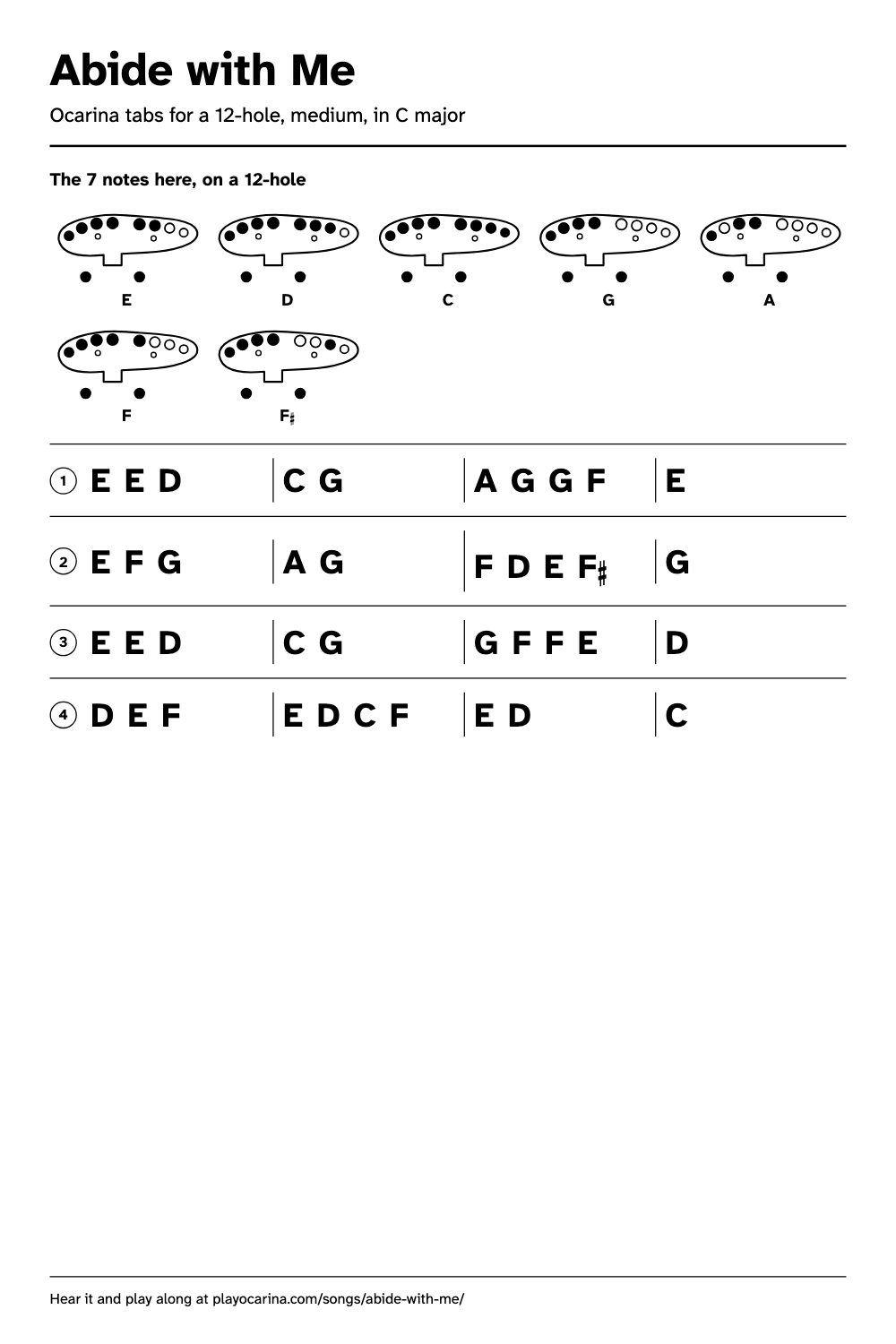
On a 12-hole it starts E, E, D, C. Medium, 40 notes, in C major.
Abide with Me
Bar 1 of 16
What are the notes for Abide with Me?
On a 12-hole. Read left to right, a line at a time.
- EEDCGAGGFE
- EFGAGTricky spot:FDEF♯G
- EEDCGGFFED
- DEFEDCFEDC
Abide with Me is a slow evening hymn in four lines of four bars, and it starts E, E, D, C, then jumps up to G. Here it is in C major, William Henry Monk's tune Eventide, between C and A, so it fits a 12-hole, a 6-hole and a 4-hole ocarina in C.
What is the tricky spot in Abide with Me?
The end of the second line, where the tune dips to D, climbs through E and F sharp and lands on a long G. On a 12-hole, Abide with Me goes from F♯ to G: you lift the right ring. On a 6-hole or 4-hole, you lift the right middle.
F sharp is the only note in the hymn that is not a natural, and it appears just this once, as the step that pulls up into G. Learn its fingering on its own, then play F sharp, G, F sharp, G slowly until the F sharp sits in tune just under the G. Everywhere else F is a plain F, so after that bar go back to the normal fingering: the next F comes four bars later, in the third line. The jump from the two-beat C up to G, in the second bar of the first and third lines, is the widest in the tune; keep the breath steady and let the G sound without pushing.
Where do you breathe in Abide with Me?
Each of the four lines ends on a four-beat note: E, G, D and the final C. Breathe after each one, cutting it a little short rather than snatching air in the middle of a line, since every line is ten slow notes long.
Which ocarina can play Abide with Me?
Any 12-hole, 6-hole or 4-hole ocarina in C plays Abide with Me in this key. On an ocarina in G or F, use the same fingerings: the tune sounds in a different key, which is fine when you play alone. Each linked chart has every fingering for its ocarina, and you can check your notes with a tuner such as our free ocarina tuner.
The 7 notes here, on a 12-holeHoles in words, with a picture
| Note | Holes to cover | Picture |
|---|---|---|
| E | Cover every main hole but the right ring and right pinky | |
| D | Cover every main hole but the right pinky | |
| C | Cover every main hole | |
| G | Cover every main hole but the right index, right middle, right ring and right pinky | |
| A | Cover the left pinky, left middle, left index, left thumb and right thumb | |
| F | Cover every main hole but the right middle, right ring and right pinky | |
| F♯ | Cover every main hole but the right index, right middle and right pinky |
Drawn as you see it while playing: mouthpiece towards you, left hand on the left.
| Note | Holes to cover | Picture |
|---|---|---|
| E | Cover every hole but the right index | |
| D | Cover every hole but the right middle | |
| C | Cover every hole | |
| G | Cover every hole but the left middle and right middle | |
| A | Cover the left index, left thumb and right thumb | |
| F | Cover every hole but the right middle and right index | |
| F♯ | Cover every hole but the left middle |
Drawn as you see it while playing: mouthpiece towards you, left hand on the left.
| Note | Holes to cover | Picture |
|---|---|---|
| E | Cover every hole but the right index | |
| D | Cover every hole but the right middle | |
| C | Cover every hole | |
| G | Cover the left index and right index | |
| A | Cover the left index | |
| F | Cover the left middle and left index | |
| F♯ | Cover every hole but the left middle |
Drawn as you see it while playing: mouthpiece towards you, left hand on the left.
Was Abide with Me written for the tune it is sung to?
No. Henry Francis Lyte wrote the words in 1847, as he was dying of tuberculosis, and gave them to a relative with an air of his own. The tune almost everyone sings came fourteen years later: William Henry Monk, the music editor of Hymns Ancient and Modern, supplied Eventide for that book. Our tabs follow its first edition of 1861, where the words are Hymn 14 and the index of tunes stars Eventide as new to the book. The page prints the tune in E flat and in long note values, which our tabs halve, and offers a chant on the next page as a second way to sing it. We play it in C, where Monk's one A natural becomes our F sharp. Since the 1927 FA Cup Final, crowds have sung it before the match. Monk died in 1889. We show the melody only. Music: the tune "Eventide" by William Henry Monk (1823-1889); words by Henry Francis Lyte (1793-1847).