Ave Maria (Schubert) on the ocarina
On a 12-hole it starts F, E, F, A. Hard, 95 notes, in F major.
Ave Maria (Schubert)
Bar 1 of 12
What are the notes for Schubert's Ave Maria?
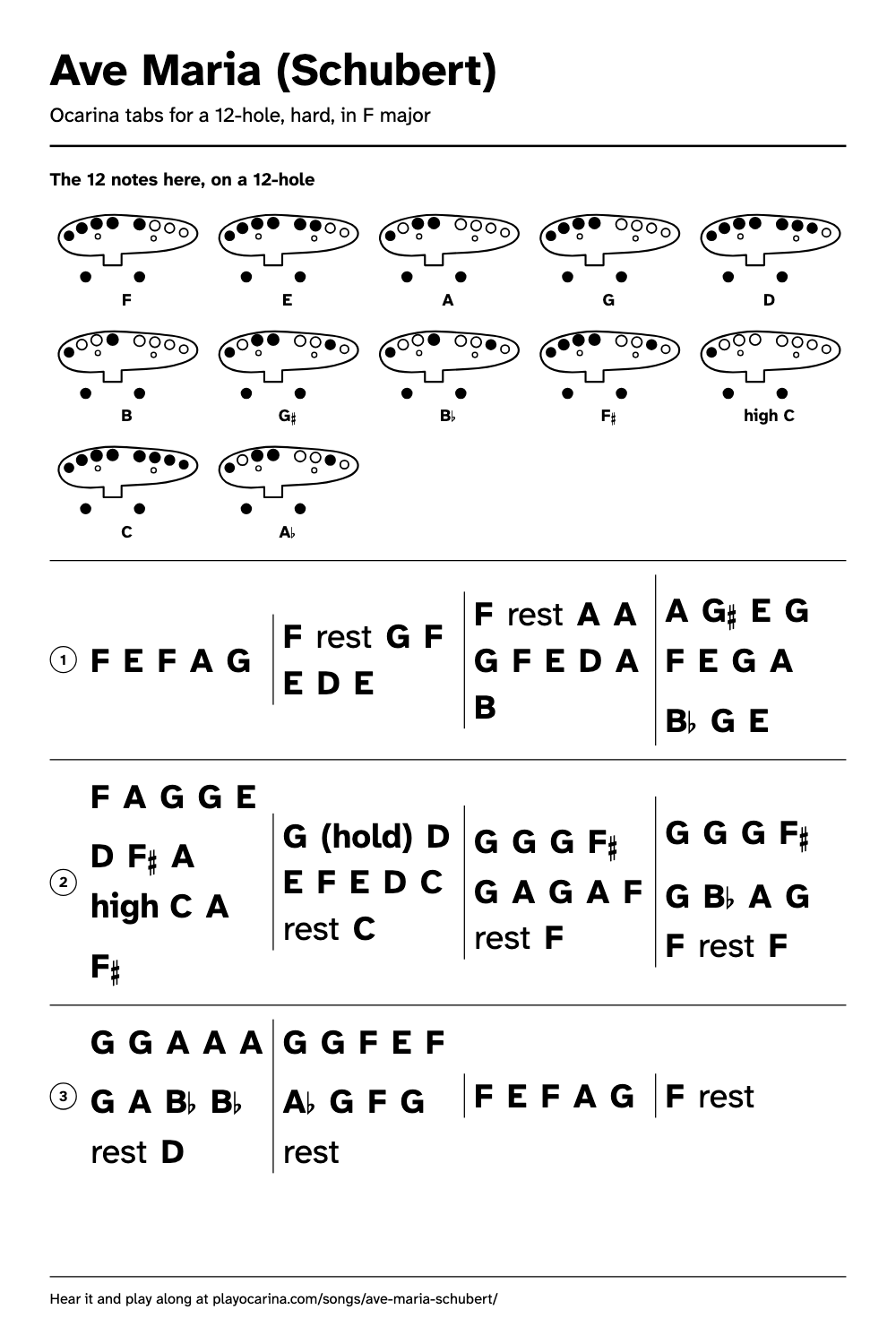
On a 12-hole. Read left to right, a line at a time.
- FEFAGFrestGFEDEFrestAAGFEDABAG♯EGFEGAB♭GE
- Tricky spot:FAGGEDF♯Ahigh CAF♯G(hold)DEFEDCrestCGGGF♯GAGAFrestFGGGF♯GB♭AGFrestF
- GGAAAGAB♭B♭restDGGFEFA♭GFGrestFEFAGFrest
Schubert's Ave Maria opens on a long F, dips to E and back, then rises to a long A that settles on G: the first of the song's "Ave Maria" calls. This is the whole melody of one verse, 12 slow bars in F major, the voice line with no words, from C up to high C. The tune is slow, but nearly every bar has a quick run of three notes to the beat or a short dotted figure, and the last two bars bring back the opening call before the tune comes to rest on F.
What is the tricky spot in Schubert's Ave Maria?
The fifth bar, where two quick triplets climb D, F-sharp, A to high C, the highest note in the song, and run straight back down. On a 12-hole, Schubert's Ave Maria goes from A to high C: you lift the left middle and left index. On a 6-hole or 4-hole, you lift the left index.
Play the climb slowly first, one note to a count, then speed it up until the six notes fit in two beats. The F-sharp is a cross-fingering on a C ocarina, so practise F-sharp to A and back on its own. The same fingering comes back in the seventh and eighth bars, between two G's. Elsewhere watch for G-sharp in the fourth bar, written A-flat in the tenth; both use one fingering. Breathe in the rests: after the first F of the second and third bars, and in the gaps of bars six to nine.
Which ocarina can play Schubert's Ave Maria?
Any 12-hole, 6-hole or 4-hole ocarina in C plays Schubert's Ave Maria in this key. On an ocarina in G or F, use the same fingerings: the tune sounds in a different key, which is fine when you play alone. Each linked chart has every fingering for its ocarina, and you can check your notes with a tuner such as our free ocarina tuner.
The 12 notes here, on a 12-holeHoles in words, with a picture
| Note | Holes to cover | Picture |
|---|---|---|
| F | Cover every main hole but the right middle, right ring and right pinky | |
| E | Cover every main hole but the right ring and right pinky | |
| A | Cover the left pinky, left middle, left index, left thumb and right thumb | |
| G | Cover every main hole but the right index, right middle, right ring and right pinky | |
| D | Cover every main hole but the right pinky | |
| B | Cover the left pinky, left index, left thumb and right thumb | |
| G♯ | Cover every main hole but the left ring, right index, right middle and right pinky | |
| B♭ | Cover the left pinky, left index, right ring, left thumb and right thumb | |
| F♯ | Cover every main hole but the right index, right middle and right pinky | |
| high C | Cover the left pinky, left thumb and right thumb | |
| C | Cover every main hole | |
| A♭ | Cover every main hole but the left ring, right index, right middle and right pinky |
Drawn as you see it while playing: mouthpiece towards you, left hand on the left.
| Note | Holes to cover | Picture |
|---|---|---|
| F | Cover every hole but the right middle and right index | |
| E | Cover every hole but the right index | |
| A | Cover the left index, left thumb and right thumb | |
| G | Cover every hole but the left middle and right middle | |
| D | Cover every hole but the right middle | |
| B | Cover the right middle, left thumb and right thumb | |
| G♯ | Cover every hole but the left middle and right index | |
| B♭ | Cover the right index, left thumb and right thumb | |
| F♯ | Cover every hole but the left middle | |
| high C | Cover the left thumb and right thumb | |
| C | Cover every hole | |
| A♭ | Cover every hole but the left middle and right index |
Drawn as you see it while playing: mouthpiece towards you, left hand on the left.
| Note | Holes to cover | Picture |
|---|---|---|
| F | Cover the left middle and left index | |
| E | Cover every hole but the right index | |
| A | Cover the left index | |
| G | Cover the left index and right index | |
| D | Cover every hole but the right middle | |
| B | Cover the right middle | |
| G♯ | Cover the right middle and left index | |
| B♭ | Cover the right index | |
| F♯ | Cover every hole but the left middle | |
| high C | All holes open | |
| C | Cover every hole | |
| A♭ | Cover the right middle and left index |
Drawn as you see it while playing: mouthpiece towards you, left hand on the left.
Where does Schubert's Ave Maria come from?
From a song in Walter Scott's poem The Lady of the Lake, in which Ellen Douglas prays to the Virgin Mary. Schubert set it in 1825 as Ellens dritter Gesang, Ellen's third song, to a German translation by Adam Storck, and it came out in 1826 in his Op. 52. Its words open with the Latin greeting Ave Maria, and the melody is now often sung to the Latin prayer instead. Our tabs follow the voice line of an early Vienna printing by Diabelli, from about 1841, which calls it Hymne an die Jungfrau and prints it in B-flat major; our tabs move it up to F major, leave out the two-bar piano opening, the small grace notes and one turn, and even out a few of the quickest dotted notes. Schubert died in 1828. We show the melody only. Music: Franz Schubert (1797-1828), Ellens dritter Gesang (Ellen's third song), D. 839, Op. 52 No. 6, 1825.