Camptown Races on the ocarina
On a 12-hole it starts G, G, G, E. Easy, 80 notes, in C major.
Camptown Races
Bar 1 of 24
What are the notes for Camptown Races?
On a 12-hole. Read left to right, a line at a time.
- G GGEGAGEEDEDG
- GGEGAGEDEDCG
- GGEGGAGEEDEDG
- GGEGGAAGGEDEDCrest
- Tricky spot:CCEGhigh CrestAAhigh CAGDE
- GGEEGGAGEDEFEDDC
Camptown Races is a quick 2/4 tune built almost entirely from G, E and A, with the two famous calls of "doo-dah" on E and D. Here are the verse and the chorus in C major, from C up to high C, with a single F near the end. The verse sits low; the chorus climbs to a long high C.
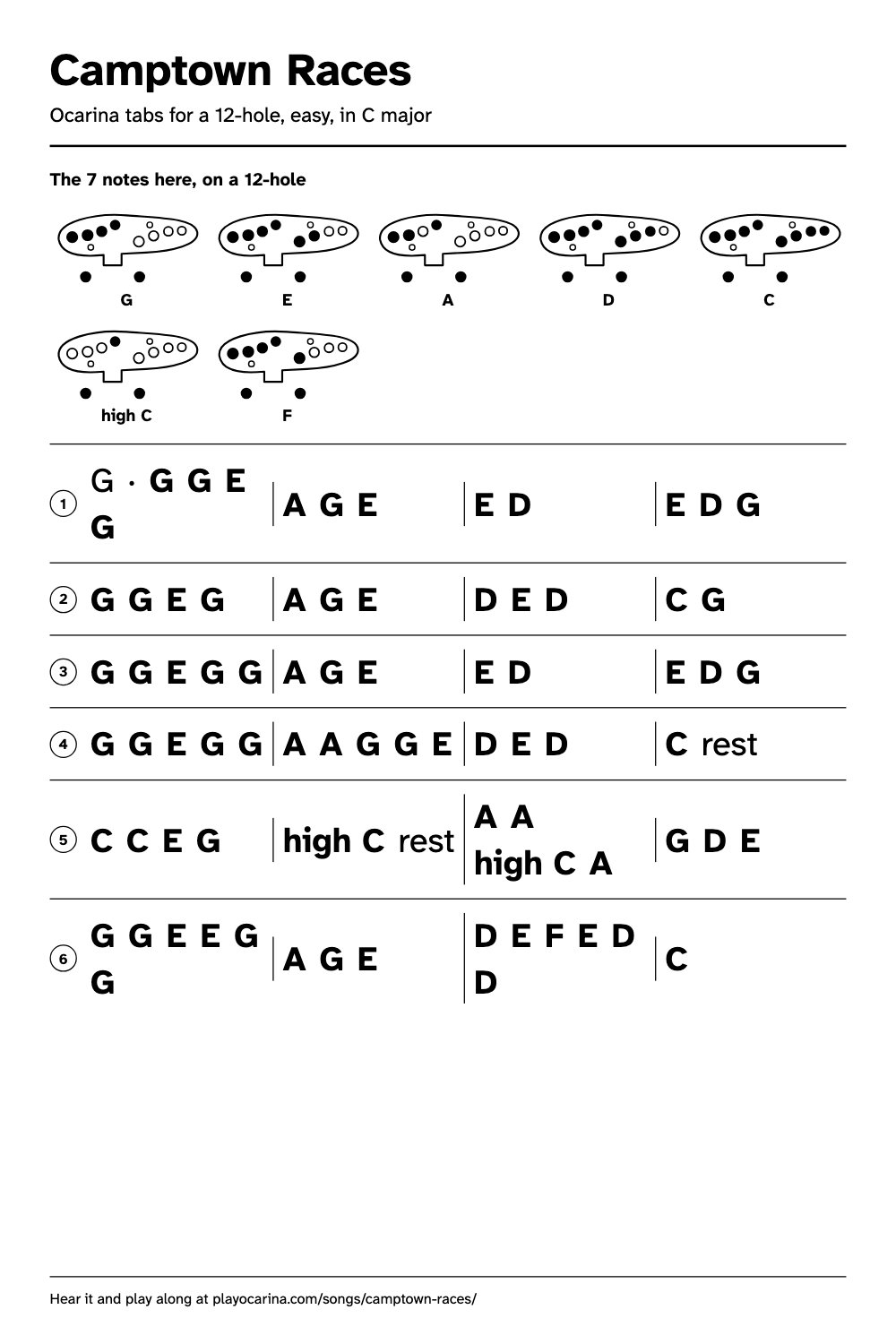
What is the tricky spot in Camptown Races?
The second bar of the chorus, where the tune climbs C, E, G and lands on a long high C. On a 12-hole, Camptown Races goes from G to high C: you lift the left ring, left middle and left index. On a 6-hole or 4-hole, you lift the left index and right index.
The chorus starts on a long low C and a short one, a dotted rhythm, then climbs. Play the climb slowly first and blow a little firmer for the high C, then hold it for its full beat and a half before the short rest. The next bar comes back down to A with the same dotted rhythm, so ease the air off as you go. In the verse, the quick pairs of G at the end of some bars are half the length of the notes around them; tongue them lightly with your fingers still.
Where do you breathe in Camptown Races?
After each long C that ends a half of the verse, in the short rest after the high C in the chorus, and after the long G before the last line. The tune is quick, so take small breaths and take them often.
Which ocarina can play Camptown Races?
Any 12-hole, 6-hole or 4-hole ocarina in C plays Camptown Races in this key. On an ocarina in G or F, use the same fingerings: the tune sounds in a different key, which is fine when you play alone. Each linked chart has every fingering for its ocarina, and you can check your notes with a tuner such as our free ocarina tuner.
The 7 notes here, on a 12-holeHoles in words, with a picture
| Note | Holes to cover | Picture |
|---|---|---|
| G | Cover every main hole but the right index, right middle, right ring and right pinky | |
| E | Cover every main hole but the right ring and right pinky | |
| A | Cover the left pinky, left middle, left index, left thumb and right thumb | |
| D | Cover every main hole but the right pinky | |
| C | Cover every main hole | |
| high C | Cover the left pinky, left thumb and right thumb | |
| F | Cover every main hole but the right middle, right ring and right pinky |
Drawn as you see it while playing: mouthpiece towards you, left hand on the left.
| Note | Holes to cover | Picture |
|---|---|---|
| G | Cover every hole but the left middle and right middle | |
| E | Cover every hole but the right index | |
| A | Cover the left index, left thumb and right thumb | |
| D | Cover every hole but the right middle | |
| C | Cover every hole | |
| high C | Cover the left thumb and right thumb | |
| F | Cover every hole but the right middle and right index |
Drawn as you see it while playing: mouthpiece towards you, left hand on the left.
| Note | Holes to cover | Picture |
|---|---|---|
| G | Cover the left index and right index | |
| E | Cover every hole but the right index | |
| A | Cover the left index | |
| D | Cover every hole but the right middle | |
| C | Cover every hole | |
| high C | All holes open | |
| F | Cover the left middle and left index |
Drawn as you see it while playing: mouthpiece towards you, left hand on the left.
Who wrote Camptown Races?
Stephen Foster. It was published in February 1850, first as "De Camptown Races" or "Gwine to Run All Night", and was written for the minstrel stage in a mock dialect, which is one reason this page teaches the tune and leaves out the words. Our tabs follow the tune as printed in Heart Songs (Boston, 1909), moved from E major to C. We show the melody only. Music: Stephen Foster (1826-1864).