Carry Me Back to Old Virginny on the ocarina
On a 12-hole it starts A, A, B♭, A. Medium, 132 notes, in F major.
Carry Me Back to Old Virginny
Bar 1 of 24
What are the notes for Carry Me Back to Old Virginny?
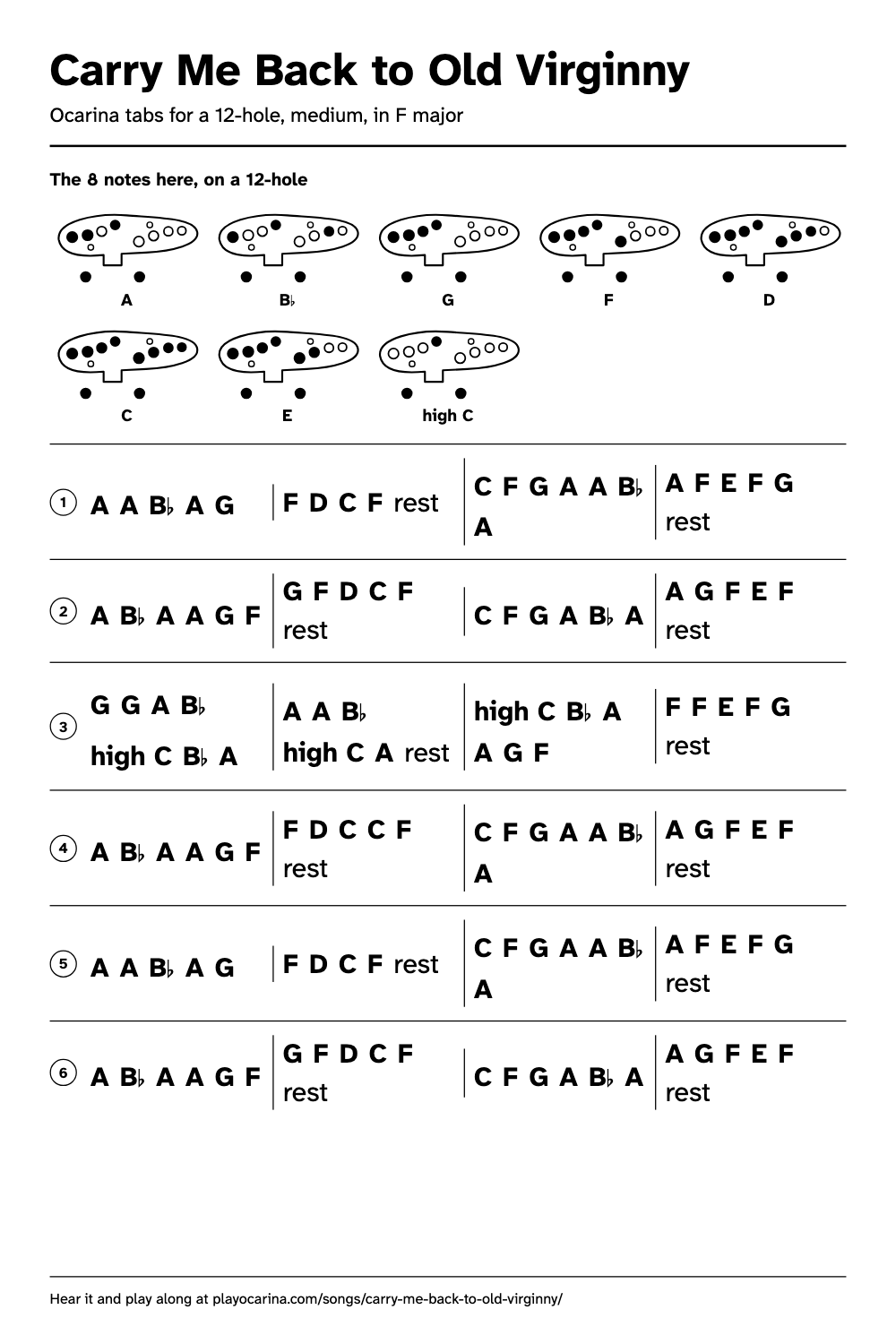
On a 12-hole. Read left to right, a line at a time.
- AAB♭AGFDCFrestCFGAAB♭AAFEFGrest
- AB♭AAGFGFDCFrestCFGAB♭AAGFEFrest
- Tricky spot:GGAB♭high CB♭AAAB♭high CAresthigh CB♭AAGFFFEFGrest
- AB♭AAGFFDCCFrestCFGAAB♭AAGFEFrest
- AAB♭AGFDCFrestCFGAAB♭AAFEFGrest
- AB♭AAGFGFDCFrestCFGAB♭AAGFEFrest
Carry Me Back to Old Virginny is a gentle, moderate tune built from two-bar lines, and every line ends in a short rest, so there is always a place to breathe. Here it is in F major, the verse and then the chorus, 24 bars from C up to high C with one flat, B flat. It plays on a 12-hole, a 6-hole or a 4-hole ocarina. The chorus has the same notes as the first eight bars of the verse.
What is the tricky spot in Carry Me Back to Old Virginny?
The ninth bar, where the second half of the verse climbs G, A, B flat to high C, the top note of the song, and turns straight back down through B flat. On a 12-hole, Carry Me Back to Old Virginny goes from B♭ to high C: you lift the left index and right ring. On a 6-hole or 4-hole, you lift the right index.
B flat is a cross-fingering on a 12-hole, and here it sits on both sides of high C, so practise B flat, high C, B flat slowly until the fingers move together. Two bars later the line starts on high C straight after a rest: give it a little more air than the A before the rest. The rest of the tune is full of dotted pairs, a long note and a quick one, such as the F and G in the third bar. Keep the quick note short and light, with a soft "du", so the rhythm lilts instead of evening out.
Where do you breathe in Carry Me Back to Old Virginny?
Every two-bar line ends in a rest, so breathe in each one: after the short F in bar 2, after the long G in bar 4, and so on to the end. Take the fuller breaths at the end of bar 8, before the second half of the verse climbs to high C, and at the end of bar 16, before the chorus.
Which ocarina can play Carry Me Back to Old Virginny?
Any 12-hole, 6-hole or 4-hole ocarina in C plays Carry Me Back to Old Virginny in this key. On an ocarina in G or F, use the same fingerings: the tune sounds in a different key, which is fine when you play alone. Each linked chart has every fingering for its ocarina, and you can check your notes with a tuner such as our free ocarina tuner.
The 8 notes here, on a 12-holeHoles in words, with a picture
| Note | Holes to cover | Picture |
|---|---|---|
| A | Cover the left pinky, left middle, left index, left thumb and right thumb | |
| B♭ | Cover the left pinky, left index, right ring, left thumb and right thumb | |
| G | Cover every main hole but the right index, right middle, right ring and right pinky | |
| F | Cover every main hole but the right middle, right ring and right pinky | |
| D | Cover every main hole but the right pinky | |
| C | Cover every main hole | |
| E | Cover every main hole but the right ring and right pinky | |
| high C | Cover the left pinky, left thumb and right thumb |
Drawn as you see it while playing: mouthpiece towards you, left hand on the left.
| Note | Holes to cover | Picture |
|---|---|---|
| A | Cover the left index, left thumb and right thumb | |
| B♭ | Cover the right index, left thumb and right thumb | |
| G | Cover every hole but the left middle and right middle | |
| F | Cover every hole but the right middle and right index | |
| D | Cover every hole but the right middle | |
| C | Cover every hole | |
| E | Cover every hole but the right index | |
| high C | Cover the left thumb and right thumb |
Drawn as you see it while playing: mouthpiece towards you, left hand on the left.
| Note | Holes to cover | Picture |
|---|---|---|
| A | Cover the left index | |
| B♭ | Cover the right index | |
| G | Cover the left index and right index | |
| F | Cover the left middle and left index | |
| D | Cover every hole but the right middle | |
| C | Cover every hole | |
| E | Cover every hole but the right index | |
| high C | All holes open |
Drawn as you see it while playing: mouthpiece towards you, left hand on the left.
Who wrote Carry Me Back to Old Virginny?
James A. Bland, an African-American composer and minstrel performer, wrote it around 1878. It was Virginia's state song from 1940 until 1997. Its words are sung by an enslaved man, in minstrel-show dialect, which is one reason this page teaches the tune and leaves out the words. Our tabs follow the voice line of Heart Songs (Boston, 1909), which prints the verse for one voice and the chorus in four parts, in A flat major. We play the verse and the top line of the chorus, moved to F major. We show the melody only. Music: James A. Bland (1854-1911), words and music, about 1878.