Give My Regards to Broadway on the ocarina
On a 12-hole it starts D, E, F♯, G. Medium, 62 notes, in G major.
Give My Regards to Broadway
Bar 1 of 32
What are the notes for Give My Regards to Broadway?
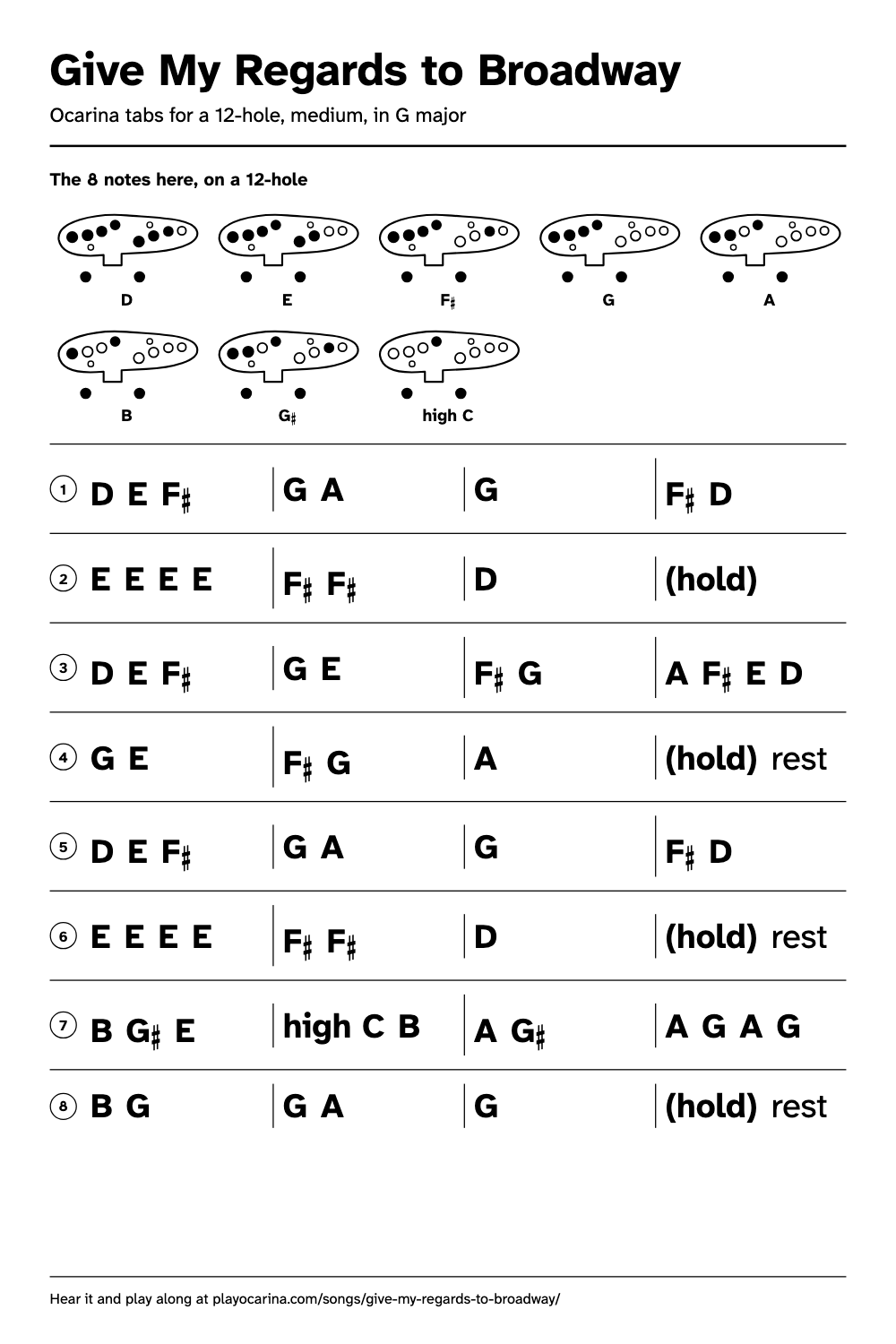
On a 12-hole. Read left to right, a line at a time.
- DEF♯GAGF♯D
- EEEEF♯F♯D(hold)
- DEF♯GEF♯GAF♯ED
- GEF♯GA(hold)rest
- DEF♯GAGF♯D
- EEEEF♯F♯D(hold)rest
- Tricky spot:BG♯Ehigh CBAG♯AGAG
- BGGAG(hold)rest
Give My Regards to Broadway is George M. Cohan's song from 1904, in march time, and its chorus opens with a climb, D, E, F sharp, G, that starts the second and third lines too. Here it is in G major, the chorus only, 32 bars in 2/4 from D up to high C. It fits a 12-hole, a 6-hole and a 4-hole ocarina. F sharp comes in each of the first three lines, so get its fingering comfortable first; the last line adds a G sharp.
What is the tricky spot in Give My Regards to Broadway?
The start of the last line, bar 25, where the tune leaps from D up to B, then drops to G sharp, the one note outside the key, and on down to E. On a 12-hole, Give My Regards to Broadway goes from B to G♯: you cover the left middle and right ring. On a 6-hole or 4-hole, you cover the left index.
D up to B is the widest jump in the song, and it comes straight after a rest, so set your fingers for B during the rest. G sharp is a cross-fingering on a C ocarina: practise B, G sharp, E slowly until it speaks, then bring it up to speed. It comes back in bar 27, A to G sharp, and the next bar goes back to plain G, A, G, so let the G sharp go once the bar is over. The four quick E's in bars 5 and 21 are tongued with the fingers still: a light "du" on each keeps them apart.
Where do you breathe in Give My Regards to Broadway?
Breathe at the end of each eight-bar line: after the long D in bar 8, letting it go a little early, and in the rests after the A in bar 16 and the D in bar 24. Take smaller breaths halfway through each line: after the long F sharp in bars 4 and 20, after the E in bar 12, and after the first A of bar 28. Then play to the end in one breath.
Which ocarina can play Give My Regards to Broadway?
Any 12-hole, 6-hole or 4-hole ocarina in C plays Give My Regards to Broadway in this key. On an ocarina in G or F, use the same fingerings: the tune sounds in a different key, which is fine when you play alone. Each linked chart has every fingering for its ocarina, and you can check your notes with a tuner such as our free ocarina tuner.
The 8 notes here, on a 12-holeHoles in words, with a picture
| Note | Holes to cover | Picture |
|---|---|---|
| D | Cover every main hole but the right pinky | |
| E | Cover every main hole but the right ring and right pinky | |
| F♯ | Cover every main hole but the right index, right middle and right pinky | |
| G | Cover every main hole but the right index, right middle, right ring and right pinky | |
| A | Cover the left pinky, left middle, left index, left thumb and right thumb | |
| B | Cover the left pinky, left index, left thumb and right thumb | |
| G♯ | Cover every main hole but the left ring, right index, right middle and right pinky | |
| high C | Cover the left pinky, left thumb and right thumb |
Drawn as you see it while playing: mouthpiece towards you, left hand on the left.
| Note | Holes to cover | Picture |
|---|---|---|
| D | Cover every hole but the right middle | |
| E | Cover every hole but the right index | |
| F♯ | Cover every hole but the left middle | |
| G | Cover every hole but the left middle and right middle | |
| A | Cover the left index, left thumb and right thumb | |
| B | Cover the right middle, left thumb and right thumb | |
| G♯ | Cover every hole but the left middle and right index | |
| high C | Cover the left thumb and right thumb |
Drawn as you see it while playing: mouthpiece towards you, left hand on the left.
| Note | Holes to cover | Picture |
|---|---|---|
| D | Cover every hole but the right middle | |
| E | Cover every hole but the right index | |
| F♯ | Cover every hole but the left middle | |
| G | Cover the left index and right index | |
| A | Cover the left index | |
| B | Cover the right middle | |
| G♯ | Cover the right middle and left index | |
| high C | All holes open |
Drawn as you see it while playing: mouthpiece towards you, left hand on the left.
Who wrote Give My Regards to Broadway?
George M. Cohan, who wrote the words and music for his musical Little Johnny Jones, which opened at the Liberty Theatre in New York on 7 November 1904; Cohan played the title role and sang the song himself. Our tabs follow a 1918 printing by the Maurice Richmond Music Co. of New York, headed Tempo di Marcia and marked "War Version by A.B.". Its verse is the 1918 war version, about soldiers in France, but its chorus is the tune people know, so we play the chorus only, once through with its last ending, moved from C major to G major. We show the melody only. Music: George M. Cohan (died 1942), words and music, for his musical Little Johnny Jones, 1904.