Hungarian Rhapsody No. 2 on the ocarina
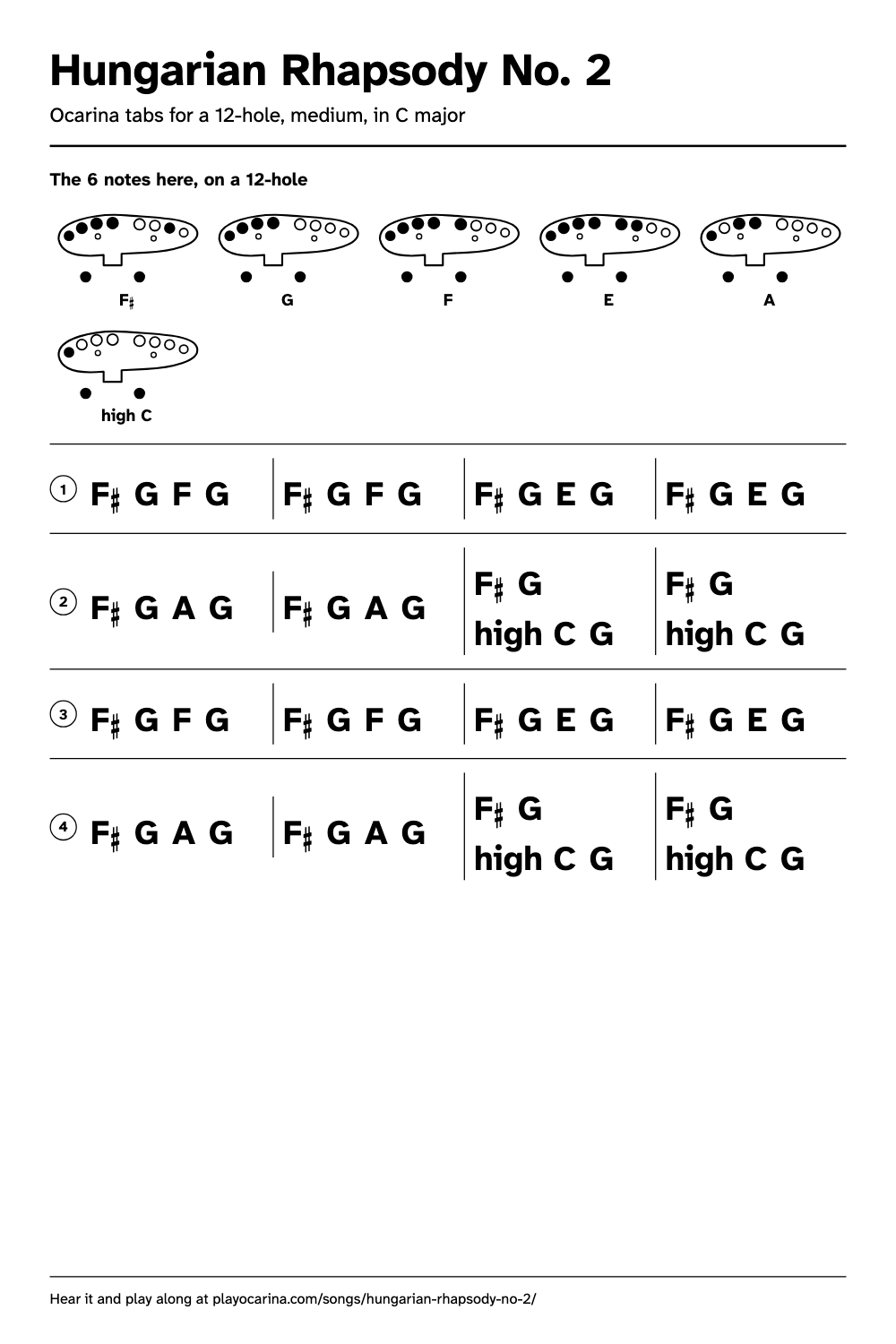
On a 12-hole it starts F♯, G, F, G. Medium, 64 notes, in C major.
Hungarian Rhapsody No. 2
Bar 1 of 16
What are the notes for Hungarian Rhapsody No. 2?
On a 12-hole. Read left to right, a line at a time.
- Tricky spot:F♯GFGF♯GFGF♯GEGF♯GEG
- F♯GAGF♯GAGF♯Ghigh CGF♯Ghigh CG
- F♯GFGF♯GFGF♯GEGF♯GEG
- F♯GAGF♯GAGF♯Ghigh CGF♯Ghigh CG
The tune most people mean by Hungarian Rhapsody No. 2 is the quick, stamping one: F sharp, G, a long accented note, G, over and over, with only the long note changing. It is the main theme of the friska, the fast second half, and here are its first 16 bars of 2/4 in the printing's own rhythm, moved from F sharp major to C major. The long note moves from F to E, A and high C, then the whole eight bars come round again.
How do you play the F sharp in Hungarian Rhapsody No. 2?
The F sharp and G that start every bar: a cross-fingered note and its neighbour, played 16 times at speed. On a 12-hole, Hungarian Rhapsody No. 2 goes from F♯ to G: you lift the right ring. On a 6-hole or 4-hole, you lift the right middle.
Every bar is the same short-short-long-short shape: F sharp and G as two crisp eighths, then the accented long note, three quarters of a beat, then a quick G that springs into the next bar. Liszt marks the two eighths with staccato dots and the long note with an accent, so tongue every note and lean on the third. Practise the F sharp to G change slowly first, since it comes in every bar. Then learn the four long notes in order, F, E, A and high C, two bars each. In the first two bars the long note is F natural, straight after F sharp and G, so take care to land on the plain F.
Which ocarina can play Hungarian Rhapsody No. 2?
Any 12-hole, 6-hole or 4-hole ocarina in C plays Hungarian Rhapsody No. 2 in this key. On an ocarina in G or F, use the same fingerings: the tune sounds in a different key, which is fine when you play alone. Each linked chart has every fingering for its ocarina, and you can check your notes with a tuner such as our free ocarina tuner.
The 6 notes here, on a 12-holeHoles in words, with a picture
| Note | Holes to cover | Picture |
|---|---|---|
| F♯ | Cover every main hole but the right index, right middle and right pinky | |
| G | Cover every main hole but the right index, right middle, right ring and right pinky | |
| F | Cover every main hole but the right middle, right ring and right pinky | |
| E | Cover every main hole but the right ring and right pinky | |
| A | Cover the left pinky, left middle, left index, left thumb and right thumb | |
| high C | Cover the left pinky, left thumb and right thumb |
Drawn as you see it while playing: mouthpiece towards you, left hand on the left.
| Note | Holes to cover | Picture |
|---|---|---|
| F♯ | Cover every hole but the left middle | |
| G | Cover every hole but the left middle and right middle | |
| F | Cover every hole but the right middle and right index | |
| E | Cover every hole but the right index | |
| A | Cover the left index, left thumb and right thumb | |
| high C | Cover the left thumb and right thumb |
Drawn as you see it while playing: mouthpiece towards you, left hand on the left.
| Note | Holes to cover | Picture |
|---|---|---|
| F♯ | Cover every hole but the left middle | |
| G | Cover the left index and right index | |
| F | Cover the left middle and left index | |
| E | Cover every hole but the right index | |
| A | Cover the left index | |
| high C | All holes open |
Drawn as you see it while playing: mouthpiece towards you, left hand on the left.
Where does the famous tune come in Hungarian Rhapsody No. 2?
In the second half. Liszt wrote the rhapsody in 1847 for Count László Teleki in two parts, a slow lassan and a fast friska, and this tune opens the friska's quick Tempo giusto section; it is the part that has turned up again and again in animated cartoons. Our tabs follow the top line of the right hand, which plays the tune in octaves, in Breitkopf & Härtel's 1926 edition of Liszt's works, moved down from F sharp major to C major. Senff's first edition of 1851, dedicated to Count Teleky, prints the same opening bars. Liszt died in 1886. The piece has no words. Music: Franz Liszt (1811-1886), the main theme of the friska of his Hungarian Rhapsody No. 2 for piano, written in 1847.