Doxology (Old Hundredth) on the ocarina
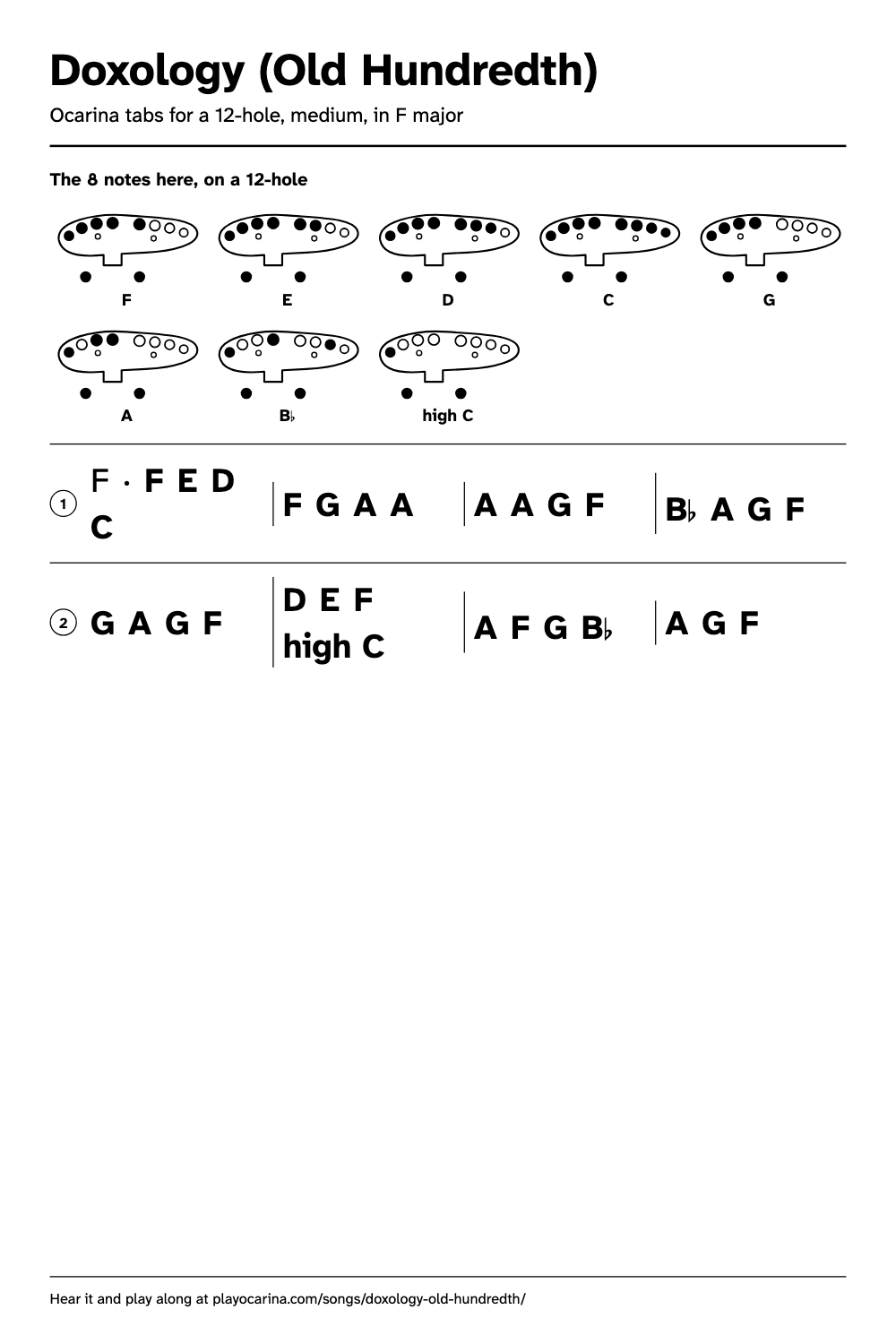
On a 12-hole it starts F, F, E, D. Medium, 32 notes, in F major.
Doxology (Old Hundredth)
Bar 1 of 8
What are the notes for the Doxology?
On a 12-hole. Read left to right, a line at a time.
- F FEDCFGAAAAGFB♭AGF
- GAGFTricky spot:DEFhigh CAFGB♭AGF
The Doxology is the four-line hymn many churches sing to the tune Old Hundredth. It opens F, F, E, D, C, then climbs back up through F, G and A. Here it is once through in F major, four lines of eight even notes from C to high C, so it fits a 12-hole, a 6-hole and a 4-hole ocarina.
What is the tricky spot in the Doxology?
The start of the last line, where the tune climbs D, E, F and then leaps a fifth up to high C, the top note of the hymn. On a 12-hole, the Doxology goes from F to high C: you lift the left ring, left middle, left index and right index. On a 6-hole or 4-hole, you lift the left middle and left index.
The F ends the third line, so take your breath there and give the high C a slightly firmer, quicker stream of air; then come down through A and F without letting the C sag flat. The other spot is B flat, the only note that is not a natural. It is the sixth note of the second line and comes back two notes before the end. On a 12-hole it is a cross-fingering: learn it on its own, then play A, B flat, A until it sits in tune.
Where do you breathe in the Doxology?
Every line is eight notes long and ends on the note the hymnal marks with a pause: the A at the end of the first line, the G at the end of the second, the F at the end of the third. Breathe after each of them. Churches often hold those notes a little longer, and you can too, as long as you come back in on the beat.
Which ocarina can play the Doxology?
Any 12-hole, 6-hole or 4-hole ocarina in C plays the Doxology in this key. On an ocarina in G or F, use the same fingerings: the tune sounds in a different key, which is fine when you play alone. Each linked chart has every fingering for its ocarina, and you can check your notes with a tuner such as our free ocarina tuner.
The 8 notes here, on a 12-holeHoles in words, with a picture
| Note | Holes to cover | Picture |
|---|---|---|
| F | Cover every main hole but the right middle, right ring and right pinky | |
| E | Cover every main hole but the right ring and right pinky | |
| D | Cover every main hole but the right pinky | |
| C | Cover every main hole | |
| G | Cover every main hole but the right index, right middle, right ring and right pinky | |
| A | Cover the left pinky, left middle, left index, left thumb and right thumb | |
| B♭ | Cover the left pinky, left index, right ring, left thumb and right thumb | |
| high C | Cover the left pinky, left thumb and right thumb |
Drawn as you see it while playing: mouthpiece towards you, left hand on the left.
| Note | Holes to cover | Picture |
|---|---|---|
| F | Cover every hole but the right middle and right index | |
| E | Cover every hole but the right index | |
| D | Cover every hole but the right middle | |
| C | Cover every hole | |
| G | Cover every hole but the left middle and right middle | |
| A | Cover the left index, left thumb and right thumb | |
| B♭ | Cover the right index, left thumb and right thumb | |
| high C | Cover the left thumb and right thumb |
Drawn as you see it while playing: mouthpiece towards you, left hand on the left.
| Note | Holes to cover | Picture |
|---|---|---|
| F | Cover the left middle and left index | |
| E | Cover every hole but the right index | |
| D | Cover every hole but the right middle | |
| C | Cover every hole | |
| G | Cover the left index and right index | |
| A | Cover the left index | |
| B♭ | Cover the right index | |
| high C | All holes open |
Drawn as you see it while playing: mouthpiece towards you, left hand on the left.
Why does the Doxology sound different in some churches?
Because the tune has two rhythms. It was first printed in Geneva, set to Psalm 134 in French, and is usually credited to Louis Bourgeois, a music teacher in Geneva who died in 1559. In the 1551 form each line starts on a long note and ends on long ones, with quicker notes between; many hymn books since have evened it out. Its English name comes from Psalm 100, "All People That on Earth Do Dwell", and the four lines called the Doxology were written in 1674 by Thomas Ken, a bishop in the Church of England who died in 1711, as the last verse of a longer morning hymn. Our tabs follow one printing, the even form in The Methodist Hymnal of 1905: 32 quarter notes, with a pause marked at the end of each line. We show the melody only. Music: the tune "Old Hundredth" from the Genevan Psalter (1551), attributed to Louis Bourgeois (c. 1510-1559); Doxology words by Thomas Ken (1637-1711).