Il est né, le divin Enfant on the ocarina
On a 12-hole it starts D, G, G, B. Medium, 103 notes, in G major.
Goes up to high E, so it does not fit a 4-hole.
Il est né, le divin Enfant
Bar 1 of 48
What are the notes for Il est né, le divin Enfant?
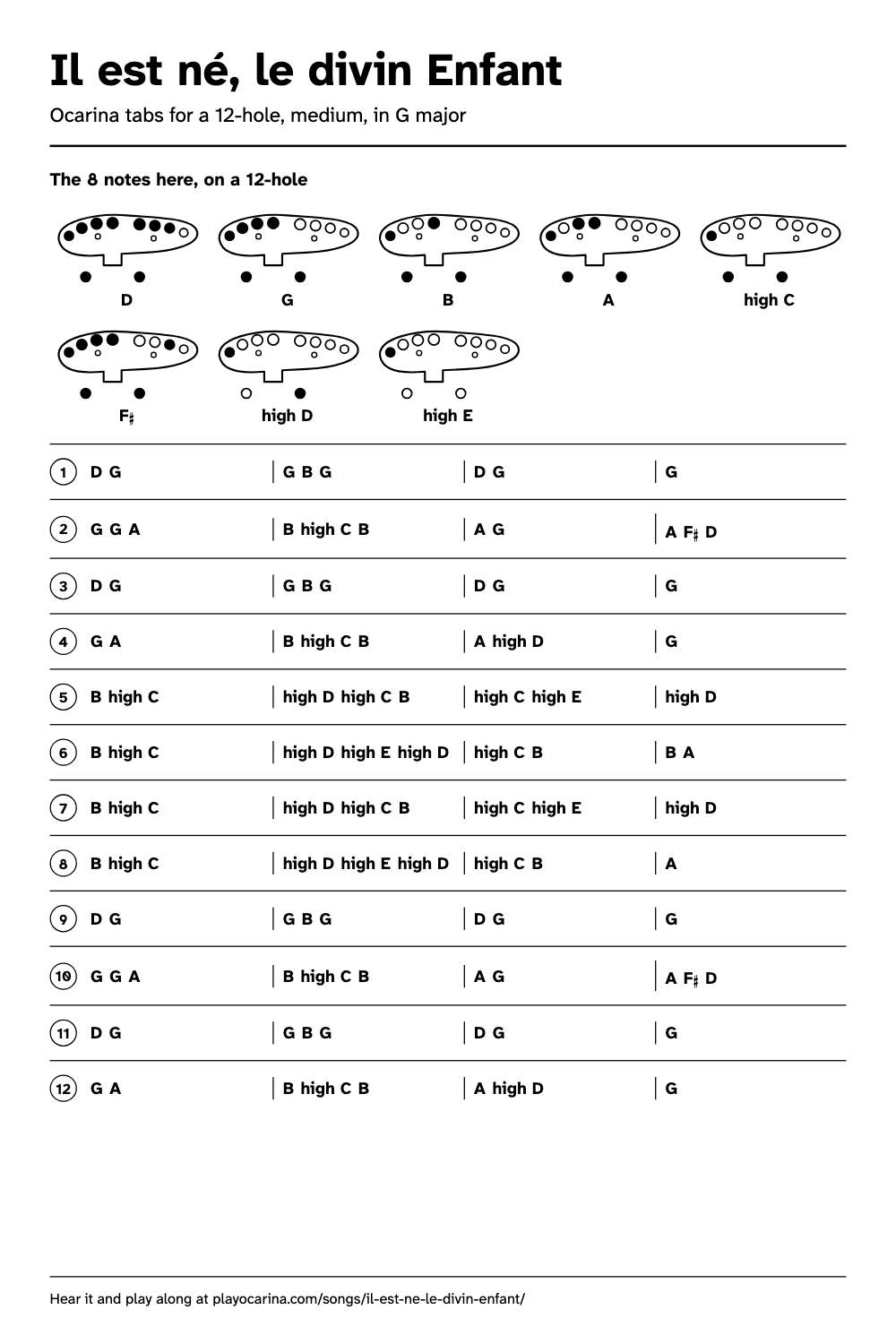
On a 12-hole. Read left to right, a line at a time.
- DGGBGDGG
- GGABhigh CBAGTricky spot:AF♯D
- DGGBGDGG
- GABhigh CBAhigh DG
- Bhigh Chigh Dhigh CBhigh Chigh Ehigh D
- Bhigh Chigh Dhigh Ehigh Dhigh CBBA
- Bhigh Chigh Dhigh CBhigh Chigh Ehigh D
- Bhigh Chigh Dhigh Ehigh Dhigh CBA
- DGGBGDGG
- GGABhigh CBAGAF♯D
- DGGBGDGG
- GABhigh CBAhigh DG
Il est né, le divin Enfant is a bright French carol in two beats a bar, in G major. Its refrain, which opens and closes the tune, starts with a leap from low D up to G and keeps coming back to that D. Between the two refrains the verse sits higher, rising from B to high E. The whole tune runs from D to high E, so it fits a 12-hole or a 6-hole ocarina in C.
What is the tricky spot in Il est né, le divin Enfant?
The end of the refrain's second line, "musettes", where a quick slurred pair, A then F sharp, falls to a low D. On a 12-hole, Il est né, le divin Enfant goes from A to F♯: you cover the left ring and right ring. On a 6-hole, you cover the right middle and right index.
F sharp is the one cross-fingered note in the carol, and here it lasts only half a beat. Finger A, then F sharp, then D slowly until the change is clean, then play the two eighths on one breath with no tongue between them, as the printing slurs them. The verse brings the other challenge: in every line it climbs to high E, so give the high notes a steady, slightly faster airstream (playing high notes) and let the C and B after them come down gently.
Where do you breathe in Il est né, le divin Enfant?
Each line of four bars ends on a held note or a falling pair, so breathe there: after the long G of each "divin Enfant", after the low D that ends "musettes", and on the long high D that ends the first and third lines of the verse. The verse ends on a long A; breathe there before the refrain comes back.
Which ocarina can play Il est né, le divin Enfant?
A 4-hole ocarina cannot reach high D and high E, so play Il est né, le divin Enfant in this key on a 12-hole or 6-hole ocarina in C. On an ocarina in G or F, use the same fingerings: the tune sounds in a different key, which is fine when you play alone. Each linked chart has every fingering for its ocarina, and you can check your notes with a tuner such as our free ocarina tuner.
The 8 notes here, on a 12-holeHoles in words, with a picture
| Note | Holes to cover | Picture |
|---|---|---|
| D | Cover every main hole but the right pinky | |
| G | Cover every main hole but the right index, right middle, right ring and right pinky | |
| B | Cover the left pinky, left index, left thumb and right thumb | |
| A | Cover the left pinky, left middle, left index, left thumb and right thumb | |
| high C | Cover the left pinky, left thumb and right thumb | |
| F♯ | Cover every main hole but the right index, right middle and right pinky | |
| high D | Cover the left pinky and right thumb | |
| high E | Cover the left pinky |
Drawn as you see it while playing: mouthpiece towards you, left hand on the left.
| Note | Holes to cover | Picture |
|---|---|---|
| D | Cover every hole but the right middle | |
| G | Cover every hole but the left middle and right middle | |
| B | Cover the right middle, left thumb and right thumb | |
| A | Cover the left index, left thumb and right thumb | |
| high C | Cover the left thumb and right thumb | |
| F♯ | Cover every hole but the left middle | |
| high D | Cover the left thumb | |
| high E | All holes open |
Drawn as you see it while playing: mouthpiece towards you, left hand on the left.
Where does Il est né, le divin Enfant come from?
From Lorraine in eastern France. The melody was first printed in the 1860s by Jean-Romary Grosjean, organist of the cathedral of Saint-Dié in the Vosges, in his collection of carols from Lorraine, and the words first appeared in a collection of old carols a dozen years later. Grosjean died in Saint-Dié in 1888, and the tune is traditional, its maker unknown. Our tabs follow Chantons un peu, a 1929 New York songbook of French songs, which prints the refrain and then the verse with a sign back to the refrain, so we play it refrain, verse, refrain, an octave up. We show the melody only, not its piano part. Music: traditional French carol, first printed by Jean-Romary Grosjean (1815-1888).