It Came Upon the Midnight Clear on the ocarina
On a 12-hole it starts F, high D, high C, high C. Medium, 66 notes, in Bb major.
Goes up to high D, so it does not fit a 4-hole.
It Came Upon the Midnight Clear
Bar 1 of 16
What are the notes for It Came Upon the Midnight Clear?
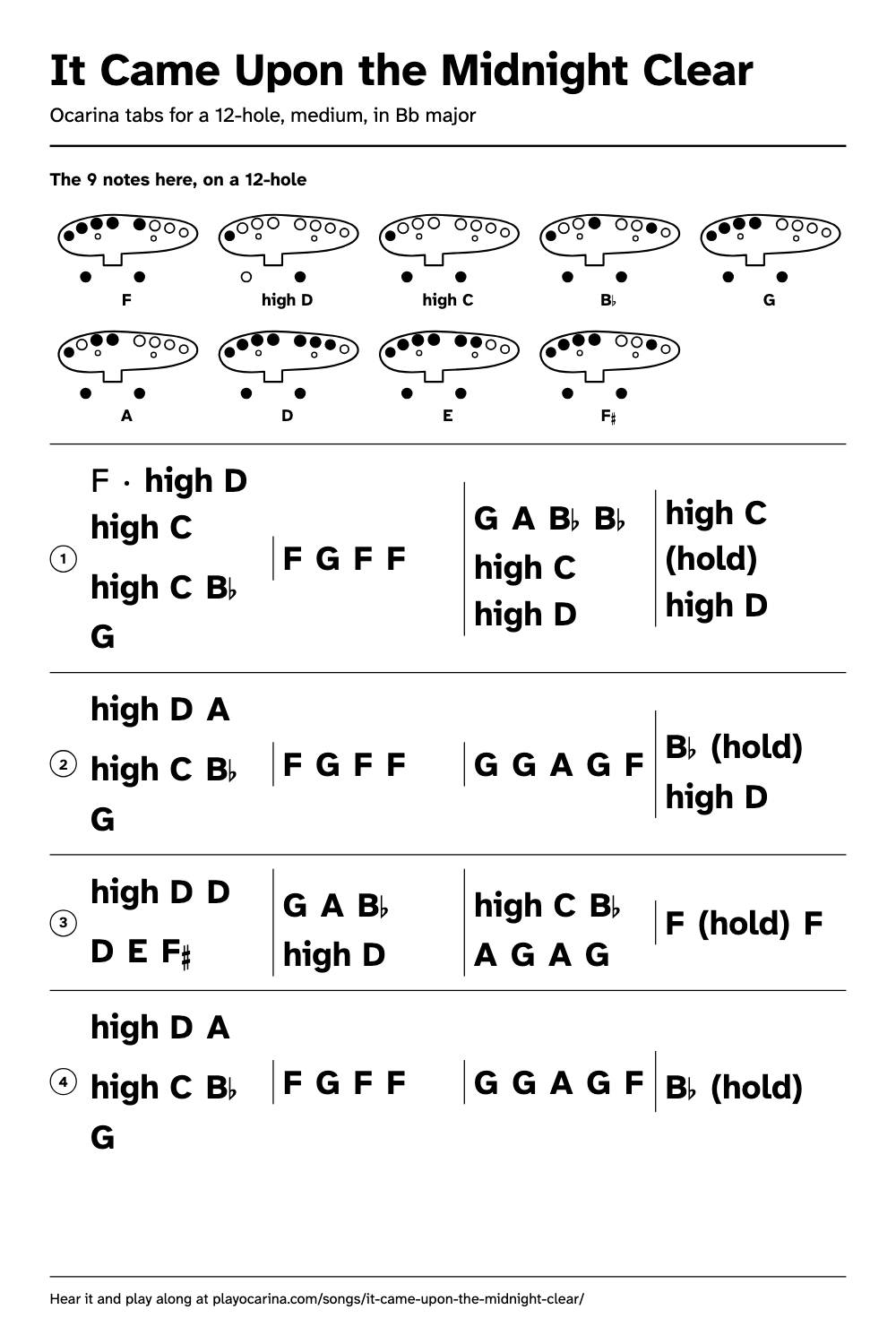
On a 12-hole. Read left to right, a line at a time.
- F high Dhigh Chigh CB♭GFGFFGAB♭B♭high Chigh Dhigh C(hold)high D
- high DAhigh CB♭GFGFFGGAGFB♭(hold)high D
- Tricky spot:high DDDEF♯GAB♭high Dhigh CB♭AGAGF(hold)F
- high DAhigh CB♭GFGFFGGAGFB♭(hold)
It Came Upon the Midnight Clear sways in 6/8 in B flat major, mostly a quarter note and an eighth to each half bar. It starts on an F upbeat and leaps straight to high D, and each of its four lines ends on a long held note. Here is the whole verse from D up to high D, which a 12-hole or a 6-hole ocarina in C can play. The first, second and last lines begin almost alike, so the third line, with its sudden drop to low D, is the one to learn on its own.
What is the tricky spot in It Came Upon the Midnight Clear?
The start of the third line, where the tune falls a full octave from high D to low D, then climbs back through E and F sharp. On a 12-hole, It Came Upon the Midnight Clear goes from high D to D: you cover the left ring, left middle, left index, right index, right middle, right ring and left thumb. On a 6-hole, you cover the left middle, left index, right index and right thumb.
Drop the air as you drop the octave: low D needs a slow, gentle breath, and a push meant for the high D will make it squeak. Practise high D, low D, E, F sharp, G slowly until the low D speaks cleanly. F sharp is a cross-fingering on a 12-hole, and so is the B flat that comes in most bars, so learn both on their own first (how to breathe for clean notes). In 6/8 feel two beats a bar, each a quarter note and an eighth, rather than counting all six.
Where do you breathe in It Came Upon the Midnight Clear?
Each line ends on a note held for most of a bar, the place to breathe: take the breath on the last part of that note, so the eighth-note upbeat that starts the next line still comes in time.
Which ocarina can play It Came Upon the Midnight Clear?
A 4-hole ocarina cannot reach high D, so play It Came Upon the Midnight Clear in this key on a 12-hole or 6-hole ocarina in C. On an ocarina in G or F, use the same fingerings: the tune sounds in a different key, which is fine when you play alone. Each linked chart has every fingering for its ocarina, and you can check your notes with a tuner such as our free ocarina tuner.
The 9 notes here, on a 12-holeHoles in words, with a picture
| Note | Holes to cover | Picture |
|---|---|---|
| F | Cover every main hole but the right middle, right ring and right pinky | |
| high D | Cover the left pinky and right thumb | |
| high C | Cover the left pinky, left thumb and right thumb | |
| B♭ | Cover the left pinky, left index, right ring, left thumb and right thumb | |
| G | Cover every main hole but the right index, right middle, right ring and right pinky | |
| A | Cover the left pinky, left middle, left index, left thumb and right thumb | |
| D | Cover every main hole but the right pinky | |
| E | Cover every main hole but the right ring and right pinky | |
| F♯ | Cover every main hole but the right index, right middle and right pinky |
Drawn as you see it while playing: mouthpiece towards you, left hand on the left.
| Note | Holes to cover | Picture |
|---|---|---|
| F | Cover every hole but the right middle and right index | |
| high D | Cover the left thumb | |
| high C | Cover the left thumb and right thumb | |
| B♭ | Cover the right index, left thumb and right thumb | |
| G | Cover every hole but the left middle and right middle | |
| A | Cover the left index, left thumb and right thumb | |
| D | Cover every hole but the right middle | |
| E | Cover every hole but the right index | |
| F♯ | Cover every hole but the left middle |
Drawn as you see it while playing: mouthpiece towards you, left hand on the left.
Why is It Came Upon the Midnight Clear sung to two different tunes?
Because the words crossed the Atlantic without their tune. Edmund Sears, a Unitarian pastor in Wayland, Massachusetts, wrote the poem in 1849, and in 1850 Richard Storrs Willis wrote a tune for it called "Carol". That pairing is the one sung in the United States; in Commonwealth countries the words go to "Noel", adapted later by Arthur Sullivan from an English melody. Our tabs follow Willis's tune as the 1905 Methodist Hymnal prints it, an octave up. Willis died in 1900 and Sears in 1876. We show the melody only. Music: tune "Carol" by Richard Storrs Willis (1819-1900); words by Edmund Sears (1810-1876).