The Holly and the Ivy on the ocarina
On a 12-hole it starts G, G, G, G. Medium, 60 notes, in G major.
Goes up to high E, so it does not fit a 4-hole.
The Holly and the Ivy
Bar 1 of 16
What are the notes for The Holly and the Ivy?
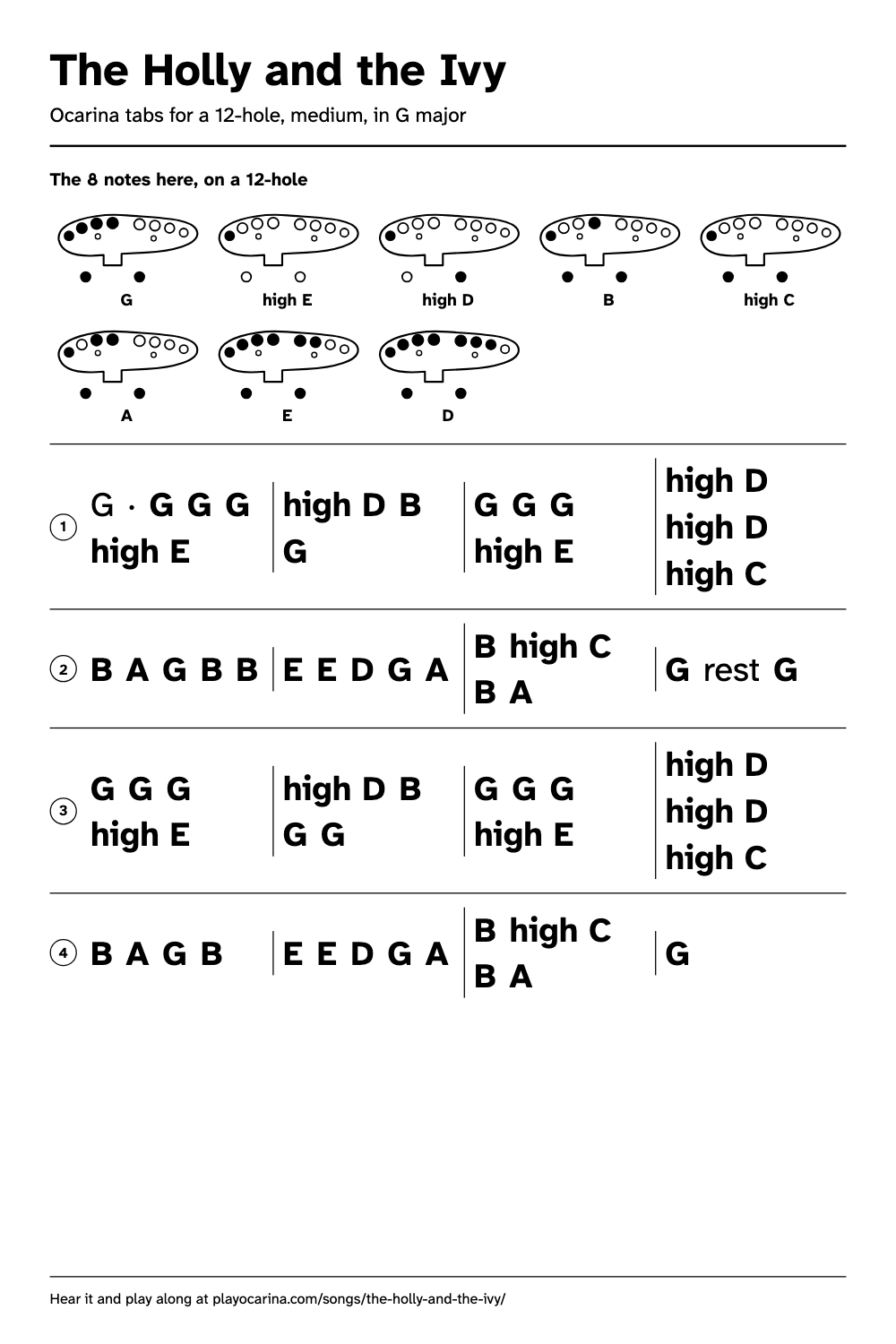
On a 12-hole. Read left to right, a line at a time.
- Tricky spot:G GGGhigh Ehigh DBGGGGhigh Ehigh Dhigh Dhigh C
- BAGBBEEDGABhigh CBAGrestG
- GGGhigh Ehigh DBGGGGGhigh Ehigh Dhigh Dhigh C
- BAGBEEDGABhigh CBAG
The Holly and the Ivy is a gentle waltz-time carol in G major. Each half opens with a run of quick G's and a leap to high E, then winds down to a low D before it climbs home to G. The tune spans D to high E with no sharps, so a 12-hole or a 6-hole ocarina in C plays it. The second half, the chorus about the rising sun and the running deer, reuses most of the first.
What is the tricky spot in The Holly and the Ivy?
The jump from G up to high E on "the ivy" and "full grown", a sixth that comes four times in the carol. On a 12-hole, The Holly and the Ivy goes from G to high E: you lift the left ring, left middle, left index, left thumb and right thumb. On a 6-hole, you lift the left index, right index, left thumb and right thumb.
Hear the high E before you play it: sing G, then E, a few times, and only then blow. High E needs a quicker, firmer stream than the G's under it, but not a harder push, or it goes sharp (playing high notes in tune). The quick G's in front of it are a chance to set up: tongue them lightly and keep the breath moving through them. The other spot to watch is the low dip near the end of each half, two E's and a long D, where the air should soften so the D does not crack.
Where do you breathe in The Holly and the Ivy?
Breathe on the long high D at the end of the second line ("grown", "deer"), and again on the long G that closes each half. The printing has a short rest after the first long G, before the chorus starts, so take a full breath there.
Which ocarina can play The Holly and the Ivy?
A 4-hole ocarina cannot reach high D and high E, so play The Holly and the Ivy in this key on a 12-hole or 6-hole ocarina in C. On an ocarina in G or F, use the same fingerings: the tune sounds in a different key, which is fine when you play alone. Each linked chart has every fingering for its ocarina, and you can check your notes with a tuner such as our free ocarina tuner.
The 8 notes here, on a 12-holeHoles in words, with a picture
| Note | Holes to cover | Picture |
|---|---|---|
| G | Cover every main hole but the right index, right middle, right ring and right pinky | |
| high E | Cover the left pinky | |
| high D | Cover the left pinky and right thumb | |
| B | Cover the left pinky, left index, left thumb and right thumb | |
| high C | Cover the left pinky, left thumb and right thumb | |
| A | Cover the left pinky, left middle, left index, left thumb and right thumb | |
| E | Cover every main hole but the right ring and right pinky | |
| D | Cover every main hole but the right pinky |
Drawn as you see it while playing: mouthpiece towards you, left hand on the left.
| Note | Holes to cover | Picture |
|---|---|---|
| G | Cover every hole but the left middle and right middle | |
| high E | All holes open | |
| high D | Cover the left thumb | |
| B | Cover the right middle, left thumb and right thumb | |
| high C | Cover the left thumb and right thumb | |
| A | Cover the left index, left thumb and right thumb | |
| E | Cover every hole but the right index | |
| D | Cover every hole but the right middle |
Drawn as you see it while playing: mouthpiece towards you, left hand on the left.
Where does the tune of The Holly and the Ivy come from?
From one singer in a Gloucestershire market town. The words were printed on Birmingham song sheets in the early 1800s, but villages sang them to different tunes. The folk song collector Cecil Sharp noted this one in 1909 from Mary Clayton of Chipping Campden. He printed it, with her name, in English Folk-Carols, published in London in 1911, and the version sung today is hers. Our tabs follow that book, an octave up. Sharp wrote the piano part, which we leave out, and died in 1924. Music: traditional English carol, as Cecil Sharp collected it from Mary Clayton of Chipping Campden.