It Is Well with My Soul on the ocarina
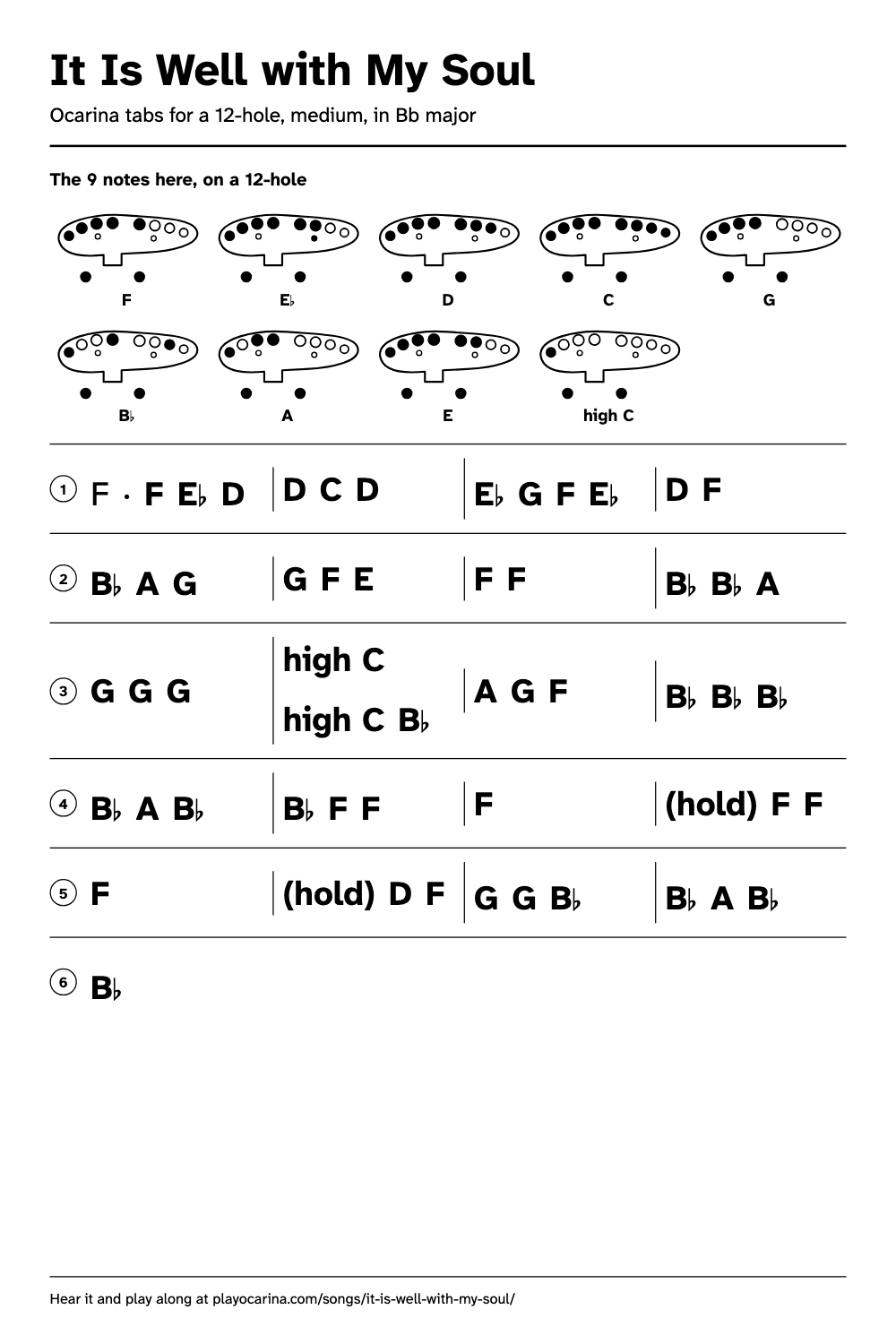
On a 12-hole it starts F, F, E♭, D. Medium, 55 notes, in Bb major.
It Is Well with My Soul
Bar 1 of 21
What are the notes for It Is Well with My Soul?
On a 12-hole. Read left to right, a line at a time.
- F FE♭DDCDE♭GFE♭DF
- B♭AGTricky spot:GFEFFB♭B♭A
- GGGhigh Chigh CB♭AGFB♭B♭B♭
- B♭AB♭B♭FFF(hold)FF
- F(hold)DFGGB♭B♭AB♭
- B♭
It Is Well with My Soul is a slow gospel hymn in four, and in B flat major it lies between C and high C, so a 12-hole, a 6-hole and a 4-hole ocarina in C can all play it. The verse climbs to a long high C on its third line; the chorus is mostly one note, F, held long while the hymn's lower voices answer it.
What is the tricky spot in It Is Well with My Soul?
The end of the second line, on "sea billows roll": the tune falls from F to E natural and then lifts back to F. On a 12-hole, 6-hole or 4-hole, It Is Well with My Soul goes from F to E: you cover the right middle.
E natural is the one note outside the key, and it comes only this once. The first line used E flat, a cross-fingering on a 12-hole, so your fingers will want to go back to it. Play F, E, F slowly until the E sits a half step under the F. The other spot to practise is the leap from the long F up to B flat that opens the second and third lines: give the B flat a slightly firmer breath and hold it the full two beats.
Where do you breathe in It Is Well with My Soul?
Breathe on the three-beat notes that end the first two lines, the long D and the long F, and on the half note before the chorus. In the chorus, F is held for six beats twice: take a full breath before each "It is", start the long F softly and keep the air even so it does not sag flat by the end.
Which ocarina can play It Is Well with My Soul?
Any 12-hole, 6-hole or 4-hole ocarina in C plays It Is Well with My Soul in this key. On an ocarina in G or F, use the same fingerings: the tune sounds in a different key, which is fine when you play alone. Each linked chart has every fingering for its ocarina, and you can check your notes with a tuner such as our free ocarina tuner.
The 9 notes here, on a 12-holeHoles in words, with a picture
| Note | Holes to cover | Picture |
|---|---|---|
| F | Cover every main hole but the right middle, right ring and right pinky | |
| E♭ | Cover every main hole but the right ring and right pinky, plus the right sub-hole | |
| D | Cover every main hole but the right pinky | |
| C | Cover every main hole | |
| G | Cover every main hole but the right index, right middle, right ring and right pinky | |
| B♭ | Cover the left pinky, left index, right ring, left thumb and right thumb | |
| A | Cover the left pinky, left middle, left index, left thumb and right thumb | |
| E | Cover every main hole but the right ring and right pinky | |
| high C | Cover the left pinky, left thumb and right thumb |
Drawn as you see it while playing: mouthpiece towards you, left hand on the left.
| Note | Holes to cover | Picture |
|---|---|---|
| F | Cover every hole but the right middle and right index | |
| E♭ | Cover the left middle, right middle, left index, left thumb and right thumb; half-cover the right index | |
| D | Cover every hole but the right middle | |
| C | Cover every hole | |
| G | Cover every hole but the left middle and right middle | |
| B♭ | Cover the right index, left thumb and right thumb | |
| A | Cover the left index, left thumb and right thumb | |
| E | Cover every hole but the right index | |
| high C | Cover the left thumb and right thumb |
Drawn as you see it while playing: mouthpiece towards you, left hand on the left.
| Note | Holes to cover | Picture |
|---|---|---|
| F | Cover the left middle and left index | |
| E♭ | Cover the left middle, right middle and left index; half-cover the right index | |
| D | Cover every hole but the right middle | |
| C | Cover every hole | |
| G | Cover the left index and right index | |
| B♭ | Cover the right index | |
| A | Cover the left index | |
| E | Cover every hole but the right index | |
| high C | All holes open |
Drawn as you see it while playing: mouthpiece towards you, left hand on the left.
Why is the tune of It Is Well with My Soul called Ville du Havre?
Because of a shipwreck. In 1873 Horatio Spafford's four daughters died when the steamer SS Ville du Havre sank in the Atlantic after a collision; he wrote the words on his own crossing to join his wife, and Philip Bliss named his tune after the ship. The hymn was first published in Gospel Hymns No. 2 by Ira Sankey and Bliss in 1876. Our tabs follow the top voice of the Toronto printing of that book, entered in 1877, which credits "H. G. Spafford" and "P. P. Bliss"; we move it from D flat major to B flat major. Its chorus is printed as a call and answer: the top voice holds "well" and "soul" while the voices below sing "it is well" and "with my soul", which is why our tabs hold F so long there. Bliss died in December 1876 and Spafford in 1888. We show the melody only. Music: the tune "Ville du Havre" by Philip P. Bliss (1838-1876); words by Horatio G. Spafford (1828-1888).