Jesus Loves Me on the ocarina
On a 12-hole it starts G, E, E, D. Easy, 49 notes, in C major.
Jesus Loves Me
Bar 1 of 16
What are the notes for Jesus Loves Me?
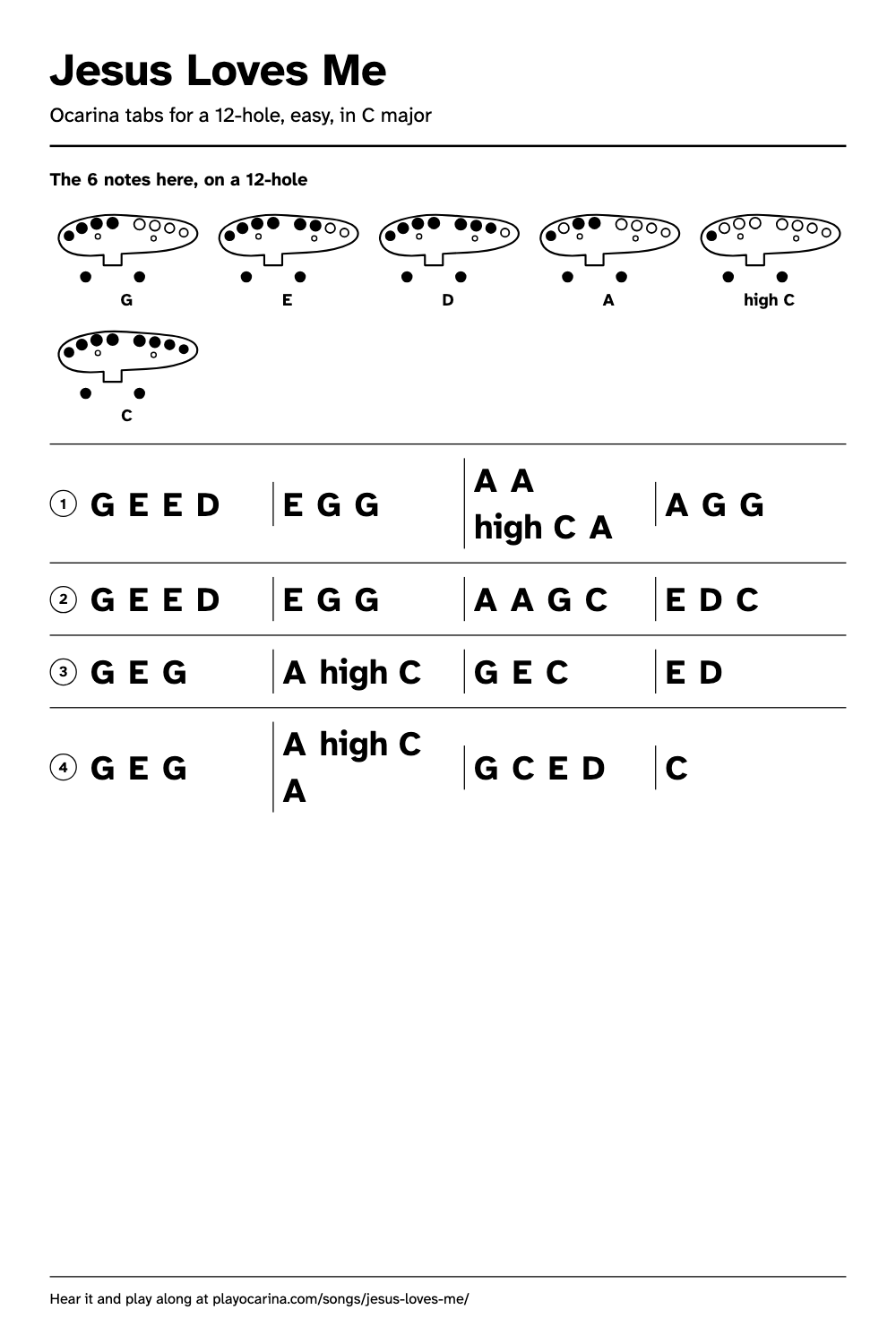
On a 12-hole. Read left to right, a line at a time.
- GEEDEGGAAhigh CAAGG
- GEEDEGGTricky spot:AAGCEDC
- GEGAhigh CGECED
- GEGAhigh CAGCEDC
Jesus Loves Me opens G, E, E, D, then E, G, G: a children's hymn built from six notes with no sharps or flats. Here it is in C major, from C to high C, so it fits a 12-hole, a 6-hole and a 4-hole ocarina in C. Our tabs play the eight-bar verse and then the eight-bar chorus, sixteen short bars of two beats each.
What is the tricky spot in Jesus Loves Me?
The end of the seventh bar, where the verse drops from G straight down to C, a fifth, before it climbs back through E and D to finish on C. On a 12-hole, Jesus Loves Me goes from G to C: you cover the right index, right middle, right ring and right pinky. On a 6-hole or 4-hole, you cover the left middle and right middle.
C is every finger down on most ocarinas, so drop all of them at once and keep the breath soft or the note cracks. The same G to C drop comes back in the last line of the chorus, followed at once by the only dotted rhythm in the song: a longer E and a very short D, which the 1862 page prints as a dotted eighth and a sixteenth. Count it as a lilt, long then short, rather than two even notes.
Where do you breathe in Jesus Loves Me?
The verse falls into two-bar pieces that each end on a held note, the G at the end of the second, fourth and sixth bars and the C at the end of the eighth, so there is time for a quick breath at each. In the chorus, breathe after the long high C in the tenth bar and after the long D in the twelfth.
Which ocarina can play Jesus Loves Me?
Any 12-hole, 6-hole or 4-hole ocarina in C plays Jesus Loves Me in this key. On an ocarina in G or F, use the same fingerings: the tune sounds in a different key, which is fine when you play alone. Each linked chart has every fingering for its ocarina, and you can check your notes with a tuner such as our free ocarina tuner.
The 6 notes here, on a 12-holeHoles in words, with a picture
| Note | Holes to cover | Picture |
|---|---|---|
| G | Cover every main hole but the right index, right middle, right ring and right pinky | |
| E | Cover every main hole but the right ring and right pinky | |
| D | Cover every main hole but the right pinky | |
| A | Cover the left pinky, left middle, left index, left thumb and right thumb | |
| high C | Cover the left pinky, left thumb and right thumb | |
| C | Cover every main hole |
Drawn as you see it while playing: mouthpiece towards you, left hand on the left.
| Note | Holes to cover | Picture |
|---|---|---|
| G | Cover every hole but the left middle and right middle | |
| E | Cover every hole but the right index | |
| D | Cover every hole but the right middle | |
| A | Cover the left index, left thumb and right thumb | |
| high C | Cover the left thumb and right thumb | |
| C | Cover every hole |
Drawn as you see it while playing: mouthpiece towards you, left hand on the left.
| Note | Holes to cover | Picture |
|---|---|---|
| G | Cover the left index and right index | |
| E | Cover every hole but the right index | |
| D | Cover every hole but the right middle | |
| A | Cover the left index | |
| high C | All holes open | |
| C | Cover every hole |
Drawn as you see it while playing: mouthpiece towards you, left hand on the left.
Where does the chorus of Jesus Loves Me come from?
Anna Bartlett Warner's words first appeared in 1860 as a poem in Say and Seal, a novel by her sister Susan Warner, and had no chorus. William B. Bradbury wrote the tune in 1862, added a chorus of his own, "Yes, Jesus loves me", and printed the song on page 68 of his Sunday-school book Golden Shower of S.S. Melodies, in two-four time with the chorus marked over the second line. In the book's preface he already names it by that chorus line, among the pieces he wanted Sunday-school children singing. Some 19th-century hymnals called the tune "China". Our tabs follow the top voice on that 1862 page. Bradbury died in 1868 and Warner in 1915. We show the melody only. Music: tune and chorus by William B. Bradbury (1816-1868), 1862; words by Anna Bartlett Warner (1827-1915).