Moonlight Sonata on the ocarina
On a 12-hole it starts E, E, E, E. Medium, 23 notes, in A minor.
Moonlight Sonata
Bar 1 of 10
What are the notes for the Moonlight Sonata?
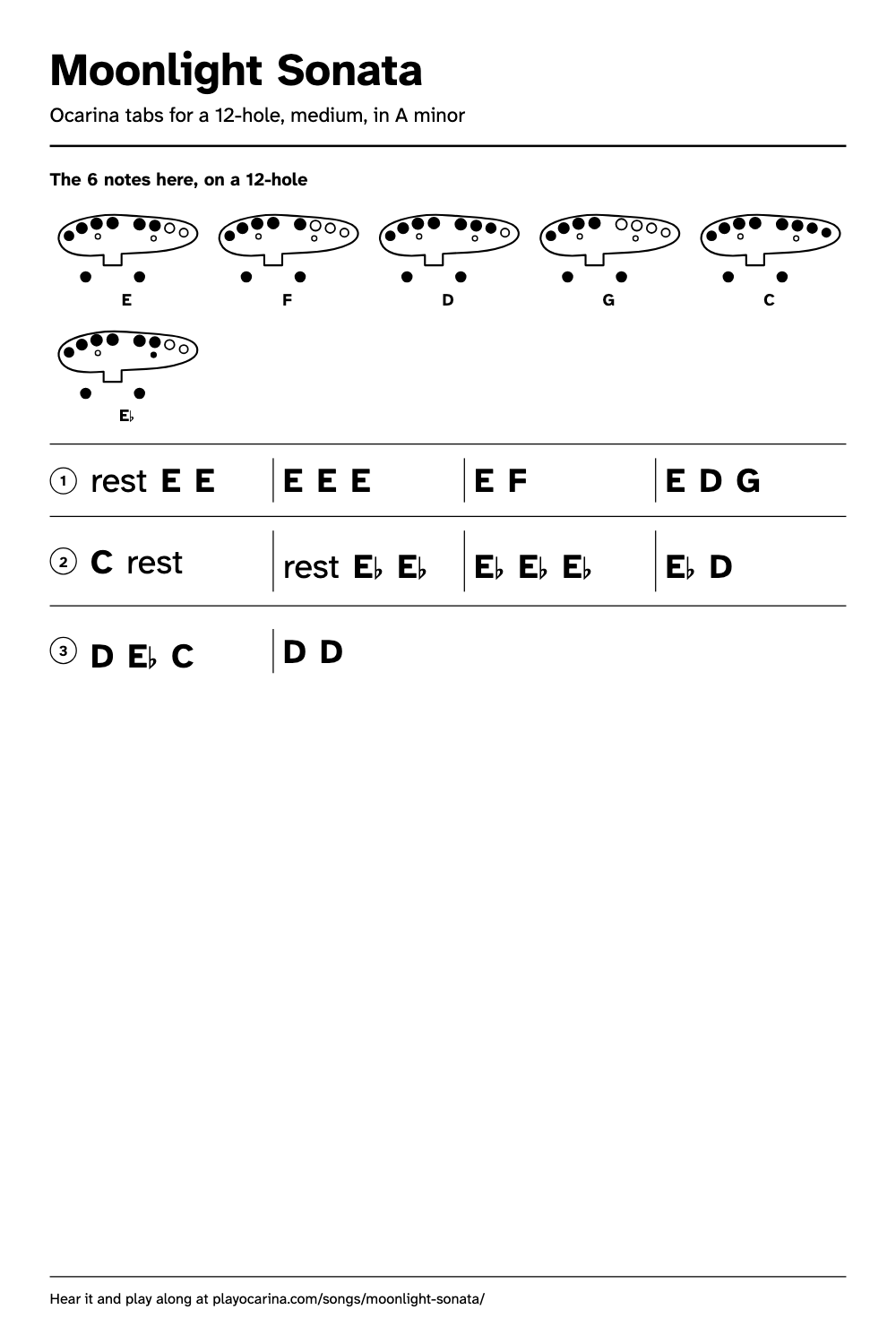
On a 12-hole. Read left to right, a line at a time.
- restEEEEEEFTricky spot:EDG
- CrestrestE♭E♭E♭E♭E♭E♭D
- DE♭CDD
The Moonlight Sonata's theme is the slow tune that enters over the piano's rippling triplets: E, E, E in a dotted rhythm, a step up to F and back, then D, G and down to a long C. Here are its first two phrases, 10 bars in A minor, from C up to G. The triplets are accompaniment, so the tabs leave them out and show the tune alone; each gap is a stretch where the piano plays only the triplets. The second phrase repeats the first rhythm a half step lower, on E-flat, and comes to rest on two long D's.
What is the tricky spot in the Moonlight Sonata?
The end of the first phrase, where the tune steps down to D, leaps up to G and then drops a fifth to a long C. On a 12-hole, the Moonlight Sonata goes from D to G: you lift the right index, right middle and right ring. On a 6-hole or 4-hole, you lift the left middle.
Land the G cleanly and give it a full beat before falling to C; nothing here is fast, so take the leap slowly until both notes speak at the same strength. The second phrase brings the one cross-fingered note, E-flat: practise E-flat to D and back on its own before you play the phrase. Count the silent beats out loud at first. The tune starts after three beats of silence, and between the two phrases six beats go by with no notes, which is where the piano plays its triplets alone.
Which ocarina can play the Moonlight Sonata?
Any 12-hole, 6-hole or 4-hole ocarina in C plays the Moonlight Sonata in this key. On an ocarina in G or F, use the same fingerings: the tune sounds in a different key, which is fine when you play alone. Each linked chart has every fingering for its ocarina, and you can check your notes with a tuner such as our free ocarina tuner.
The 6 notes here, on a 12-holeHoles in words, with a picture
| Note | Holes to cover | Picture |
|---|---|---|
| E | Cover every main hole but the right ring and right pinky | |
| F | Cover every main hole but the right middle, right ring and right pinky | |
| D | Cover every main hole but the right pinky | |
| G | Cover every main hole but the right index, right middle, right ring and right pinky | |
| C | Cover every main hole | |
| E♭ | Cover every main hole but the right ring and right pinky, plus the right sub-hole |
Drawn as you see it while playing: mouthpiece towards you, left hand on the left.
| Note | Holes to cover | Picture |
|---|---|---|
| E | Cover every hole but the right index | |
| F | Cover every hole but the right middle and right index | |
| D | Cover every hole but the right middle | |
| G | Cover every hole but the left middle and right middle | |
| C | Cover every hole | |
| E♭ | Cover the left middle, right middle, left index, left thumb and right thumb; half-cover the right index |
Drawn as you see it while playing: mouthpiece towards you, left hand on the left.
| Note | Holes to cover | Picture |
|---|---|---|
| E | Cover every hole but the right index | |
| F | Cover the left middle and left index | |
| D | Cover every hole but the right middle | |
| G | Cover the left index and right index | |
| C | Cover every hole | |
| E♭ | Cover the left middle, right middle and left index; half-cover the right index |
Drawn as you see it while playing: mouthpiece towards you, left hand on the left.
When did Beethoven write the Moonlight Sonata?
In 1801. Beethoven completed the sonata in 1801 and dedicated it in 1802 to his pupil Countess Giulietta Guicciardi, and the first edition, printed in Vienna by Cappi, names her on its title page and calls the piece Sonata quasi una fantasia. The name Moonlight came later, from the poet Ludwig Rellstab's picture of moonlight on a lake. Our tabs follow the theme on page 2 of that first edition, the upper notes of the right hand from bar 5 to bar 14, moved from C-sharp minor up to A minor; we leave out the triplets that run underneath. Beethoven died in 1827. We show the melody only. Music: Ludwig van Beethoven (1770-1827), the theme of the first movement of his Piano Sonata No. 14 in C-sharp minor, Op. 27 No. 2, 1801.