O Come, O Come, Emmanuel on the ocarina
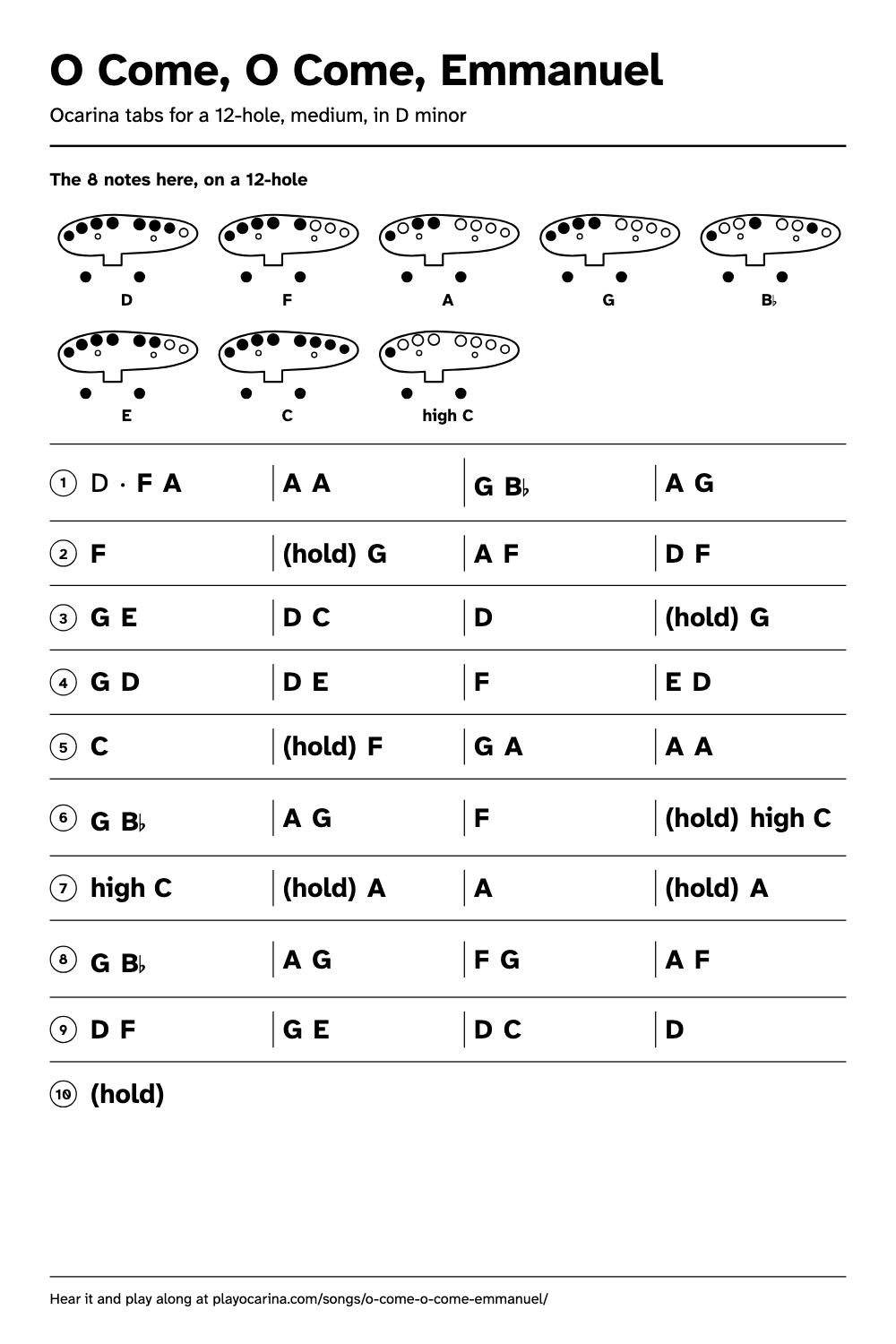
On a 12-hole it starts D, F, A, A. Medium, 59 notes, in D minor.
O Come, O Come, Emmanuel
Bar 1 of 37
What are the notes for O Come, O Come, Emmanuel?
On a 12-hole. Read left to right, a line at a time.
- D FAAAGB♭AG
- F(hold)GAFDF
- GEDCD(hold)G
- GDDEFED
- C(hold)FGAAA
- GB♭AGFTricky spot:(hold)high C
- high C(hold)AA(hold)A
- GB♭AGFGAF
- DFGEDCD
- (hold)
O Come, O Come, Emmanuel moves like a slow chant: almost every note is the same length, and most lines end on a note held for three beats. Here it is in D minor, between C and high C, with B♭ as its one flat, so a 12-hole, a 6-hole and a 4-hole ocarina in C can play it. The refrain closes with the verse's second line, note for note.
What is the tricky spot in O Come, O Come, Emmanuel?
The start of the refrain, where the long F at the end of the fourth line jumps up a fifth to high C for "Rejoice". On a 12-hole, O Come, O Come, Emmanuel goes from F to high C: you lift the left ring, left middle, left index and right index. On a 6-hole or 4-hole, you lift the left middle and left index.
Play F, then high C, slowly, until the C speaks cleanly on its first breath; it is the highest note in the hymn and needs a firmer, faster stream of air than the F (more on breath). The C is then held for three beats and drops to A, which is also held: keep the air steady through both, so the pitch does not sag. The other place to practise is G, B♭, A, G, which comes three times. B♭ is a cross-fingering on a 12-hole, so learn it on its own and then play A, B♭, A until it sits in tune.
Where do you breathe in O Come, O Come, Emmanuel?
On every long note. Most lines end on a note held for three beats, then one short note starts the next line, so take your breath at the end of the long note. The refrain's two held notes, high C and then A, come one after the other; if you need air there, breathe between them.
Which ocarina can play O Come, O Come, Emmanuel?
Any 12-hole, 6-hole or 4-hole ocarina in C plays O Come, O Come, Emmanuel in this key. On an ocarina in G or F, use the same fingerings: the tune sounds in a different key, which is fine when you play alone. Each linked chart has every fingering for its ocarina, and you can check your notes with a tuner such as our free ocarina tuner.
The 8 notes here, on a 12-holeHoles in words, with a picture
| Note | Holes to cover | Picture |
|---|---|---|
| D | Cover every main hole but the right pinky | |
| F | Cover every main hole but the right middle, right ring and right pinky | |
| A | Cover the left pinky, left middle, left index, left thumb and right thumb | |
| G | Cover every main hole but the right index, right middle, right ring and right pinky | |
| B♭ | Cover the left pinky, left index, right ring, left thumb and right thumb | |
| E | Cover every main hole but the right ring and right pinky | |
| C | Cover every main hole | |
| high C | Cover the left pinky, left thumb and right thumb |
Drawn as you see it while playing: mouthpiece towards you, left hand on the left.
| Note | Holes to cover | Picture |
|---|---|---|
| D | Cover every hole but the right middle | |
| F | Cover every hole but the right middle and right index | |
| A | Cover the left index, left thumb and right thumb | |
| G | Cover every hole but the left middle and right middle | |
| B♭ | Cover the right index, left thumb and right thumb | |
| E | Cover every hole but the right index | |
| C | Cover every hole | |
| high C | Cover the left thumb and right thumb |
Drawn as you see it while playing: mouthpiece towards you, left hand on the left.
| Note | Holes to cover | Picture |
|---|---|---|
| D | Cover every hole but the right middle | |
| F | Cover the left middle and left index | |
| A | Cover the left index | |
| G | Cover the left index and right index | |
| B♭ | Cover the right index | |
| E | Cover every hole but the right index | |
| C | Cover every hole | |
| high C | All holes open |
Drawn as you see it while playing: mouthpiece towards you, left hand on the left.
Is O Come, O Come, Emmanuel a medieval tune?
Probably, though for over a century no one could show it. The choirmaster Thomas Helmore first set these words to it in 1851, with John Mason Neale's translation of the Latin hymn, and named a French missal in Lisbon as his source, but gave no way to check it. Then in 1966 Mary Berry found the melody in a 15th-century French manuscript, with other words. Our tabs follow Hymns Ancient and Modern, 1861, which prints the tune in long half notes with no time signature; we halve them and count the tune in twos. Helmore died in 1890 and Neale in 1866. We show the melody only. Music: the tune Veni Emmanuel, first set to these words by Thomas Helmore (1811-1890) in 1851; words translated by John Mason Neale (1818-1866).