Raindrop Prelude on the ocarina
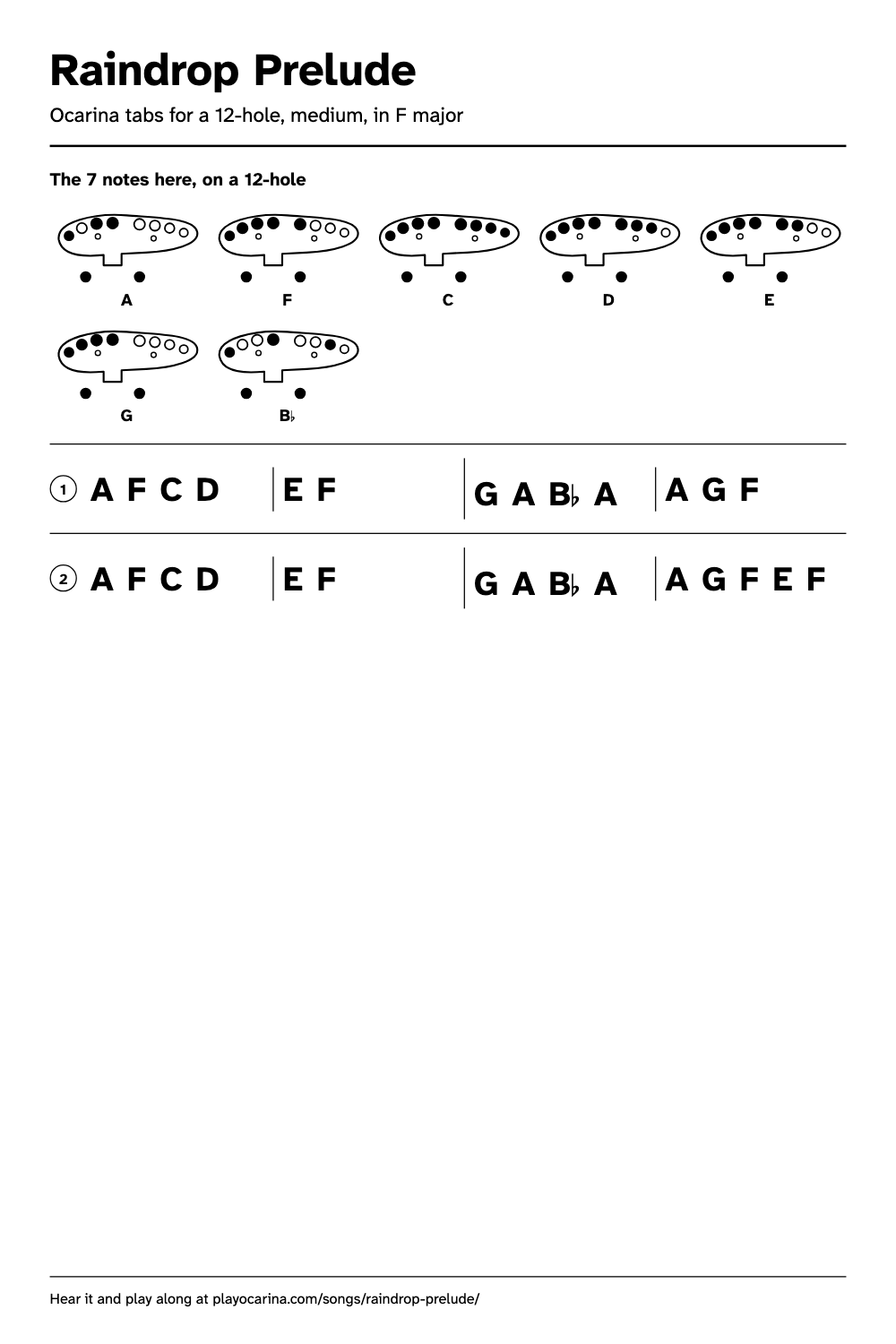
On a 12-hole it starts A, F, C, D. Medium, 28 notes, in F major.
Raindrop Prelude
Bar 1 of 8
What are the notes for the Raindrop Prelude?
On a 12-hole. Read left to right, a line at a time.
- AFCDEFTricky spot:GAB♭AAGF
- AFCDEFGAB♭AAGFEF
Chopin's Raindrop Prelude opens on A, a quick F and a long low C, then steps up through D, E and F and climbs G, A to B flat: a slow, singing tune over a note that repeats like rain. Here is its main theme, simplified: the first eight bars of the melody, 4/4 in F major, from C up to B flat, with one flat. It fits a 4-hole, 6-hole or 12-hole ocarina.
What is the tricky part of the Raindrop Prelude?
The top of each phrase, where the tune climbs G, A and then B flat, the highest note and the only one that is not in the C major scale, and holds it for two beats. On a 12-hole, the Raindrop Prelude goes from A to B♭: you swap hands: lift the left middle and cover the right ring. On a 6-hole or 4-hole, you swap hands: lift the left index and cover the right index.
Play G, A, B flat slowly until the B flat sounds clear and in tune; our tuner shows whether it sits flat. The quick notes come in pairs, a long one and a very short one, three quarters of a beat and then a quarter, as in the opening A then F: keep the short note light and land on the long note after it. The printing marks the piece Sostenuto, sustained, with no speed; our player starts at 60 beats a minute, slow enough to let every long note sing.
Where do you breathe in the Raindrop Prelude?
Breathe at the end of bar 4, after the long F that closes the first phrase, and again at the end of bar 8. If you need more air, a quick breath after the long E in bar 2 or bar 6 also works.
Which ocarina can play the Raindrop Prelude?
Any 12-hole, 6-hole or 4-hole ocarina in C plays the Raindrop Prelude in this key. On an ocarina in G or F, use the same fingerings: the tune sounds in a different key, which is fine when you play alone. Each linked chart has every fingering for its ocarina, and you can check your notes with a tuner such as our free ocarina tuner.
The 7 notes here, on a 12-holeHoles in words, with a picture
| Note | Holes to cover | Picture |
|---|---|---|
| A | Cover the left pinky, left middle, left index, left thumb and right thumb | |
| F | Cover every main hole but the right middle, right ring and right pinky | |
| C | Cover every main hole | |
| D | Cover every main hole but the right pinky | |
| E | Cover every main hole but the right ring and right pinky | |
| G | Cover every main hole but the right index, right middle, right ring and right pinky | |
| B♭ | Cover the left pinky, left index, right ring, left thumb and right thumb |
Drawn as you see it while playing: mouthpiece towards you, left hand on the left.
| Note | Holes to cover | Picture |
|---|---|---|
| A | Cover the left index, left thumb and right thumb | |
| F | Cover every hole but the right middle and right index | |
| C | Cover every hole | |
| D | Cover every hole but the right middle | |
| E | Cover every hole but the right index | |
| G | Cover every hole but the left middle and right middle | |
| B♭ | Cover the right index, left thumb and right thumb |
Drawn as you see it while playing: mouthpiece towards you, left hand on the left.
| Note | Holes to cover | Picture |
|---|---|---|
| A | Cover the left index | |
| F | Cover the left middle and left index | |
| C | Cover every hole | |
| D | Cover every hole but the right middle | |
| E | Cover every hole but the right index | |
| G | Cover the left index and right index | |
| B♭ | Cover the right index |
Drawn as you see it while playing: mouthpiece towards you, left hand on the left.
Why is it called the Raindrop Prelude?
Because of the A-flat that repeats under the tune through the whole piece, which sounds like raindrops to many listeners. George Sand wrote that she came home through a rainstorm to the monastery at Valldemossa, Mallorca, where she and Chopin spent the winter of 1838, and found him at the piano; she did not say which prelude he played, and most critics assume it was this one. Chopin finished the 24 Preludes there and they were published in 1839. Our tabs follow the first eight bars of Breitkopf & Härtel's complete edition of his works, printed in Leipzig in 1878: two four-bar phrases of the tune, without the repeated note and the chords. The printing is in D-flat major; our tabs move every note up a major third to F major, and in bar 4 they hold the D-flat (our F) for two beats in place of a grace note and a fast seven-note run. Chopin died in 1849. Music: Frédéric Chopin (1810-1849), the opening theme of his Prelude in D-flat major, Op. 28 No. 15, published 1839.