Reveille on the ocarina
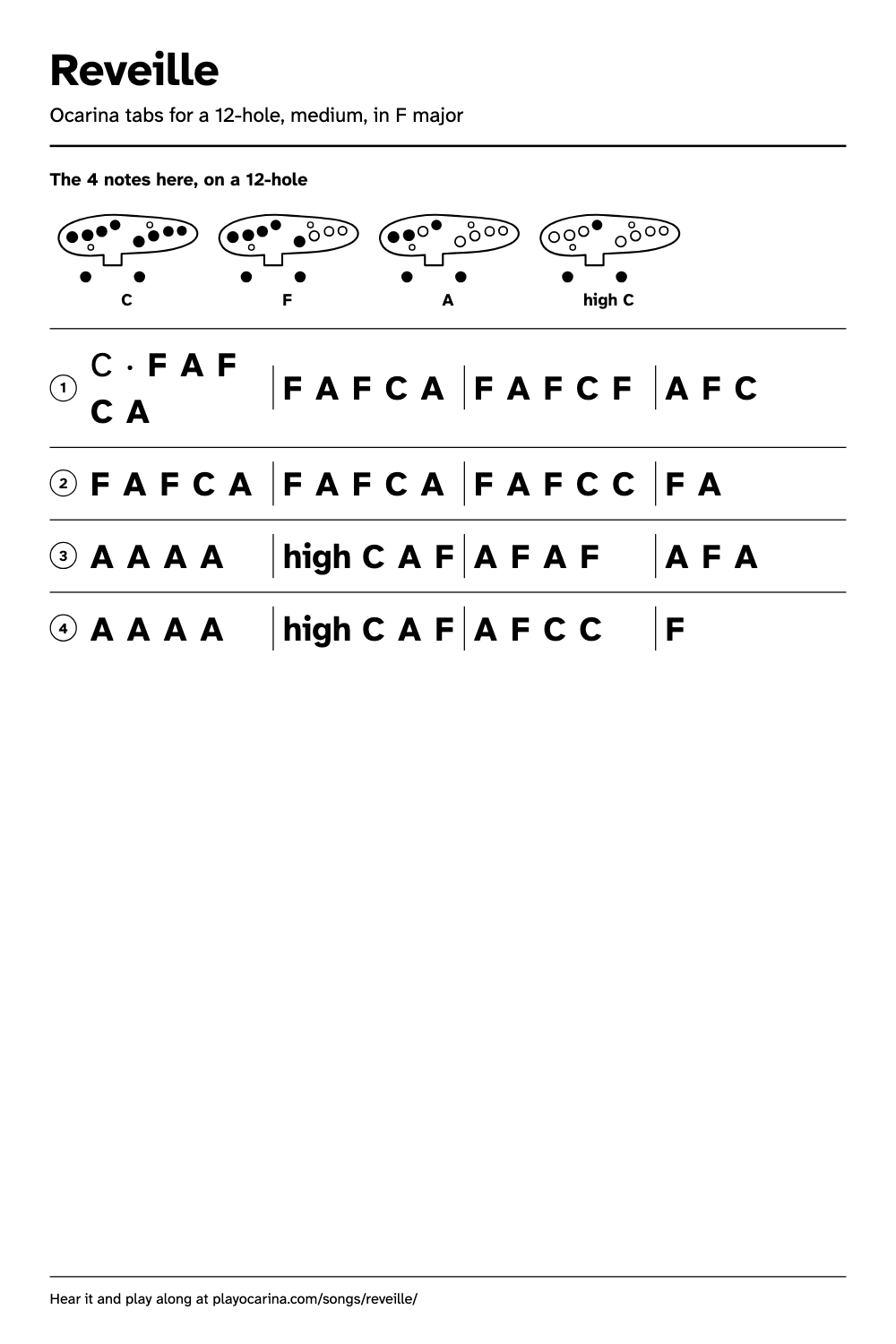
On a 12-hole it starts C, F, A, F. Medium, 62 notes, in F major.
Reveille
Bar 1 of 16
What are the notes for the U.S. Army Reveille?
On a 12-hole. Read left to right, a line at a time.
- Tricky spot:C FAFCAFAFCAFAFCFAFC
- FAFCAFAFCAFAFCCFA
- AAAAhigh CAFAFAFAFA
- AAAAhigh CAFAFCCF
Reveille is the U.S. Army's wake-up call, and like every bugle call it uses only a few notes: C, F, A and high C in this key, F major. It has two strains, 16 bars in all. The first is a quick, bouncing pattern that repeats; the second is a run of repeated A's that climbs to a high C and falls back.
What is the tricky spot in the U.S. Army Reveille?
The jump from the low C up to A, a sixth, in the last half beat of the quick bars of the first strain. On a 12-hole, the U.S. Army Reveille goes from C to A: you lift the left ring, right index, right middle, right ring and right pinky. On a 6-hole or 4-hole, you lift the left middle, right middle and right index.
That leap comes four times in the first strain, so it is worth drilling alone: low C, then A, slowly, until your fingers move together and the A speaks first time. The A, F just before it are two sixteenth notes squeezed into half a beat; practise it at half speed as an even trill and only then speed it up to the printed Quick. In the second strain the four repeated A's are tongued, not fingered: keep your fingers still and start each one with a soft "tu".
Where do you breathe in the U.S. Army Reveille?
The first strain runs eight bars, so take small breaths where the quick pattern lands on the held A in the fourth bar and on the long F at the end of the eighth. In the second strain there is no rest: steal a breath by cutting the high C that starts the tenth and fourteenth bars a hair short.
Which ocarina can play the U.S. Army Reveille?
Any 12-hole, 6-hole or 4-hole ocarina in C plays the U.S. Army Reveille in this key. On an ocarina in G or F, use the same fingerings: the tune sounds in a different key, which is fine when you play alone. Each linked chart has every fingering for its ocarina, and you can check your notes with a tuner such as our free ocarina tuner.
The 4 notes here, on a 12-holeHoles in words, with a picture
| Note | Holes to cover | Picture |
|---|---|---|
| C | Cover every main hole | |
| F | Cover every main hole but the right middle, right ring and right pinky | |
| A | Cover the left pinky, left middle, left index, left thumb and right thumb | |
| high C | Cover the left pinky, left thumb and right thumb |
Drawn as you see it while playing: mouthpiece towards you, left hand on the left.
| Note | Holes to cover | Picture |
|---|---|---|
| C | Cover every hole | |
| F | Cover every hole but the right middle and right index | |
| A | Cover the left index, left thumb and right thumb | |
| high C | Cover the left thumb and right thumb |
Drawn as you see it while playing: mouthpiece towards you, left hand on the left.
| Note | Holes to cover | Picture |
|---|---|---|
| C | Cover every hole | |
| F | Cover the left middle and left index | |
| A | Cover the left index | |
| high C | All holes open |
Drawn as you see it while playing: mouthpiece towards you, left hand on the left.
Which Reveille is this?
There are several: Wikipedia notes that the Commonwealth's calls are different tunes from the U.S. one. Our tabs are the U.S. trumpet call as the Army's Infantry Drill Regulations of 1891 print it as call 14, marked Quick; the same book, about 25 pages on, prints a separate drum-and-fife Reveille that is another tune. The 1904 revision prints the trumpet call again, as call 15, with the same notes. No composer is named in either. We moved it from C up a fourth to F major so it sits in the ocarina's middle range, and we play the two strains once each. Music: traditional U.S. Army trumpet call, composer unknown.