Taps on the ocarina
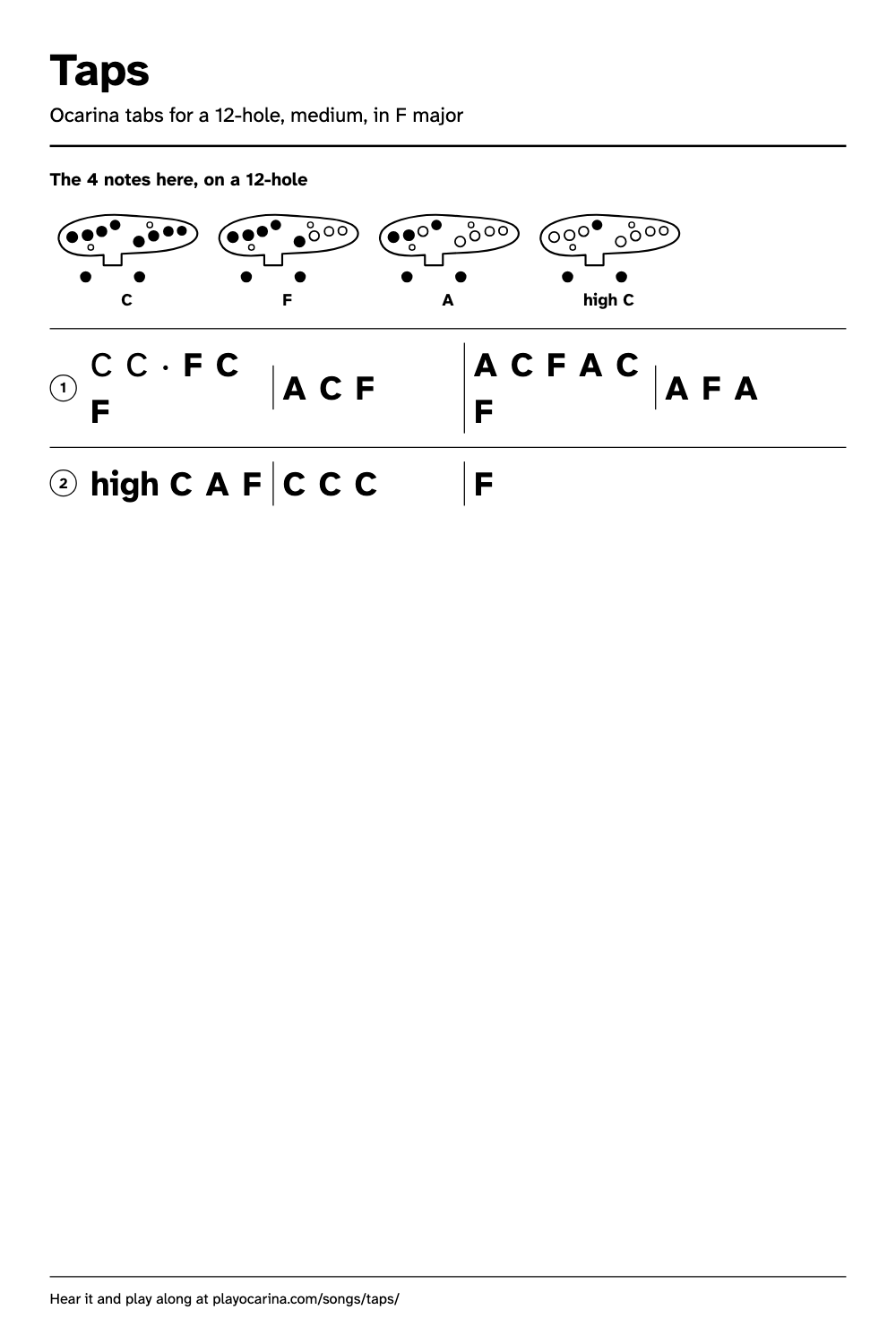
On a 12-hole it starts C, C, F, C. Medium, 24 notes, in F major.
Taps
Bar 1 of 7
What are the notes for Taps?
On a 12-hole. Read left to right, a line at a time.
- CC FCFACFACFACFTricky spot:AFA
- high CAFCCCF
Taps is built from just four notes: C, F, A and high C in this key, F major, with no sharps or flats. It is slow and solemn, with long held notes joined by short quick pairs, so it asks less of your fingers than of your breath. The printing marks it Slow and puts a pause on four of the long notes: hold them a little past their count.
What is the tricky spot in Taps?
The high C at the top of the call, reached from a quick A right after the held A, where the tune climbs a third and then falls back down through A and F. On a 12-hole, Taps goes from A to high C: you lift the left middle and left index. On a 6-hole or 4-hole, you lift the left index.
The A that leads into the high C is only a sixteenth, the short half of a quick pair that follows the three-beat A, so the high C comes almost straight off it. Give the long A its full count, place the quick F and A lightly, then lift for the high C with a little more air, not a push, which makes it shrill and sharp, and let the call fall back down on a gentler breath.
Where do you breathe in Taps?
Breathe after the held F, after each of the two held A's that carry a printed pause, and after the held high C. The quick pair that follows a held note is short enough to play on the same breath.
Which ocarina can play Taps?
Any 12-hole, 6-hole or 4-hole ocarina in C plays Taps in this key. On an ocarina in G or F, use the same fingerings: the tune sounds in a different key, which is fine when you play alone. Each linked chart has every fingering for its ocarina, and you can check your notes with a tuner such as our free ocarina tuner.
The 4 notes here, on a 12-holeHoles in words, with a picture
| Note | Holes to cover | Picture |
|---|---|---|
| C | Cover every main hole | |
| F | Cover every main hole but the right middle, right ring and right pinky | |
| A | Cover the left pinky, left middle, left index, left thumb and right thumb | |
| high C | Cover the left pinky, left thumb and right thumb |
Drawn as you see it while playing: mouthpiece towards you, left hand on the left.
| Note | Holes to cover | Picture |
|---|---|---|
| C | Cover every hole | |
| F | Cover every hole but the right middle and right index | |
| A | Cover the left index, left thumb and right thumb | |
| high C | Cover the left thumb and right thumb |
Drawn as you see it while playing: mouthpiece towards you, left hand on the left.
| Note | Holes to cover | Picture |
|---|---|---|
| C | Cover every hole | |
| F | Cover the left middle and left index | |
| A | Cover the left index | |
| high C | All holes open |
Drawn as you see it while playing: mouthpiece towards you, left hand on the left.
Where does Taps come from?
Wikipedia says Taps is a variation of an older bugle call, the Scott Tattoo, arranged in its present form by Daniel Butterfield at Harrison's Landing, Virginia, in July 1862. Butterfield died in 1901, and Wikipedia notes that some dispute whether he composed it or arranged an older call. The call carries no composer's name on the page our tabs follow, call 17 in the Army's Infantry Drill Regulations of 1891, marked Slow, among the numbered trumpet and bugle calls of the appendix. The book writes it in C; we moved it up a fourth to F major so that its four notes sit in the middle of the ocarina, from C to high C. We show the call only, with no words. Music: U.S. Army bugle call, credited to Daniel Butterfield (1831-1901), 1862.