The Stars and Stripes Forever on the ocarina
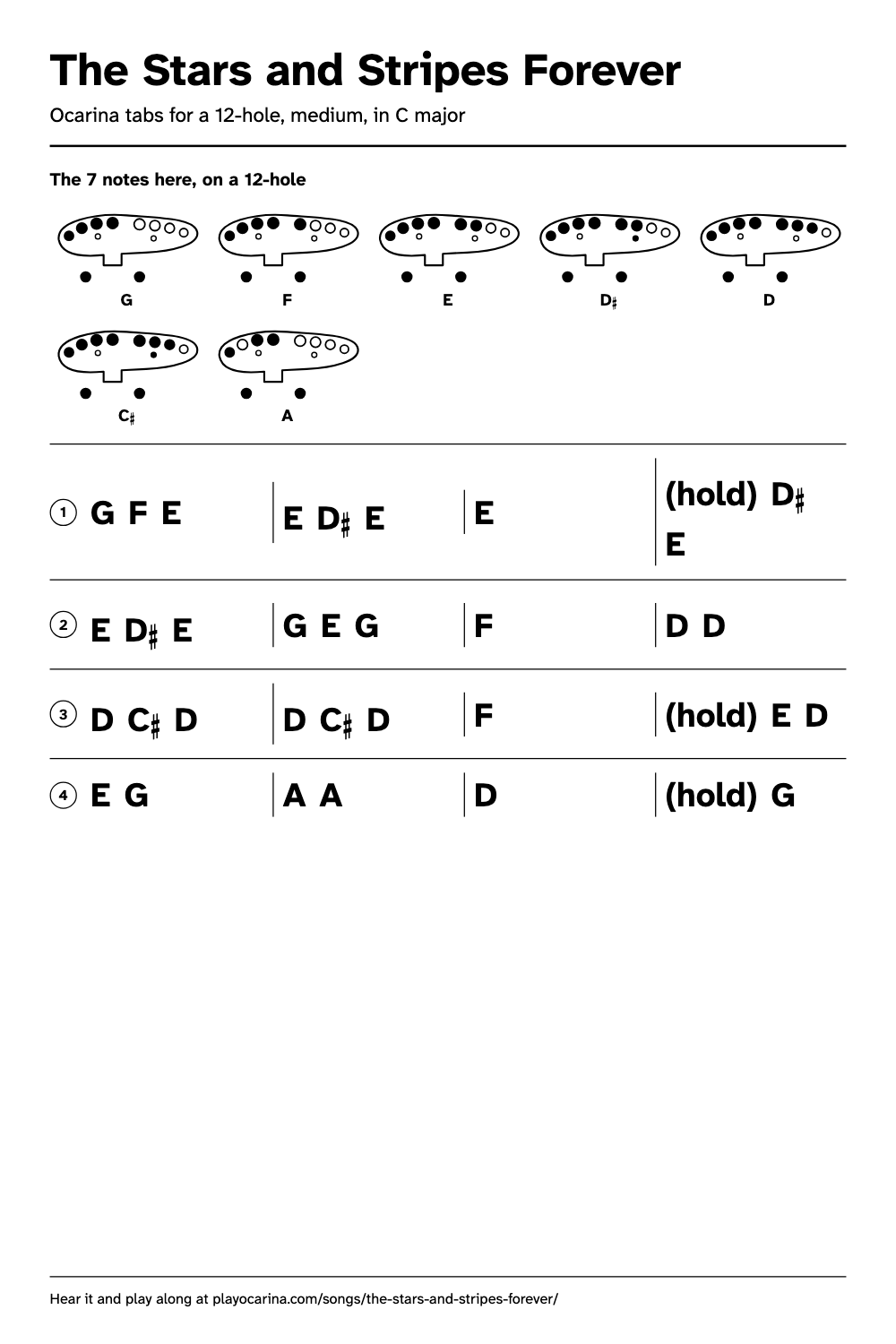
On a 12-hole it starts G, F, E, E. Medium, 33 notes, in C major.
The Stars and Stripes Forever
Bar 1 of 16
What are the notes for The Stars and Stripes Forever?
On a 12-hole. Read left to right, a line at a time.
- GFETricky spot:ED♯EE(hold)D♯E
- ED♯EGEGFDD
- DC♯DDC♯DF(hold)ED
- EGAAD(hold)G
The Stars and Stripes Forever is a long march, so this page teaches its main theme: the broad tune of the trio, the first 16 bars of it, in C major from C sharp up to high A. It starts on a high G, steps down to E and holds that E for a bar and a half. The page follows the right hand of the 1897 piano edition; the piccolo part people also remember is not on it.
What is the tricky spot in The Stars and Stripes Forever?
The little wobble E, D sharp, E that comes three times in the first half, a half step away from the held E. On a 12-hole, The Stars and Stripes Forever goes from D♯ to E: you lift the right sub-hole. On a 6-hole or 4-hole, you keep the same fingering.
D sharp is outside the plain C major scale, so the quick step back to E asks for tidy fingers: play the three notes slowly on their own and tongue each one lightly, as a band would. The longest note comes first, a tied E of six beats, so take a breath before the first note and another after it.
Where do you breathe in The Stars and Stripes Forever?
On the long notes of the whole-note bars, the third, seventh, eleventh and fifteenth. Each gives you a free beat or two before the tune goes on.
Which ocarina can play The Stars and Stripes Forever?
Any 12-hole, 6-hole or 4-hole ocarina in C plays The Stars and Stripes Forever in this key. On an ocarina in G or F, use the same fingerings: the tune sounds in a different key, which is fine when you play alone. Each linked chart has every fingering for its ocarina, and you can check your notes with a tuner such as our free ocarina tuner.
The 7 notes here, on a 12-holeHoles in words, with a picture
| Note | Holes to cover | Picture |
|---|---|---|
| G | Cover every main hole but the right index, right middle, right ring and right pinky | |
| F | Cover every main hole but the right middle, right ring and right pinky | |
| E | Cover every main hole but the right ring and right pinky | |
| D♯ | Cover every main hole but the right ring and right pinky, plus the right sub-hole | |
| D | Cover every main hole but the right pinky | |
| C♯ | Cover every main hole but the right pinky, plus the right sub-hole | |
| A | Cover the left pinky, left middle, left index, left thumb and right thumb |
Drawn as you see it while playing: mouthpiece towards you, left hand on the left.
| Note | Holes to cover | Picture |
|---|---|---|
| G | Cover every hole but the left middle and right middle | |
| F | Cover every hole but the right middle and right index | |
| E | Cover every hole but the right index | |
| D♯ | Cover the left middle, right middle, left index, left thumb and right thumb; half-cover the right index | |
| D | Cover every hole but the right middle | |
| C♯ | Cover the left middle, left index, right index, left thumb and right thumb; half-cover the right middle | |
| A | Cover the left index, left thumb and right thumb |
Drawn as you see it while playing: mouthpiece towards you, left hand on the left.
| Note | Holes to cover | Picture |
|---|---|---|
| G | Cover the left index and right index | |
| F | Cover the left middle and left index | |
| E | Cover every hole but the right index | |
| D♯ | Cover the left middle, right middle and left index; half-cover the right index | |
| D | Cover every hole but the right middle | |
| C♯ | Cover the left middle, left index and right index; half-cover the right middle | |
| A | Cover the left index |
Drawn as you see it while playing: mouthpiece towards you, left hand on the left.
How did Sousa write The Stars and Stripes Forever?
Sousa wrote the march on Christmas Day 1896 aboard a ship bound home from Europe, after hearing that the manager of his band had died, and it was first played in Philadelphia on 14 May 1897. He said the three tunes of the last section stand for three regions: the broad melody for the North, the piccolo for the South and the trombones for the West. Congress made it the national march of the United States in 1987. Our tabs follow the 1897 piano edition printed in Cincinnati. We show the melody only. Music: John Philip Sousa (1854-1932), the trio tune of his march, 1897.