Nutcracker March on the ocarina
On a 12-hole it starts C, C, C, C. Medium, 49 notes, in F major.
Nutcracker March
Bar 1 of 8
What are the notes for the Nutcracker March?
On a 12-hole. Read left to right, a line at a time.
- CrestCCCDrestDrestErestCrestDCrestCCCDrestDrestErestCrestD(hold)restD
- B♭resthigh CB♭restAGrestFErestCArestB♭ArestGFrestEDrestFTricky spot:ErestDC♯restGFrestEDrestAB♭restAGrestFCresthigh Crest
The Nutcracker March opens with a bright call: C, then three quick C's, D, D, then E, C and a long D. Then a quick answer runs down from B flat and ends with a leap from C to high C. Here are the march's first eight bars in F major, from C to high C, so a 4-hole, 6-hole or 12-hole ocarina in C plays them. This is the main theme, simplified to its top line.
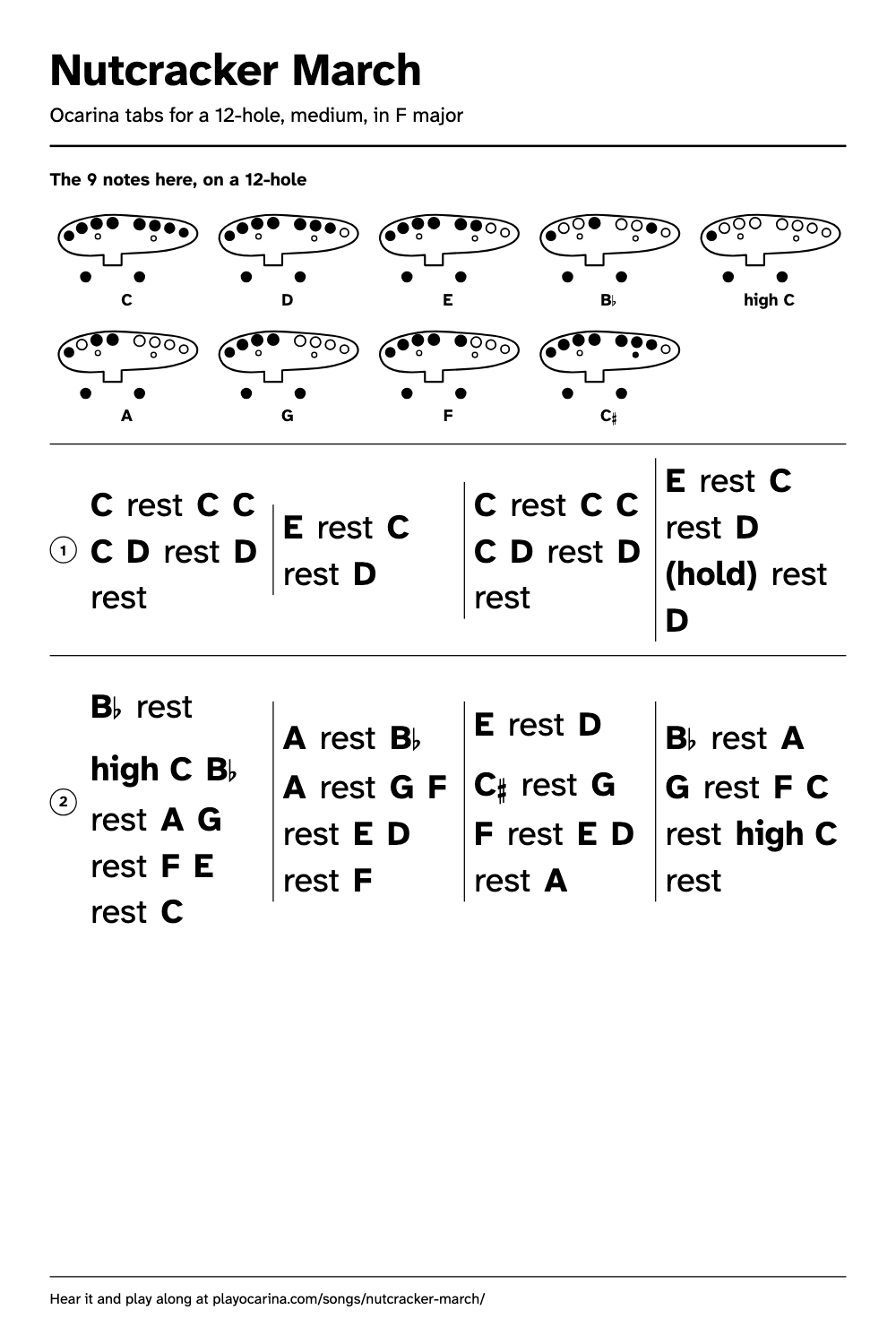
What is the tricky spot in the Nutcracker March?
The C sharp in the seventh bar: the quick answer slips down E, D, C sharp, a semitone below D, then jumps up to G. On a 12-hole, the Nutcracker March goes from D to C♯: you cover the right sub-hole. On a 6-hole or 4-hole, you keep the same fingering.
Learn the C sharp fingering on its own, then play E, D, C sharp, G slowly until each note speaks. Every beat of the answer is a longer note, a tiny gap, and a quick note that leads into the next beat, so think "ta, ti" and stop each long note short. The three quick C's in the first and third bars are a triplet: keep the fingers still and tongue them "tu tu tu" in the time of one beat.
Where do you breathe in the Nutcracker March?
Take a quick breath in any of the call's short rests, and a full one in the little gap at the end of the fourth bar: the answer runs four bars with only tiny gaps, and the last two rests are where to breathe again.
Which ocarina can play the Nutcracker March?
Any 12-hole, 6-hole or 4-hole ocarina in C plays the Nutcracker March in this key. On an ocarina in G or F, use the same fingerings: the tune sounds in a different key, which is fine when you play alone. Each linked chart has every fingering for its ocarina, and you can check your notes with a tuner such as our free ocarina tuner.
The 9 notes here, on a 12-holeHoles in words, with a picture
| Note | Holes to cover | Picture |
|---|---|---|
| C | Cover every main hole | |
| D | Cover every main hole but the right pinky | |
| E | Cover every main hole but the right ring and right pinky | |
| B♭ | Cover the left pinky, left index, right ring, left thumb and right thumb | |
| high C | Cover the left pinky, left thumb and right thumb | |
| A | Cover the left pinky, left middle, left index, left thumb and right thumb | |
| G | Cover every main hole but the right index, right middle, right ring and right pinky | |
| F | Cover every main hole but the right middle, right ring and right pinky | |
| C♯ | Cover every main hole but the right pinky, plus the right sub-hole |
Drawn as you see it while playing: mouthpiece towards you, left hand on the left.
| Note | Holes to cover | Picture |
|---|---|---|
| C | Cover every hole | |
| D | Cover every hole but the right middle | |
| E | Cover every hole but the right index | |
| B♭ | Cover the right index, left thumb and right thumb | |
| high C | Cover the left thumb and right thumb | |
| A | Cover the left index, left thumb and right thumb | |
| G | Cover every hole but the left middle and right middle | |
| F | Cover every hole but the right middle and right index | |
| C♯ | Cover the left middle, left index, right index, left thumb and right thumb; half-cover the right middle |
Drawn as you see it while playing: mouthpiece towards you, left hand on the left.
| Note | Holes to cover | Picture |
|---|---|---|
| C | Cover every hole | |
| D | Cover every hole but the right middle | |
| E | Cover every hole but the right index | |
| B♭ | Cover the right index | |
| high C | All holes open | |
| A | Cover the left index | |
| G | Cover the left index and right index | |
| F | Cover the left middle and left index | |
| C♯ | Cover the left middle, left index and right index; half-cover the right middle |
Drawn as you see it while playing: mouthpiece towards you, left hand on the left.
Why do our tabs play the quick answer higher than Tchaikovsky wrote it?
Because on paper these eight bars span two octaves, more than any ocarina has. The March opens the "Danses caractéristiques" in the Nutcracker Suite, Op. 71a, eight numbers Tchaikovsky took from the ballet and first conducted on 19 March 1892, nine months before the ballet's première. In his own piano arrangement of the suite, marked "Tempo di marcia viva", the right hand plays the call in chords, then the answer runs down in short notes to the D an octave below the call, and the phrase ends with a leap up to high D after a quick run of grace notes. Our tabs move that answer up an octave, keep the call and the last two notes where he wrote them, and move the whole tune down a step from G major to F major. We show the top line of the chords and leave out the grace notes. Music: Pyotr Ilyich Tchaikovsky (1840-1893), from his ballet The Nutcracker.